Games for Couples: Picks by Round Length and Setup
As an Amazon Associate, Rulenook earns from qualifying purchases.
Games for couples by round length, scorekeeping and setup: how many rounds fit in an evening, which games pause cleanly, and what you write down. Couples night runs on a clock. We sort 14 games by 3 numbers: the time on the box, the score you keep, and the private cards you write down. The two-players page sorts the same shelf for any 2 players. The card games for 2 players page compares the decks.
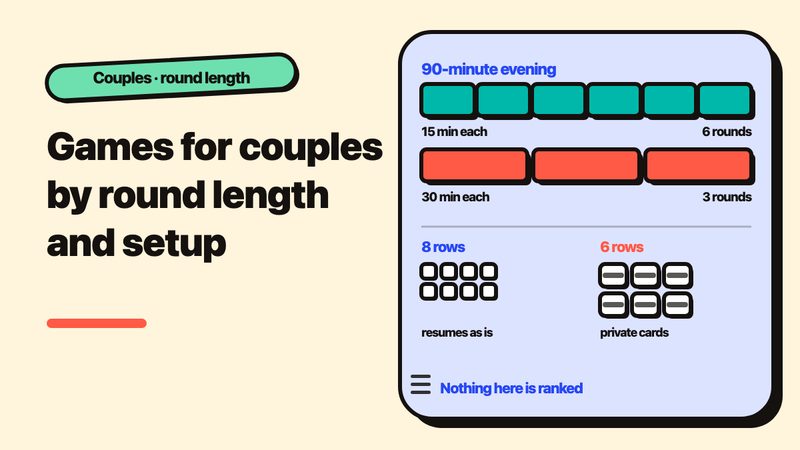
Games for couples by round length and setup
Table A is the evening audit for your table. It holds 14 rows: 13 board games that seat 2, plus the 2-player dominoes set.
Each row carries 6 cells besides the game name. Two come off the box: seats printed and minutes printed. One is ours, rounds in a 90-minute evening.
Three more come from the rule page: the score, the pause verdict and the ending.
Our assumptions, before the table.
- A row appears only for a printed seat range that includes 2. A printed maximum above 2 does not disqualify a game.
- Rounds in a 90-minute evening = floor(90 ÷ printed minutes). A printed range gives a range, and no printed length reads not printed.
- We do not estimate a length we cannot read. Rummikub prints 1 minute per turn, and a turn clock is not a game length.
- Score to write down follows the rule page: a pen, paper, a score track, a scoreboard, a doubling cube, or no tally.
- Pause asks 1 question: after the public state is written down, can the game continue as it stands?
- Private cards, tiles or dice change that answer. Winner follows the ending the rule page prints.
- Nothing here is ranked. The rows keep the shelf order of our two-players page.
Two boxes stay off this table. Codenames prints 4 to 8 or more, and its 2-player version is a separate box called Duet. Catan prints 3 to 4 players, and its rulebook holds no official 2-player mode.
| Game | Seats printed | Printed length | Rounds in a 90-minute evening | Score to write down | Pause | Winner |
|---|---|---|---|---|---|---|
| 7 Wonders Duel | 2 | 30 min | 3 | count the points on paper | resumes as is | one winner, a tie is possible |
| Backgammon | 2 | not printed | not printed | the doubling cube | note the dice | one winner |
| Mancala | 2 | not printed | not printed | no tally | resumes as is | one winner, a tie is possible |
| Checkers | 2 | not printed | not printed | no tally | resumes as is | one winner, a tie is possible |
| Ticket to Ride | 2–5 | 30–60 min | 1 to 3 | the score track | note the private cards | one winner, a tie is possible |
| Carcassonne | 2–5 | 30–45 min | 2 to 3 | the scoreboard | note the private tiles | one winner, a tie is possible |
| Azul | 2–4 | 30–45 min | 2 to 3 | the score track | note the private tiles | one winner, a tie is possible |
| Sushi Go | 2–5 | 15 min | 6 | a pen or the score track | resumes as is | one winner, a tie splits the points |
| Rummikub | 2–4 | not printed | not printed | a pen | note the private tiles | one winner |
| Pandemic | 2–4 | 45 min | 2 | no tally | resumes as is | shared goal |
| Wingspan | 1–5 | 40–70 min | 1 to 2 | count the points on paper | resumes as is | one winner, a tie is possible |
| Sorry! | 2–4 | not printed | not printed | no tally | resumes as is | one winner, pegs can be sent home |
| Trouble | 2–4 | not printed | not printed | no tally | resumes as is | one winner, pegs can be sent home |
| Dominoes for 2 | 2 | not printed | not printed | a pen for the pip total | note the private tiles | one winner |
The round column settles the first argument. Sushi Go prints 15 minutes. A 90-minute evening holds 6 rounds.
7 Wonders Duel prints 30, so it holds 3. Wingspan prints 40 to 70, so it holds 1 or 2.
A second Wingspan round needs a second evening, and 7 rows print no length.
The score column settles the second one. 5 rows ask for no tally: Mancala, Checkers, Pandemic, Sorry! and Trouble.
3 more track the score on the board: Ticket to Ride, Carcassonne and Azul. Sushi Go takes a pen or the score track, and Rummikub takes a pen.
7 Wonders Duel and Wingspan want the points counted on paper. Backgammon adds a doubling cube, and the dominoes need a pen for the pip total.
One-deck card games for two
The card branch answers a different question for you. When no box comes out, 1 deck of 52 cards still gives you a table.
Table B counts what each 2-player card game takes from that deck. It also names where the score lives.
Our assumptions, before the table.
- Cards in play counts what each player holds. It adds the cards that come up during the hand.
- Cards left in the 52-card box = 52 − cards in play. That subtraction is the whole column.
- Cribbage plays 13 cards: 12 dealt, 4 of them into the crib, plus the starter. The crib's 4 come out of the 12 dealt, so 39 go back in the box.
- Euchre plays from a 24-card pack. The 52-card column reads n/a, and all 24 cards are dealt.
- Where to keep score follows the rule page: a peg board, a pencil and a 2-column sheet, or a pen.
| Game | Pack you need | Cards each | Cards in play | Cards left in the 52-card box | Score to write down | Where to keep score |
|---|---|---|---|---|---|---|
| Cribbage | 1 standard 52-card deck, jokers removed | 6 | 13 (12 dealt + 1 starter) | 39 | peg to 121 | a 2-track board of 121 holes, or the printable score sheet |
| Gin rummy | 1 standard 52-card deck, no jokers | 10 | 21 (20 + 1 upcard) | 31 | a running total to 100 | a pen and a 2-column sheet |
| Basic rummy | 1 standard 52-card deck, no jokers | 10 | 21 (20 + 1 upcard) | 31 | a hand total, or a running total | a pen |
| 500 rummy | 52 cards + 2 jokers | 13 | 27 (26 + 1 upcard) | 25 | melded minus cards in hand, to 500 | a pen |
| Spades for 2 | 1 standard 52-card deck | 13, drawn from 26 seen | 26 | 26 | 10 per trick bid, +1 per overtrick | a pen and a bag count |
| Euchre for 2 | a 24-card pack, 9 through A | 12 (4 hand, 4 down, 4 up) | 24 | n/a | 1 for 7 tricks, up to 6 for 12 | a pen |
One 52-card deck covers 4 of these games: cribbage, gin rummy, basic rummy and spades for 2.
Euchre needs a separate 24-card pack. 500 rummy needs 2 jokers on top of the 52.
Deck sizes and finishes are on our playing cards page.
Cribbage deals 6 cards each and turns 1 over as the starter. 13 cards take part.
The game ends at 121 points. The board has 2 tracks of 121 holes. The dealer keeps the crib.
Gin rummy deals 10 cards each and turns 1 up. 21 cards are in play, and 31 stay in the stock.
It ends at 100 points. A knock on 10 or fewer cards ends a hand early.
Basic rummy deals the same 10 cards and the same upcard. Each hand settles on its own, unless you agree a target first.
Spades for 2 draws 26 cards and keeps 13. 26 cards are in play. 26 sit in the discard pile.
An average hand is worth about 55 points. 300 points takes roughly 6 hands.
500 rummy deals 13 cards each and needs 2 jokers. 27 cards are in play, and 25 stay behind.
It runs to 500 points.
Euchre for 2 has published versions. The bid version deals all 24 cards of a small pack.
Each player holds 12 cards. 4 are in hand, 4 face down and 4 face up.
It ends at 10 points. Our euchre page lines the 2-player versions side by side.
The card games for 2 players page compares 7 classics by deck. We keep the date-night angle: the length of a hand, and where your score lives.
Which games pause cleanly and which keep a private hand
The Pause column asks 1 question. If the public state is written down, can the game continue as it stands? 8 rows answer yes.
Those 8 rows are 7 Wonders Duel, Mancala, Checkers, Sushi Go, Pandemic, Wingspan, Sorry! and Trouble.
Everything on the table is face up, and a break for dinner costs you nothing.
The other 6 rows keep something face down. Backgammon needs the dice, and Azul and Carcassonne need their tile stacks.
Rummikub needs the tiles on your rack. Ticket to Ride needs the cards in your hand. The dominoes need their tiles.
Write 1 line before you leave the room, and the table picks up where it stopped.
Every card game on the table B list holds a private hand too: cribbage, gin rummy, basic rummy, 500 rummy, spades and euchre.
Note your hand down before the break. Keep the cribbage count on our printable score sheet.
Games you can win together
The Winner column splits the shelf 3 ways. 5 rows end with 1 winner and no tiebreak: Backgammon, Rummikub, Sorry!, Trouble and the dominoes.
Sorry! and Trouble add 1 twist: you can send an opponent's pawn back to the start. A lead can slip.
7 rows end with 1 winner and a possible tie: 7 Wonders Duel, Mancala, Checkers, Ticket to Ride, Carcassonne, Azul and Wingspan.
Sushi Go ends with 1 winner too, and a tie splits the points.
Each rule page prints its own tiebreak. 7 Wonders Duel ends with a shared win, and the points and the tiebreaks are even.
1 row ends with a shared goal: Pandemic. The table treats 4 diseases and races to discover all 4 cures.
The cooperative list holds the shared-goal formats we publish.
Winning together is not the same as playing alone. A shared goal still needs 2 people at your table.
The solo page covers the boxes that print a 1-player mode.
How to pick a game for two
Our assumptions, before the table. A row lands only on numbers table A and table B already carry. Nothing is weighted.
| If your evening looks like | Land on | The number that puts it there |
|---|---|---|
| It has to end inside 30 minutes | Sushi Go | 15 minutes printed, so 6 rounds fit 90 |
| You would rather not keep score | Pandemic or Sorry! | no tally on either, and Pandemic prints 45 min |
| Dinner interrupts the game | 7 Wonders Duel or Mancala | resumes as is |
| You want to win together | Pandemic | shared goal, 2 to 4 players |
| The cupboard holds 1 deck | Gin rummy | 21 of 52 cards in play |
| You are buying a gift | the 3 steps below | seats, minutes, and what you write on |
Read the box in 3 steps.
- Check the seat range on the front. You are hunting for a printed 2, or a range that includes 2.
- Check the printed minutes against the time you really have. A printed 15 gives 6 rounds in 90 minutes. A printed 45 gives 2.
- Count what the game asks you to write on. A peg board, a score sheet and a doubling cube change the packing. So do 2 jokers and a 24-card pack.
The 3 steps leave 7 rows, every game that prints a length. Only 1 of them prints exactly 2 seats.
That one is the 7 Wonders Duel base box: 2 players, a 30-minute playtime and ages 10 and up, and 1 pen and 1 sheet.
What are the best games for couples?
We publish no best list. The answer stays in the numbers above. Table A holds 14 rows, and 7 print a length.
Past that shelf, read the printed minutes first. The number of things you write down comes second.
Read next
- Find a game gathers every scene page in this cluster.
- The two-players page sorts the shelf by play time.
- The solo page covers the boxes that print a 1-player mode.
- The kids page sorts it by the age on the box.
- The family page takes it when adults sit with children.
- The party page covers the louder rooms.
- The groups page sorts the games for 5 or more.
- The Christmas page points at boxes for a December table.
- The board games hub lists every rule page.
- The card games hub does the same for card games.
- The card games for 2 players page compares 7 classics by deck, deal and target score, casino and crazy eights included.
- The types of rummy page sorts the rummy family.
- The cooperative list holds the shared-goal formats.
- The dominoes page starts the domino side.
- Domino set sizes counts what a set holds.
- The mahjong for 2 or 3 players page covers the tile branch.
Sources
- Board game rule pages, group 1, read 2026-11-19: 7 Wonders Duel (a shared win when the points tie), Ticket to Ride, Carcassonne (a tie is a shared victory) and Azul.
- Board game rule pages, group 2, read 2026-11-19: Wingspan, Pandemic (a shared goal), Sushi Go (ties split the points), Rummikub (1 minute per turn, mark the winner with the points), Sorry! and Trouble.
- Board game rule pages, group 3, read 2026-11-19: Backgammon (a doubling cube), Mancala (a draw is allowed), Checkers (a draw is possible) and the dominoes for 2 players page (7 tiles each).
- Card game rule pages, read 2026-11-19: how to play cribbage (6 cards each, 4 of them into the crib, 121 points), gin rummy rules (10 cards each, 1 upcard, 100 points), rummy rules (10 cards each) and 500 rummy rules (13 cards each).
- Same group and date: spades for 2 or 3 players (13 cards each, 300 or 500 points) and euchre for 2, 3, 5 or 6 players (a 24-card pack, 1 point for 7 tricks, up to 6 for 12).
- Seat, minute and age fields also read the per-game data files, whose check fields point back at the rule pages. Read 2026-11-19.
- Recomputed here: the 14 rows and 3 verdicts of table A, the round counts, and the 6 rows of table B.
- The deck arithmetic and the 6 bars of Fig. 01 come from the same data file, and a check script re-runs every number.
- The buy box reads the Amazon item return for ASIN B014DMSTXK: title and 4 feature bullets (2 players, about 30 minutes, ages 10 and up), and productInfo (1 item, 8 x 8 x 2 in, about 1.1 lb). Read 2026-11-19.
- How we handle sources and numbers: methodology.