How to Play Mahjong With 2 or 3 Players (American and Chinese Variants)
Mahjong is designed for 4 players, but you can play with 2 or 3. In American (NMJL) mahjong the official short-handed rule is simple: keep all 152 tiles, build all 4 walls, deal only to the people at the table, and skip the Charleston.
Chinese and Hong Kong mahjong have no governing body, so the 2- and 3-player versions are table conventions. The usual one for 3 players removes part of one suit. Pick your style first. They don't mix.
Which variant fits your table?
| Style and players | Tiles used | Walls built | Tiles in hand | Charleston | Status |
|---|---|---|---|---|---|
| American, 4 players | 152 | 4 | 13 (East 14) | Yes | Official |
| American, 3 players | 152 | 4 | 13 (East 14) | No | Official |
| American, 3 players with a "ghost" seat | 152 | 4 | 13 (East 14) | Yes, via the empty seat | House rule |
| American, 2 players | 152 | 4 | 13 (East 14) | No | Official |
| Siamese mahjong, 2 players | 152 | 4 | 27 in 2 racks (East draws a 28th) | No | Published variant |
| Hong Kong, 4 players | 144 | 4 | 13 (dealer 14) | None in this style | Standard |
| Hong Kong, 3 players | 116 (characters 2 to 8 removed) | 3 or 4 | 13 (dealer 14) | None | House rule |
| Hong Kong, 2 players | 144, or 116 as above | 2 or 4 | 13 (dealer 14) | None | House rule |
"Official" in this table means the rule is in the National Mah Jongg League's book, Mah Jongg Made Easy. "House rule" means common practice that you should agree on before the first deal. Full 4-player rules are on our American mahjong and Hong Kong mahjong pages.
How do you play American mahjong with 3 players?
- Build all 4 walls of 19 stacks, including the wall in front of the empty seat. That's still 152 tiles.
- East breaks the wall as usual. Players take 4 tiles at a time until each of the 3 holds 12; the empty seat gets nothing.
- Each player takes 1 more tile and East takes 1 extra. East holds 14, the other 2 hold 13.
- Skip the Charleston entirely, including the courtesy pass. East discards to start.
- Draw from the walls in the normal order. When play reaches the empty seat's wall, keep drawing from it.
Nothing else changes.
Official rule vs house rule. The League's rule is no Charleston with fewer than 4 players. Many groups miss the passing and add a ghost player (often nicknamed "Bob") who passes tiles taken from the empty seat's wall. That's a house rule, and it raises questions the book doesn't answer, such as what happens when a joker comes out of the ghost's stack. Settle every detail before you start.
How do you play American mahjong with 2 players?
Sit opposite each other, so that the 2 empty seats are on either side of you and the turn order stays easy to follow. Each player builds their own wall and the wall to their right, so all 4 walls go up and the set stays at 152 tiles. Deal only to the 2 players, skip the Charleston, and East discards first. Turns simply alternate, and East switches to the other player after every game.
You can still call. With only 1 opponent, though, every discard you can claim comes from the same player, so you get 1 claimable discard per round of turns instead of the 3 you would get at a full table.
A separate 2-player game, Siamese mahjong, was published in 2015 by Gladys Grad. Each player holds 27 tiles across 2 racks and must complete 2 card hands to win. It uses the same tiles and card but different rules, so treat it as its own game rather than a tweak to the official 2-player rule.
Does a short-handed game change the payments?
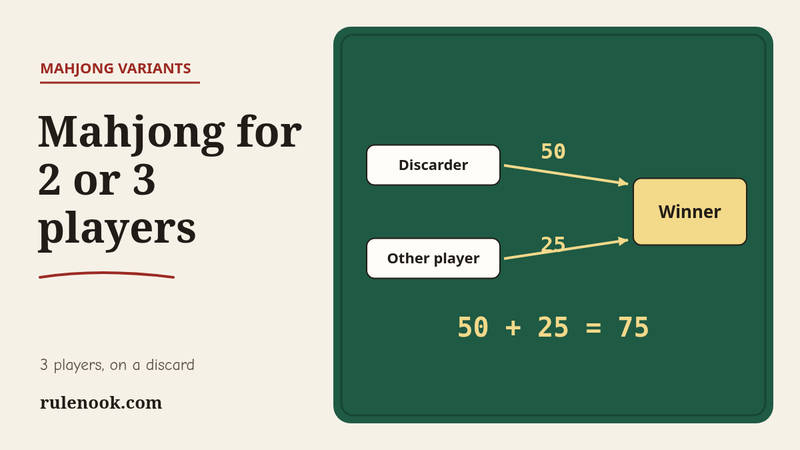
No. The payment rules stay exactly as they are at a full table, so the discarder of the winning tile pays double the hand's value and everyone else at the table pays single. On a self-drawn win, everyone pays double.
Worked example, 3 players. You win a 25-point hand on a discard. The discarder pays 50 and the third player pays 25, so you collect 75. The same hand at a full table would collect 100.
Worked example, 2 players. You win the same 25-point hand by drawing your own tile. Your only opponent pays double, so you collect 50.
How much longer is the wall with fewer players?
This is the biggest practical change. With fewer hands dealt, more tiles stay in the wall and each player gets more draws, which is the reason the League gives for dropping the Charleston in short-handed games.
| American game | Tiles dealt | Tiles left in the wall | Most draws per player (before any calls) |
|---|---|---|---|
| 4 players | 53 | 99 | 24.8 |
| 3 players | 40 | 112 | 37.3 |
| 2 players | 27 | 125 | 62.5 |
In a 3-player game you get roughly 50% more draws than at a full table. With 2 players, you get about 2.5 times as many. These are upper limits, since every call skips somebody's draw.
How do you play Chinese or Hong Kong mahjong with 3 players?
The most common convention, borrowed from Japanese 3-player riichi, removes the characters from 2 to 8. That takes out 7 ranks x 4 copies, or 28 tiles, which leaves 116 tiles from a 144-tile set or 108 from a 136-tile set. The 1 and 9 of characters stay in play.
Some tables instead remove one whole suit, which takes out 36 tiles. Others keep all 144 and simply skip the empty seat. Hands take longer that way.
Agree on two more points:
- Chows. Japanese 3-player riichi bans them. Hong Kong home tables are split. With characters 2 to 8 gone, a chow in characters is impossible anyway.
- Minimum score. With fewer tiles, big hands come together more often. Some groups raise the minimum faan by 1 or 2.
For 2 players in the Hong Kong style there's no standard at all. The usual approach copies the 3-player tile removal and lets the 2 players alternate as dealer.
Common Rules Questions
Can 5 people play American mahjong?
Yes, but only 4 play each game. The fifth player sits out and rotates in, so everyone sits out about one game in five. The player sitting out may not help anyone at the table. Some groups let the sitting-out player build the walls for the next game to keep the pace up, which is a convenience rather than a rule.
Is a 3-player game easier or harder than a 4-player game?
Easier, for most beginners. It also plays faster, because you get about 37 draws instead of 25 and face only 2 opponents' discards to watch. The card, jokers and calling rules don't change, so skills carry over directly. The trade-off is that you lose the Charleston, which is where many players learn which hands to aim for.
Should a beginner learn on a 2-player game?
It works as practice, not as a substitute. With 62 draws available, nearly any hand comes together, so 2-player games teach you to read the card and recognize joker swaps. They won't teach you defense, because there's only 1 discard stream to watch. Mix in 3- and 4-player games once the card feels familiar.
What to read next
- American mahjong rules
- How to play Hong Kong mahjong
- How many tiles are in a mahjong set
- How to choose a mahjong set
- All mahjong rules
Sources: National Mah Jongg League, Mah Jongg Made Easy: rules for 2 and 3 players (all 4 walls built, Charleston omitted). Siamese mahjong: published rules by its creator. Hong Kong 2- and 3-player conventions are house rules and labeled as such. Wall and draw counts are our arithmetic, see methodology. Last updated 2026-10-10.
Sources
- National Mah Jongg League, Mah Jongg Made Easy: short-handed play (2 and 3 players)
- Hong Kong and Japanese 3-player conventions as commonly published (house rules, labeled)