Trouble Board Game Rules: Pop-O-Matic Rolls, Bumping and the FINISH Line
As an Amazon Associate, Rulenook earns from qualifying purchases.

Trouble at a glance
- Players
- 2–4
- Age
- 5+
- Complexity
- Light
- Mode
- Competitive
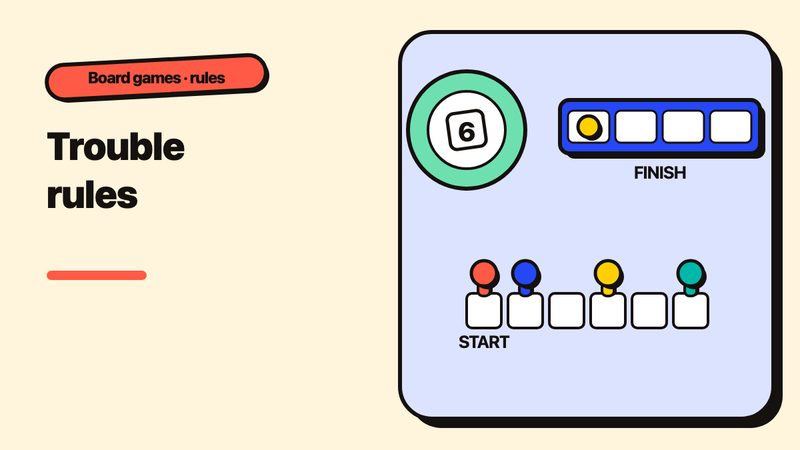
Trouble rules: 2 to 4 players, 4 pegs each, and the first player to move all 4 pegs around the board into the FINISH line wins the game. Pop once per turn. A popped 6 frees a peg from HOME and buys you one more pop. Land on an opponent and that peg goes back to HOME. FINISH takes an exact count.
Most disputes come down to 3 points. Can a 5 free a peg? Who gets bumped on START? What may a peg do inside FINISH? This page settles each one from the classic Hasbro instruction sheet. House rules and the Power Up option sit in a table near the end.
What's in the box
The classic set is one game unit, one gameboard and 16 pegs. Each count has a printed source.
| Part | Count | Source |
|---|---|---|
| Game unit with Pop-O-Matic die roller | 1 | Sheet, CONTENTS |
| Gameboard | 1 | Sheet, CONTENTS |
| Playing pegs | 16, 4 in each of 4 colors | Sheet, CONTENTS; 4 colors x 4 pegs = 16 |
| Rubber gameboard feet | 4 | Sheet, CONTENTS |
| Players | 2 to 4 | Sheet header; listing title |
| Age | 5 and up | Listing title; Hasbro instructions page |
The pegs come in 4 colors with 4 pegs per color. That is 4 x 4 = 16, and the sheet prints the same 16 count in its contents list.
The die sits inside the Pop-O-Matic bubble. It shows Arabic numerals 1 to 6, not pips, per Wikipedia. The sheet prints no playing time. It prints no track length either. This page says not printed rather than guessing.
How to set up Trouble
Setup takes 3 steps.
- Each player picks a color and puts all 4 pegs in the matching color HOME.
- Every player pops the die once. The highest number goes first. Play then moves to the left of the starter, which runs the turns clockwise around the table.
- In a 2-player game, each player may take a second set of pegs and play 8 pegs instead of 4. That option is printed on the sheet.
Ties for the highest pop have no printed tiebreak. Agree on a re-pop before the first turn.
The board has 5 kinds of spaces. The arguments live in the edges between them. This table lines them up.
| Zone | What it is | Who may stop there | Bumped back to HOME? | Source |
|---|---|---|---|---|
| HOME | 4 waiting holes in your color | Only your own 4 pegs | N/A; pegs start here, and a bumped peg returns here | Sheet, setup and step 5 |
| START | Your color's entry space on the track | Your peg after a popped 6; an opponent's peg can also sit here | Yes, in both cases | Sheet, steps 1 and 6 |
| Playing track | The open loop around the board | Any player's pegs | Yes, when an opponent lands on you | Sheet, steps 3 and 5 |
| Your FINISH line | 4 slots in your color off the track | Only your color | No; pegs there are safe | Sheet, step 7; Wikipedia counts 4 slots |
| Another player's FINISH line | Their 4 slots | Nobody but that color | Never reached | Sheet, step 7 |
How the Pop-O-Matic die works
The die lives in a sealed plastic bubble. Press the dome down. Let go. The die tumbles and settles on a number from 1 to 6.
A turn is one pop and one move, if a move exists. The sheet prints that as the frame for every turn. Nothing else happens on your turn. No second pop. No bonus move.
If the die does not settle flat, the sheet is silent. Wikipedia prints the fix tables use. Tap the bubble. Do not re-pop while the die hangs in limbo. We follow the printed source that exists, and we name it.
The two pop results do different jobs. One frees pegs. The other only moves them. This table splits them.
| Pop | Free a peg from HOME? | Move a track peg? | Extra pop? | Limits |
|---|---|---|---|---|
| 6 | Yes, into START | Yes, instead of freeing a peg | Yes, one more pop | Your own peg on START blocks the exit; on the first turn you pop only once |
| 1 to 5 | No | Yes, a peg already on the track | No | If no track peg can use the count, nothing moves |
When you pop a 6 you get an additional pop and move, in the sheet's own words. Wikipedia adds the detail tables fight over. The extra pop stands even when the 6 moved nothing. Every 6 buys exactly one extra pop. A 6 followed by another 6 chains one more pop. The sheet prints no cap on that chain. It prints no penalty for 6s in a row.
No bubble, no game. The die is not a loose cube. A damaged unit stops play. The classic Trouble box carries the Pop-O-Matic dice roller, the game board and all 16 pegs in one shell.
Getting a peg out of HOME
Only a popped 6 opens the START space. A 5 frees nothing. The table may want it to. The sheet does not.
The first turn is stricter. You pop only once. No 6, no move, and the turn passes.
The full sequence runs in 4 steps. Order matters.
- You pop a 6.
- One peg moves from HOME to START.
- The 6 buys one more pop. Pop again.
- The new count moves that peg out of START, clockwise, along the track.
Worked example: your first pop is a 6. The peg reaches START. Your extra pop is a 3. The peg advances 3 spaces from START. On your next turn a popped 6 has two uses. It frees another peg, or it moves a track peg. Either way you pop again.
START holds one more trap. If your own peg already sits on START, the exit is blocked. You must use the 6 on a peg that is already on the track. An opponent's peg on your START does the opposite. Pop a 6, bump that peg back to its HOME, and move yours in.
Moving pegs: bumps and blocked moves
Track pegs move clockwise only. Count each space, empty or full. Land on the space that matches the pop.
Landing on an opponent's peg bumps it. The sheet is blunt. That peg returns to its HOME and starts over. Your peg takes the space. There is no capture pile. The only penalty is the lost distance.
Landing on your own peg is not a move. You cannot land on your own pegs. If a count would end on one, that peg cannot take the pop. Pick another peg, or end the turn.
The rules print no wall. Wikipedia states the point directly. Counters cannot block an opponent's path. Passing an occupied space is normal. Occupied spaces still count as 1 space each.
The FINISH line and how you win
A peg travels one lap. After one full turn around the board, it enters its matching FINISH line. The sheet adds the limit people forget. A peg cannot go around a second time.
FINISH is exact count. The pop must equal the distance to a FINISH space. Overshooting is not an entry. Worked example: the first FINISH space sits 3 spaces ahead. Pop a 3 and the peg moves in. Pop a 5 and the count is not exact. That peg waits. Another peg takes the 5.
Once inside, pegs are safe. No player can move into another player's FINISH line. No bump reaches them. A peg inside can still advance. Only in arrow direction. Only by exact count. A pop of 1 moves it 1 slot deeper. Moving deeper frees the entry slot for your next peg.
The 4 slots fit the 4 pegs. Wikipedia counts the FINISH line at 4 slots. The sheet prints the count nowhere. The page carries the number with its source named.
The win is simple. Move all 4 pegs around the board and into FINISH first. The game is yours. The sheet asks players to continue for second and third place.
The rules print no score, no time limit and no draw. One lap, 4 pegs, exact counts.
Classic rules vs common house rules
House rules are not errors. Tables change them on purpose. Usually to shorten the game. Sometimes to soften a bump streak. Trouble happens when a player brings a house rule to a table that plays by the sheet.
Our assumptions: this page follows the classic Hasbro instruction sheet, read from the scan Hasbro hosts on 2026-11-01. UltraBoardGames carries a verbatim copy of the same rules, and Wikipedia fills the rows the sheet leaves open. The house column collects common table variations, not printed rules.
| Rule point | Classic printed rule | Common house rule | This page plays by |
|---|---|---|---|
| Number that frees a peg | 6 only (sheet, step 1) | Any number frees a peg | The sheet |
| Extra pop on a 6 | One extra pop and move (sheet, HOW TO PLAY) | Extra pop only if the 6 moved a peg | The sheet, plus Wikipedia's no-move case |
| Three 6s in a row | Not printed; no penalty exists on the sheet | The streak ends the turn, or the peg goes back | The sheet, by agreement before play |
| Landing on your own peg | Not allowed (sheet, step 6) | Stacking or jumping over your own pegs | The sheet |
| Opponent's peg on your START | Bump it to HOME and move in (sheet, step 6) | The exit stays blocked until it moves | The sheet |
| Count into FINISH | Exact number required (sheet, step 7) | Overshoot allowed, or a 6 always enters | The sheet |
| Pegs inside FINISH | Safe; advance by exact count, arrow direction (sheet, step 7) | Frozen once they enter | The sheet; older wordings differ |
| Two-player peg count | Each player may take 2 sets, 8 pegs (sheet, setup) | Standard 4 pegs each | The sheet's option, chosen out loud |
| Blocking the track | Sheet prints no wall rule | A line of pegs holds a gap shut | No walls, per Wikipedia |
Three house rules break more games than the rest. Freeing a peg on any number packs the track early. Cancelling the exact count lets pegs drift into FINISH by rounding. Freezing FINISH pegs jams the entry slot. A parked peg in slot 1 never clears the way.
Power Up Spaces: not printed for this box
The listing for the box we link prints no Power Up Spaces option, so that variant is not printed for this box. The classic sheet behind these rules prints one mode of play, and the rules above cover that mode. They match the sheet Hasbro hosts. We cross-checked every line against UltraBoardGames' copy.
Common mistakes
A 5 frees nothing. Only a 6 opens START. The sheet caps the first turn at one pop.
The extra pop after a 6 gets lost. Pop once more. Move on the new count. The reverse slip is taking two extra pops after one 6.
The blocked exit is quiet. Your own peg on START cancels the free. The 6 must move a track peg instead.
Counting skips occupied spaces. The sheet counts every space, empty or full. Your own pegs cannot be landed on.
FINISH takes rounding shortcuts. The count into FINISH is exact. A pop of 5 from 3 away is not a move.
A peg wall is not in the rules. Wikipedia prints the no-blocking point. Passing an occupied space is legal.
Common Rules Questions
Do you need a 6 to get out of HOME in Trouble?
Yes. The sheet's step 1 says a peg leaves HOME for START on a popped 6. On your first turn you pop only once. A 5 frees nothing. A 4 frees nothing. On later turns a 6 still frees a peg, or moves a track peg instead.
What happens when you pop a 6, do you go again?
Yes. A popped 6 buys one additional pop and move, in the sheet's words. Wikipedia adds the case tables argue about. The extra pop stands even if the 6 moved nothing. Another 6 on the extra pop buys one more. The sheet prints no cap. It prints no penalty.
Can you bump a peg sitting on its own START space?
Yes. Step 6 covers it. An opponent's peg on your START goes back to HOME when you pop a 6 and move in. The block works the other way for your own peg. It stops the free and forces the 6 onto a track peg.
Do you need an exact roll to enter FINISH?
Yes. Step 7 requires the exact number for a FINISH space. A peg 3 spaces out enters on a 3. It waits on a 5. The same exactness applies inside FINISH. Pegs advance by exact count, in arrow direction only.
Can pegs in FINISH move or be bumped?
They can move within the FINISH area. Exact count only. Arrow direction only. They cannot be bumped. No other player can move into your FINISH line. The sheet prints both halves. So the old claim that FINISH freezes pegs is a house rule on this page.
How does Trouble work with 2 players?
Two ways, both on the sheet. The standard game is 4 pegs each. The printed option lets each player take a second set and play 8 pegs. Pick one before the first pop. The 8-peg game runs longer.
If you like Trouble, try these
Sorry! · 2 to 4 players · Light
Same: a race with bumps and a safe home stretch. Different: Sorry! deals cards, while Trouble pops a die in a bubble.
Backgammon · 2 players · Light
Same: dice move your pieces toward an exact-count finish. Different: bear off removes pieces from the board entirely.
Checkers · 2 players · Light
Same: land on an opponent and it leaves the game. Different: there is no track and no luck, only jumps.
Mancala · 2 players · Light
Same: count-driven moves around a fixed loop. Different: you sow stones into stores, and no peg ever gets bumped.
More guides are in our board games section, or pick a table in games for.
Sources
- Hasbro / Milton Bradley, Trouble instruction sheet, part 4658, PDF scan hosted at hasbro.com, read 2026-11-01 (object, contents, setup, all 7 steps, winner). The scan has no text layer, so we read the rules off the rendered page and cross-checked every line against the verbatim copy below.
- UltraBoardGames, "How to play Trouble", read 2026-11-01 (verbatim rules copy used as the cross-check)
- Wikipedia, "Trouble (board game)", read 2026-11-01 (4 FINISH slots, no blocking, die not settling flat, Arabic numerals on the die)
- Hasbro instructions site, Trouble Game, SKU A5064, read 2026-11-01 (16 pegs, Pop-O-Matic die roller unit, ages 5 and up)
- Amazon listing B00EIJU40U, read 2026-11-25 (2 to 4 players, ages 5 and up, contents are a game board, a Pop-O-Matic dice roller, 16 pegs and instructions, box 10.5 x 12 x 1.75 in., 1.1 lb)
- Recomputed here: 4 colors x 4 pegs = 16 pegs, FINISH at 4 slots, and the 2 worked examples, all recomputed by Rulenook
Where the official rules live
Hasbro hosts the classic sheet as a one-page scan on its own site, and the instructions site lists the current edition under SKU A5064. The sheet stays on the publisher's site, because it is their text and still in copyright. Every rule above is stated only as far as a player needs, and the worked examples are calculated here.
How we check rules and build the intro card: our methodology.