Checkers Rules: Setup, Captures, Kings and How to Win
As an Amazon Associate, Rulenook earns from qualifying purchases.
Checkers rules turn on 2 questions. The first: must you take a jump when one is available? The second: how far can a king move? Settle those, and the rest is simple. The board is 8×8 squares. Each side has 12 pieces. That is 24 in the box. You move diagonally. You jump to capture. You crown on the far row. You win by taking every opponent piece.
Captures are compulsory. A jump is never optional. A man that reaches the far row turns into a king. The game ends when one side has no pieces left or no legal move.
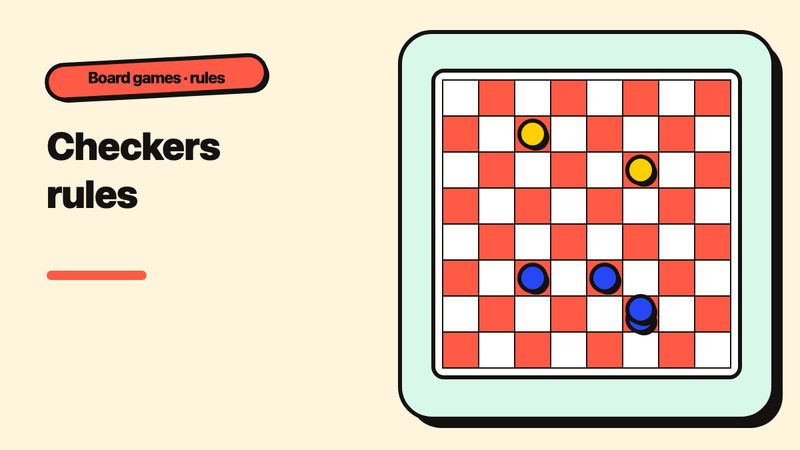
What you need to play
One board, 24 pieces, and a way to stack 2 pieces. That is the whole kit.
The board is 8×8, so 64 squares. Only the 32 dark squares are played on. A standard set holds 24 pieces. 12 are dark. 12 are light.
A king is not a separate piece. It is a man with a second man stacked on top. The colour is the same.
A folding board stores flat. The listing below names one.
This Pressman checkers set listing describes 64 squares on an 8x8 grid. It also lists a folding game board. The checkers interlock. It is for 2 players aged 6 and up.
The recorded size is 1 pack, 15.63 in × 8 in × 1.5 in, and 0.6 lb. The listing prints no material and no piece count. The 24 pieces above are the rule count. The box spec stays silent.
How to set up the board
Only the dark squares carry pieces. Each side fills the 3 rows nearest it, 4 pieces per row. The 2 middle rows stay empty.
| Item | Count | Note |
|---|---|---|
| Board | 8×8 = 64 squares | 32 dark squares are played on |
| Pieces per side | 12 | 3 rows × 4 pieces |
| Pieces in a full set | 24 | 12 dark + 12 light |
| Starting rows | 3 per side | The 2 middle rows stay empty |
| Kings row | 1 row per side | The row at your own back edge |
| First mover | The darker side | Then the turns alternate |
Table note: rule counts from Wikipedia, English draughts (read 2026-11-01). Every line is recomputed by Rulenook.
Your own back row is your kings row. The crownhead is the same row. A man is crowned when it reaches the opponent's kings row. Every piece crosses the whole board before it can crown.
The darker side moves first. After that, the turns alternate. If your box gives you a red set and a black set, the black set starts.
How to move a piece
A man moves 1 square diagonally forward, onto an empty dark square. A king moves 1 square diagonally in any of the 4 directions. It can step backward as well as forward.
Only diagonal steps count. There is no sideways move. There is no straight move. You cannot jump over your own piece. A piece cannot land on an occupied square.
A king in American checkers moves 1 square at a time. It never slides 2 or 3 squares in one move. It never jumps over a gap of empty squares.
The 7 legal opening moves
The opening is not a puzzle to solve. It is 7 legal moves. The rules do not rank them.
The 32 playable squares are numbered 1 to 32, with the darker side at the top. There are 4 squares per row.
The darker side's 12 pieces sit on squares 1 to 12. The lighter side's sit on 21 to 32. Only 4 pieces can move on the first turn: the ones on 9, 10, 11, and 12.
| Opening move | From | To | Captures the lighter side has | Legal replies for the lighter side |
|---|---|---|---|---|
| 9-13 | 9 | 13 | 0 | 7 |
| 9-14 | 9 | 14 | 0 | 7 |
| 10-14 | 10 | 14 | 0 | 7 |
| 10-15 | 10 | 15 | 0 | 7 |
| 11-15 | 11 | 15 | 0 | 7 |
| 11-16 | 11 | 16 | 0 | 7 |
| 12-16 | 12 | 16 | 0 | 7 |
Square 9 reaches 13 and 14. Square 10 reaches 14 and 15. Square 11 reaches 15 and 16. Square 12 reaches only 16. 2 + 2 + 2 + 1 = 7 legal opening moves.
After each of those 7 moves, the lighter side has 0 captures. It also has 7 legal replies. No piece has moved close enough to jump. The script behind this table counts both numbers again for every row.
Captures: jumps and chains
A jump is the only way to take a piece. Your piece steps diagonally over 1 adjacent enemy piece. It lands on the empty square immediately beyond. The jumped piece comes off the board.
If a jump is available, you must take it. That rule holds even when the jump hands your opponent a better position.
One jump can leave another. The same piece has to keep jumping. It jumps until no further jump is left. The chain can change direction at every step. The turn ends only when that piece is stuck.
Men capture forward only. Kings capture in all 4 directions. Any piece, man or king, can jump a king. A king is removed exactly like a man.
If 2 pieces can jump, you pick the piece and the chain. You need not take the longest chain. You do have to finish the chain you picked.
Worked example: a dark man on 14 jumps over 18. It lands on 23. From 23 the same man jumps the light man on 26. It lands on 30.
One piece, 2 captures, and the direction changes once. Wikipedia's notation joins the start and end squares. That turn reads 14x30.
Kings and crowning
Crowning is what the jumps are aiming at. A man that reaches the opponent's kings row is crowned on the spot. You show it by stacking a second man of the same colour on top.
The crowning move is finished when the man lands. If it jumps into the kings row, it is crowned. The turn ends there. It cannot jump again until your next turn.
After that, a king moves 1 square diagonally in any of the 4 directions. It captures backward as well as forward.
International draughts is a different game: a 10×10 board, 20 pieces a side, flying kings, and a rule that asks for the capture with the most pieces.
Winning, losing and draws
You win in 2 ways: take every opponent piece. Or leave the opponent without a legal move. A player with pieces left but no legal move has lost. The game is over.
A draw happens in 2 ways. Both sides can agree. Or neither side can force a win. The 8×8 game was weakly solved in 2007. Perfect play from the standard start ends in a draw.
A full board is not a draw by itself. The game ends when one side has no legal move. When neither side can move, nobody has won.
Official rules vs common house rules
The official column follows Wikipedia's English draughts article. Same for the Checkers article. Both read 2026-11-01. The house column names what tables at home often change. The type column says which side of the line each row sits on.
| Question | Official American rule | Common house rule | Type | Source |
|---|---|---|---|---|
| Must you take a jump when one is available? | Yes. Jumping is always mandatory, even when it costs you | Huffing, a variation that has fallen out of favor: the piece that could have jumped is removed | Official | English draughts |
| Can a man capture backward? | No. In American checkers men capture diagonally forward only | Backward capture is the international and Russian rule, not the American one | Official | Checkers |
| How far does a king move, and can it go backward? | 1 square diagonally in any of the 4 directions, and it captures backward. American checkers has no flying king | The king that slides any number of squares is the international game | Official | Checkers, English draughts |
| Does the crowning move end the turn? | Yes. A man that moves or jumps into the kings row is crowned, and the move terminates there | A listed variant that no association recognises: the man may keep jumping in the same turn | Official | English draughts |
| Opponent is blocked but still has pieces. Who wins? | The player who leaves the opponent with no legal move wins | A table that calls a blocked game a draw is changing the rule | Official | English draughts, Checkers |
| What happens if you do not capture? | Capturing is compulsory in most official rules, and the world federation rules drop the old huffing penalty | The muffin: the opponent may remove the piece that could have jumped | Mixed | Checkers, English draughts |
| How is a draw settled? | A draw if neither side can force a win, or by agreement. From the standard start, perfect play draws | A clock or a move limit would be a house addition | Official | English draughts, Checkers |
| What is the three-move restriction? | Tournament practice: the first 3 moves are drawn at random from accepted openings, and 2 games are played with each player at either side | Not a house rule. At home you start from the standard position | Official | English draughts |
Read 2 rows twice: the compulsory jump, and the king that moves 1 square. Both are settled in the rule text. Both are cheap to agree on before the first move.
Common mistakes
The most common error: 2 rows instead of 3. Each side fills the 3 rows nearest it, 4 pieces per row, so 12 a side and 24 in the box. 2 rows hold 8 a side. The game is wrong before it starts.
The next one is jumping onto an occupied square. The square immediately beyond the jumped piece has to be empty, or the jump is not legal.
After that, stopping after a single jump breaks the chain rule. The same piece keeps jumping until it has no further jump, even when the next jump runs in a different direction.
The same turn causes the next argument: crowning and jumping again. A man that lands in the kings row is crowned. The turn ends there.
A different mix-up treats a king as a sliding piece. In American checkers a king moves 1 square diagonally. It may step or jump backward.
Then there is the plain move while a jump is on the board. A jump is compulsory, so the plain move is illegal until the jump is gone.
The last one confuses the dark squares with the dark pieces. Only the 32 dark squares are played on, and your 12 pieces sit on the 12 dark squares of your own 3 rows.
Common Rules Questions
Must you take a jump when one is available?
Yes. Jumping is always mandatory, even when taking the jump leaves you worse off. Wikipedia's own example is a mandated single jump that sets up a multi-jump in reply.
You choose which piece jumps and which chain it follows. But you make the jump.
Can a king move backward?
Yes, 1 square diagonally backward. It can capture backward as well. A king moves 1 square diagonally in any of the 4 directions. That is the only extra power crowning gives it here. The king that slides any number of squares is the international draughts piece.
Can a man capture backward?
No. In American checkers a man captures diagonally forward only. A backward jump by a man is not legal.
Backward capture by men belongs to international draughts and Russian draughts. A king jumps in all 4 directions from the moment it is crowned.
If a man reaches the kings row by jumping, can it jump again?
No. The move ends there. A man that jumps into the kings row is crowned on the spot. It cannot jump back out as part of a multi-jump until the next turn.
Some tables allow the extra jump, and Wikipedia lists that as a variant no player association recognises.
How many pieces do you need for a set of checkers?
24: 12 dark and 12 light. Each side fills the 3 rows nearest it, 4 pieces per row. Only the 32 dark squares of the 8×8 board are used.
A king is made by stacking a second piece of the same colour, so a king still counts as 1 piece.
Can a checkers game end in a draw?
Yes. A game is drawn when neither side can force a win. Or when both sides agree.
From the standard starting position, perfect play ends in a draw: the 8×8 game was weakly solved in 2007. A full board is not a draw by itself. The game ends when one side has no legal move.
If you like checkers, try these
Backgammon · 2 players · Light
Same: 2 players, one board between you. Different: the dice decide where you move. Each side has 15 checkers.
Mancala · 2 players · Light
Same: 2 players, public domain rules, and no dice. Different: you sow 48 stones into 12 pockets and count them into 2 stores.
Cribbage · 2 players · Competitive
Same: 2 players, one small board, and a running score. Different: the score comes from cards on a cribbage board. The race ends at 121.
Catan · 3-4 players · Moderate
Same: a race for resources on a shared map. Different: 3 or 4 players build settlements and cities instead of moving 12 pieces.
More guides are in our board games section.
Sources
- Wikipedia, English draughts (read 2026-11-01): 8×8 board, 12 pieces a side, kings row, the darker side moves first, simple move and jump, mandatory jumping, multi-jump chains, crowning ends the move, end of game, the 2007 weak solution, huffing, three-move restriction, and the square numbering
- Wikipedia, Checkers (read 2026-11-01): only the dark squares are used, capturing is mandatory in most official rules, the muffin penalty, men capture forward only in American checkers, no flying king, and a player with no legal move loses
- Wikipedia, International draughts (read 2026-11-01): 10×10 board, 20 pieces a side, flying kings, backward capture, used only for the one line that separates it from this game
- Wikimedia Commons, Draughts Notation.svg (read 2026-11-01): the 1 to 32 square numbering, read off the diagram that Wikipedia's notation section links to
- Amazon listing B00GPK8ISK (read 2026-11-01): title, features and product facts for the folding board set
- Our own recomputation: setup counts, the 7 opening moves, the reply and capture counts, the jump chain, and the figure labels How we check rules and build the intro card: our methodology.