Solo Board Games by the Printed Player Count
As an Amazon Associate, Rulenook earns from qualifying purchases.
Solo board games by the printed player count: which boxes seat 1 player with an official solo mode, which setups are house rules, and which start at 2. The check is 1 number: the lowest seat count a box prints. We read it on our 15 rule pages. Exactly 1 box passes. A table for two is a different scene, and the two-players page sorts that shelf. Tile drills for one sit on the mahjong alone page.
Board games that seat 1 player, by the printed count
Table A audits the shelf. 15 games, 1 row each, and every cell traces back to the rule page we publish for that game. Rows keep the running order of the other scene pages, so the numbers line up across the cluster. You can pull any row and re-check it against its page.
Our assumptions, before the table. The verdict reads only what a page prints. We never lower a printed floor, and we never invent a variant to fill a gap.
Seats and play time come from the per-game data files the whole cluster uses. Each field carries a check that points back at its rule page. 6 pages print no whole-game length, so those cells read not printed. Rummikub's 1-minute turn clock is a turn limit, not a game length.
| Game | Seats printed | Play time printed | What the page prints about 1 player |
|---|---|---|---|
| Catan | 3–4 | 60–90 min | Prints a floor of 3. No official 2-player mode, so no 1-player seat. |
| Ticket to Ride | 2–5 | 30–60 min | Prints a floor of 2. No printed 1-player mode. |
| Carcassonne | 2–5 | 30–45 min | Prints a floor of 2. No printed 1-player mode. |
| Azul | 2–4 | 30–45 min | Prints a floor of 2. No printed 1-player mode. |
| Codenames | 4–8+ | 15 min | Prints a floor of 4. Two teams, 1 spymaster each; the Duet version still seats 2. |
| Wingspan | 1–5 | 40–70 min | Prints 1. The Automa deck is an official solo mode. |
| Pandemic | 2–4 | 45 min | Prints a floor of 2. The page names 1 player running 2 roles as a house rule. |
| 7 Wonders Duel | 2 | 30 min | Prints exactly 2. No solo mode and no team mode in the rulebook. |
| Sushi Go | 2–5 | 15 min | Prints a floor of 2. No printed 1-player mode. |
| Rummikub | 2–4 | not printed | Prints a floor of 2. No printed 1-player mode. |
| Sorry! | 2–4 | not printed | Prints a floor of 2. No printed 1-player mode. |
| Trouble | 2–4 | not printed | Prints a floor of 2. No printed 1-player mode. |
| Checkers | 2 | not printed | Prints exactly 2. No printed 1-player mode. |
| Backgammon | 2 | not printed | Prints exactly 2. No printed 1-player mode. |
| Mancala | 2 | not printed | Prints exactly 2. No printed 1-player mode. |
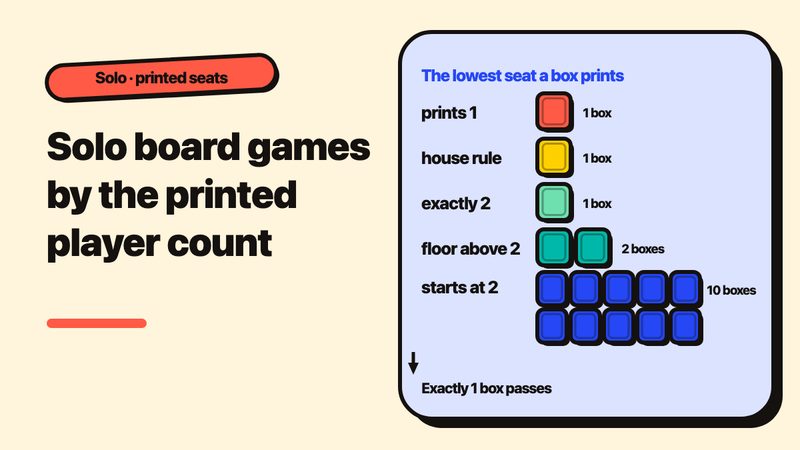
Read the last column down and the shelf lands in 5 verdicts. 1 box prints a 1 and names its solo mode. 1 page names a house rule. 1 rulebook prints exactly 2 with no mode at all. 2 boxes carry a floor above 2. The other 10 start at 2 and print nothing about 1 player.
That is the whole audit. The chart draws the same 15 rows sideways: each bar spans the printed seat range, and the dashed line marks 1 player. Only 1 bar reaches it. Games that seat exactly 2 draw as short marks.
The box that prints an official solo mode
Wingspan prints 1 to 5 players, 40 to 70 minutes, ages 10 and up, and a Medium tier. The base box ships an Automa deck. That deck is the official 1-player mode. You shuffle it in as a rival.
On its turn the Automa flips a card, and the card says what it does. It lays birds, gathers food, and contests the round goals.
Your own turns never change. You draw, play, and score by the printed rules, the same ones a 5-player sitting uses. The box adds a rival deck, and that is the entire difference. The Wingspan rule page walks the solo setup, turn by turn.
The retail box makes the same claim in print. The listing for the base Wingspan box reads 1 to 5 players and describes the Automa the same way: the rival acts, and your play stays untouched.
House-rule solo: what it is and what it is not
Three labels keep the shelf honest. An official solo mode is a box that prints 1 and names the setup. On this shelf that is Wingspan alone.
A house rule is a setup a page describes without the publisher printing it as a mode. Pandemic prints 2 to 4 players. Its rule page walks the 1-player workaround: one person runs 2 roles.
The page flags it as a house rule, not an official mode, and this audit carries the same flag. The third label is the one we refuse to write. A printed 2 is a printed 2. We will not lower a floor the publisher set, and we will not invent a 1-player variant for a box that prints none.
Mahjong practice runs under the same discipline. The mahjong alone page teaches drills for one seat, and it labels them house practice, not league rules. That page trains tile skills. This page picks boxes. The two jobs do not swap.
Boxes that start at 2 or more
Three boxes earn their own lines, because their pages print the reason in full.
7 Wonders Duel seats exactly 2. Its rulebook holds no solo mode and no team mode, so the rule page describes none. A game runs about 30 minutes, at ages 10 and up.
Codenames splits into 2 teams before it starts, and each team fields 1 spymaster. That puts the floor at 4. The publisher's answer for smaller tables is Codenames Duet. It seats 2, which is still not 1. The rule page keeps the team format clear.
Catan prints 3 to 4 players, and the 6th-edition rules carry no official 2-player mode. The rule page says so in its player-count section. When a floor sits above your head count, the box stays shut.
What can you do with these three? Hand each one a partner. The two-players page re-sorts the same shelf for 1-on-1 tables. If the goal is winning together rather than beating each other, the cooperative list collects shared-goal formats. Shared goals are still not a 1-player mode.
How to pick a solo board game
Our assumptions, before the table. Rows land only on numbers table A already carries, and nothing gets weighted. Solo picking runs no age axis of its own; the printed age floor does that job.
| At your table | Land on | Basis in the printed numbers |
|---|---|---|
| You want an official solo game in 40 to 70 minutes | Wingspan | The 1 box that prints 1, with the Automa deck |
| You want a cooperative game alone | Pandemic, run as a house rule | 1 player runs 2 roles; the page flags it, not the publisher |
| You want to drill mahjong by yourself | The mahjong alone page | Tile drills, not a box pick |
| Two chairs, 1 table | The two-players page | Boxes that seat 2, and what changes |
| A mixed table of adults and kids | The family page or the kids page | Sorted by players and minutes, or by the age on the box |
| You are buying a new box | The 3-step check below | Read the printed numbers before anything else |
The check runs 3 steps at the shelf.
- Read the seat range on the front. You are hunting for a printed 1.
- Look for a solo mode with a name on the box. An Automa deck is the pattern to match.
- Match the printed minutes and the age floor to your table, then read our rule page before you pay.
What is the best solo board game?
We do not rank boxes, so we do not publish a best. The nearest checkable answer sits in table A: only 1 of the 15 rule pages seats a solo player through an official mode. The short list builds itself. Past this shelf, read the printed player count first.
Read next
- Find a game for your table gathers every scene page in this cluster.
- The two-players page takes the 1-on-1 table next door.
- The kids page sorts the same shelf by the age printed on the box.
- The family page re-sorts it when adults take seats too.
- The party page covers bigger, louder rooms.
- The groups page sorts games for 5 or more.
- The Christmas page points at boxes built for your December table.
- The rules hub lists every rule page we publish.
- The cooperative list holds the shared-goal formats.
- The mahjong alone page teaches the tile drills this page stays out of.
Sources
- Seat, minute, age and tier fields read our 15 rule pages: Catan, Ticket to Ride, Carcassonne, Azul, Codenames, Wingspan, Pandemic, 7 Wonders Duel, Sushi Go, Rummikub, Sorry!, Trouble, Checkers, Backgammon and Mancala. Read 2026-11-16.
- The 1-player verdicts read 5 solo lines: Wingspan for the Automa deck, Pandemic for the 2-roles house rule, 7 Wonders Duel for no solo and no team mode, Codenames for the 2-team format and the Duet seating, and Catan for the missing official 2-player mode. Read 2026-11-16.
- Seat, minute, age and tier fields also read the per-game data files, whose check fields point back at the rule pages. Read 2026-11-16.
- The buy box reads the Amazon item return for ASIN B07YQ641NQ: its title and feature bullets give 1 to 5 players, the Automa for a 1-player game with your play unchanged, and the swift-start pack. Read 2026-11-16.
- Verdict buckets, decision rows, and the chart's 15 seat bars come from one data file, re-run through our check script.
- How we handle sources and numbers: methodology.