Gin Rummy Rules for Two Players: Knocking, Gin, Undercuts and Scoring
Gin rummy is a 2-player rummy game. Each player gets 10 cards and tries to arrange them into sets and runs. You can end a hand by knocking once your unmatched cards (deadwood) total 10 or less, or by going gin with no deadwood at all. Points carry over hands until someone reaches 100.
The rules below follow Bicycle and Pagat. Same numbers. Where many tables play differently, the difference is labeled.
What do you need, and how do you deal?
| Item | Rule |
|---|---|
| Players | 2 |
| Deck | 1 standard 52-card deck, no jokers |
| Cards each | 10 |
| Card values | Ace 1; 2 to 10 face value; J, Q, K 10 each |
| Ace | Low only: A-2-3 is a run, Q-K-A isn't |
| Game | First to 100 points |
Cut for the first deal, and under Bicycle's rules the player who draws the higher card picks a seat and deals the first hand. Deal 10 cards each, one at a time. Turn the 21st card face up to start the discard pile and set the rest face down beside it as the stock. After the first hand, the winner of each hand deals the next.
How does the first turn work?
The first turn has a special step, and it's the part of the game where most new players go wrong, so it's worth reading twice.
- The non-dealer may take the face-up card. If they do, they discard a different card and play is under way.
- If the non-dealer refuses it, the dealer may take it and discard.
- If both refuse, the non-dealer draws the top card of the stock and discards. Normal turns follow.
From then on, each turn is simple: draw 1 card from the stock or the top of the discard pile, then discard 1. You can't throw back the card you just took from the discard pile on the same turn.
What are melds and deadwood?
A set is 3 or 4 cards of the same rank: 8♠ 8♥ 8♦. A run is 3 or more cards in sequence in one suit: 4♥ 5♥ 6♥ 7♥. Each card can belong to only 1 meld at a time, even if it would fit 2.
Deadwood is every card that isn't part of a meld. Its total is your count.
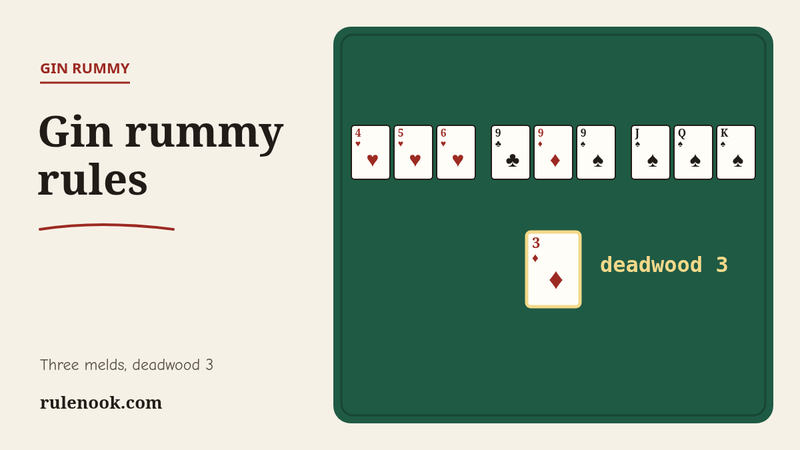
Example: you hold 4♥ 5♥ 6♥, 9♣ 9♦ 9♠, J♠ Q♠ K♠, and 3♦. The 3♦ is your only deadwood, so your count is 3.
When can you knock?
Once your deadwood totals 10 or less, after drawing, you may knock. Discard 1 card face down, then lay out your hand in melds with your deadwood set apart so your opponent can check the count.
You don't have to knock. Many players hold on for a few more turns, hoping for gin or a lower count that is harder to undercut.
Gin is a hand with no deadwood at all: all 10 cards in melds after your discard. Gin can't be undercut. Ever.
What happens after a knock?
Your opponent lays out their own melds. Then, unless you went gin, they may lay off deadwood onto your melds: a fourth 9 on your three 9s, or a 7♥ on your 4♥ 5♥ 6♥. Whatever is left is their count.
Official rule: the knocker never lays off on the opponent's melds, and no one can lay off on deadwood.
If the stock is down to 2 cards and the player who drew the third-to-last card discards without knocking, the hand is a draw. Nobody scores. Same dealer again.
How do you score gin rummy?
| Result | Who scores | Points |
|---|---|---|
| Knock, knocker lower | Knocker | Difference between the 2 counts |
| Undercut: opponent equal or lower | Opponent | Difference + 10 bonus |
| Gin | Player going gin | Opponent's count + 20 bonus |
Worked example 1: a knock: You knock with 4♣ 3♦ as deadwood, a count of 7. Your opponent lays off what they can and is left with K♠ 9♥ 5♣, a count of 24. You score 24 − 7 = 17.
Worked example 2: an undercut: You knock with a lone 9♠, a count of 9. Your opponent lays off and keeps only 4♦ 2♣, a count of 6. They score (9 − 6) + 10 = 13, and you score nothing.
Worked example 3: gin: You go gin. Your opponent can't lay off and holds Q♦ J♣ 8♥ 3♠, a count of 31. You score 31 + 20 = 51.
What bonuses come at the end of the game?
The game ends when a player reaches 100 or more. Then add the bonuses below to each player's running total.
| Bonus | Points |
|---|---|
| Winning the game | 100 |
| Winning when the opponent scored 0 all game | 200 instead of 100 |
| Each hand won, both players (box or line bonus) | 20 per hand |
Worked example 4: Player A reaches 104 and won 4 hands. Player B has 61 and won 2. A's total: 104 + 100 + 4 x 20 = 284. B's total: 61 + 2 x 20 = 101. A wins by 183.
House rule: many tables use 25 for gin, 25 for an undercut and 25 per box instead of 20, 10 and 20. Pick one set of numbers before you deal and write it on the score sheet.
Common Rules Questions
Can you knock with exactly 10 points of deadwood?
Yes. The rule is 10 or less, so a count of exactly 10 is a legal knock. Count after you've drawn and before you discard face down, because the discard leaves your hand. A single king, queen, jack or 10 in deadwood is fine. In Oklahoma gin, a popular variation, the first upcard can lower that limit, but that isn't the standard game.
Can you lay off cards when your opponent goes gin?
No. When a player goes gin, the opponent spreads their hand and counts all their deadwood, with no laying off at all. That's part of what makes gin worth more than a knock: the 20-point bonus plus a full count. Laying off is only allowed when the knocker has deadwood, and even then only the knocker's opponent may do it.
Can gin rummy be played with 3 or 4 players?
Gin is built for 2. A common workaround with 3 is for one player, usually the dealer, to sit out each hand and keep score. With 4, split into 2 partnerships, play 2 separate 2-player games at once, and add each partnership's results together after every hand. Neither is the standard game, so settle the details first.
What to read next
Sources: Bicycle, Gin Rummy (deal, first-turn upcard, knocking, gin and undercut values, game and line bonuses), and John McLeod's Pagat page on Gin Rummy (draw when 2 stock cards remain, no laying off against gin, 200-point shutout bonus, 25-point variations), both read 2026-10-10. Worked examples are our arithmetic, rechecked by script. Last updated 2026-10-10.
Sources
- Bicycle, Gin Rummy rules, bicyclecards.com (read 2026-10-10; snapshot verify/sources/bicycle_gin-rummy.html)
- John McLeod, Gin Rummy, pagat.com (read 2026-10-10; snapshot verify/sources/pagat_ginrummy.html)