How to Play Cribbage: The Deal, the Crib, Pegging and the Show
Cribbage is a 2-player card game where the first player to peg 121 points wins. Each deal has three scoring stages: the cut, the play (called pegging), where you score as cards hit the table, and the show, where you count your hand and the dealer also counts the crib.
The rules below are the 2-player game as written by the American Cribbage Congress (ACC), which publishes the rule book used at sanctioned tournaments. Three- and four-player games use the same scoring with a different deal; see 3- and 4-player cribbage.
What do you need to play?
| Item | For 2 players | Why |
|---|---|---|
| Deck | 1 standard 52-card deck, jokers removed | Kings count 10, aces count 1 |
| Board | 1 board with 2 tracks of 121 holes | You score so often that paper is slow |
| Pegs | 2 per player | You leapfrog the back peg over the front one, so the gap shows your last score |
One deal at a glance
| Step | What happens | Who scores |
|---|---|---|
| 1. Deal | 6 cards each, one at a time, non-dealer first | Nobody |
| 2. Discard | Each player puts 2 cards face down in the crib | Nobody yet |
| 3. Cut | Non-dealer cuts; dealer turns the top card as the starter | Dealer pegs 2 if it's a jack |
| 4. Play | Alternate cards, counting up to 31 | Either player, as cards are played |
| 5. Show | Non-dealer counts hand, then dealer counts hand, then crib | Each player, in that order |
The non-dealer is called the pone. The crib always belongs to the dealer, which is why you throw your worst cards there when your opponent deals. The deal alternates every hand.
How do you deal and fill the crib?
Cut the deck to decide who deals first; under ACC rules the player who cuts the lower card deals. The dealer shuffles, the pone cuts, and the dealer gives 6 cards to each player, one at a time, starting with the pone.
Each player keeps 4 cards and puts 2 face down in the crib, which makes 4 crib cards in a 2-player game. Nobody looks at the crib until the show.
What is the starter card?
After both discards, the pone cuts the rest of the deck and the dealer turns over the top card of the bottom half. This starter counts as a fifth card for both hands and for the crib.
If the starter is a jack, the dealer pegs 2 at once. That's called his heels.
How does pegging work?
The pone plays first. Players alternate, each laying one card face up in front of themselves and saying the running total out loud, and the total can never go past 31.
| During play | Points |
|---|---|
| Count reaches exactly 15 | 2 |
| Count reaches exactly 31 | 2 |
| Last card when the count stops below 31 (a "go") | 1 |
| Pair with the card just played | 2 |
| Three of a kind in a row | 6 |
| Four of a kind in a row | 12 |
| Run of 3 or more among the last cards played | 1 per card |
When you can't play without going over 31, say "go." Your opponent plays every card they can, scoring as usual, then pegs 1 for the last card (or 2 at exactly 31). The count resets to 0 and the player who said go leads the next series. After an exact 31, the other player leads.
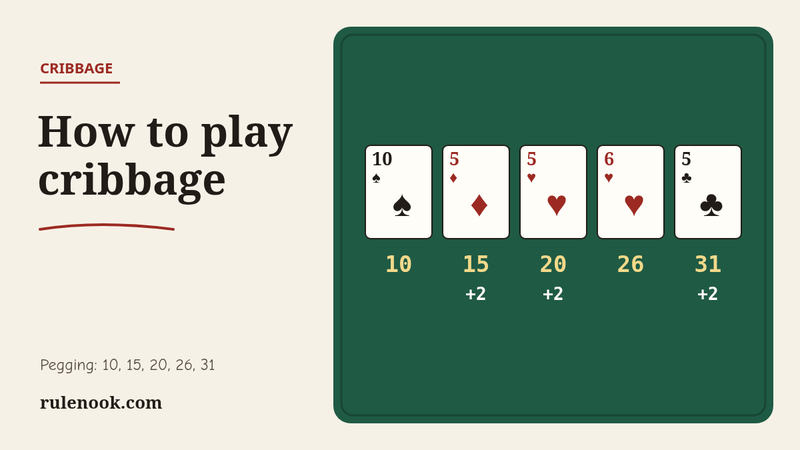
Worked example: pegging. The pone holds 5♥ 5♣ 10♠ J♦. The dealer holds 3♣ 4♣ 5♦ 6♥.
- Pone plays 10♠: "10."
- Dealer plays 5♦: "15 for 2." Dealer pegs 2.
- Pone plays 5♥: "20 and a pair." Pone pegs 2.
- Dealer plays 6♥: "26." No score; 5-5-6 isn't a run.
- Pone plays 5♣: "31 for 2." Pone pegs 2. The count resets.
- Dealer leads 3♣, pone plays J♦ for 13, dealer plays 4♣ for 17. That's the last card, so the dealer pegs 1.
Pegging totals: pone 4, dealer 3.
How do you count your hand in the show?
After the play, pick your 4 cards back up. Count them with the starter in this order: fifteens, pairs, runs, flush, nobs. The pone counts first, then the dealer counts their hand, then the crib. Full point values and the odds of every score are on our cribbage scoring chart.
Worked example: the show. The starter is 6♠.
- Pone: 5♥ 5♣ 10♠ J♦. Fifteens: each 5 with the 10 and each 5 with the jack, so 4 fifteens for 8. Pair of 5s: 2. The jack isn't a spade, so no nobs. Total 10.
- Dealer: 3♣ 4♣ 5♦ 6♥. Fifteens: 3+6+6, plus 4+5+6 twice (once with each 6), for 6. Pair of 6s: 2. Runs: 3-4-5-6 twice, for 8. Total 16.
- Crib: 8♠ A♥ 7♦ 2♣. Fifteens: 8+7, 8+6+A and 7+6+2, for 6. Run: 6-7-8 for 3. Total 9, scored by the dealer.
Over the whole deal, the pone scores 4 + 10 = 14 and the dealer scores 3 + 16 + 9 = 28. To check a hand quickly, use our cribbage hand calculator.
How does a game end?
The game ends the moment someone pegs the 121st hole, even in the middle of pegging or halfway through the show, and nobody finishes counting after that.
Counting order matters near the end. Because the pone counts first, the pone can win with a hand that the dealer's larger hand and crib would have beaten.
A skunk is a win by 31 or more points, which means the loser finished on hole 90 or lower. On ACC tournament scorecards a normal win is worth 2 game points and a skunk is worth 3; at home, most players just note it and some count it as two wins.
Common Rules Questions
Do pegging runs have to be played in order?
No. The cards just need to form a run among the last cards played, with nothing breaking them up. If the cards go 3, 5, 6, 7, 4, the 7 scores a run of 3 (5-6-7) and the 4 scores a run of 5. A pair in the middle breaks the run. In 4, 5, 5, 6, the 6 scores no run, because the last 3 cards are 5, 5, 6.
Can the pone win before the dealer counts?
Yes. The show is counted in a fixed order: pone's hand, dealer's hand, then the crib. If the pone's hand carries them to 121, the game ends there. The dealer doesn't get to count first, even holding a bigger hand. This is the official ACC order, and it's the main reason players near 121 care about who deals next.
Is muggins an official rule?
It's optional. Muggins lets you claim points your opponent missed in their count. Official rule: the ACC allows muggins only when the tournament announces it in advance. Common house rule: many kitchen-table games use it to keep counts honest, while others turn it off for new players. Decide before the first deal, since it can swing a close game.
How hard is cribbage to learn?
The rules fit on one page, but counting takes practice. Most new players can play a full game the first time with the scoring chart open. Fast, accurate counting of fifteens and double runs comes after a few dozen hands. Counting out loud in the fixed order (fifteens, pairs, runs, flush, nobs) is the quickest way to stop missing points.
What to read next
- Cribbage scoring chart and odds
- Cribbage hand calculator
- 3- and 4-player cribbage
- How to choose a cribbage board
- All card game rules
Sources: American Cribbage Congress, Rules of Cribbage (2025): Rule 1.5 playing sequence, Rule 1.7 scoring chart, Rule 7.2 scoring during play, Rule 9.2 order of counting, glossary entries for skunk and muggins. Worked examples rechecked by our scoring script. Last updated 2026-10-10.
Sources
- American Cribbage Congress, Rules of Cribbage (2025): Rules 1.1-1.7, 7.1-7.2, 9.2, glossary (evidence/acc_rulebook_2025.pdf)
- Example deal rechecked with cribbage_calc.py and content/verify/g22_check.py