Rummy Rules: How to Play Basic Rummy, Melds, Layoffs and Scoring
In basic rummy you race to empty your hand, laying cards down in sets (3 or 4 of a kind) and runs (3 or more in a row, same suit). Two players get 10 cards each; 3 or 4 players get 7. The player who goes out scores the value of every card left in the other hands.
This is the plain draw-and-discard game, sometimes called Rum or straight rummy. Gin, 500 Rum, Liverpool and the rest change the deal, the melds or the scoring; our types of rummy page compares 14 of them side by side. The rules below follow the version Bicycle publishes, with common house rules labeled.
How many cards do you deal?
| Players | Cards each | Deck |
|---|---|---|
| 2 | 10 | 1 standard deck, no jokers |
| 3 or 4 | 7 | 1 deck |
| 5 or 6 | 6 | 1 deck |
| 7 or more | 6 or 7 | 2 decks shuffled together (house practice; the published rules stop at 6) |
Deal one card at a time, face down, starting on the dealer's left. Put the rest face down as the stock and turn the top card face up beside it to start the discard pile. In a 2-player game the winner of each hand deals the next one; with more players the deal passes to the left.
What counts as a meld?
A meld is a group you lay face up on the table. There are only two kinds.
| Meld | Rule | Legal | Not legal |
|---|---|---|---|
| Set | 3 or 4 cards of the same rank | 8♠ 8♥ 8♦ | 8♠ 8♥ |
| Run | 3 or more cards in sequence, same suit | 4♥ 5♥ 6♥ 7♥ | 4♥ 5♠ 6♥ |
Cards rank K (high) down to A (low). That makes A-2-3 a legal run, while Q-K-A and K-A-2 are not, under the published rules. Many tables let the ace go high as well; see the questions at the end.
What do you do on your turn?
Play starts with the player to the dealer's left and moves clockwise. Each turn has three parts.
- Draw. Take the top card of the stock, or the top card of the discard pile.
- Meld and lay off (optional). Lay down any sets or runs you hold. You may also lay off: add cards from your hand to any meld already on the table, yours or anyone else's.
- Discard. Put one card face up on the discard pile. If you drew from the discard pile, you can't throw that same card back this turn.
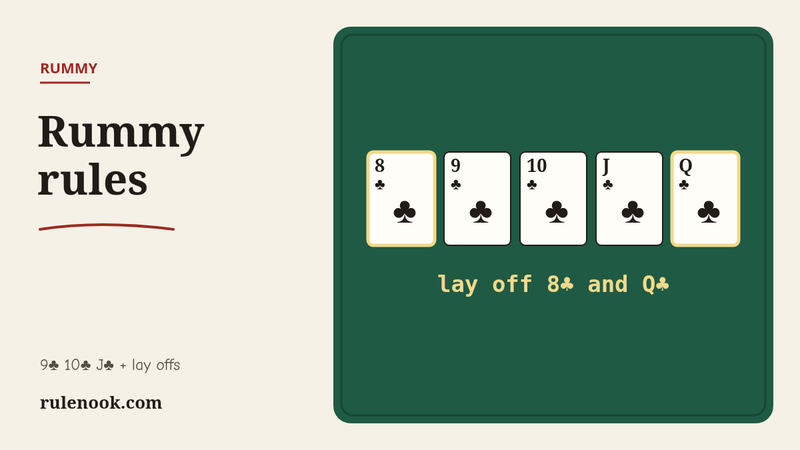
Laying off is where most hands are won. If 9♣ 10♣ J♣ is on the table, you can add the 8♣, the Q♣, or both. If three 4s are down, you can add the fourth.
How do you go out?
You go out when your last card leaves your hand, whether you meld it, lay it off or discard it. That ends the hand at once.
Official rule vs house rule. Under the published rules, if all your remaining cards form melds, you may lay them down without a final discard. Plenty of tables play a house rule that you must finish with a discard. Agree on it before the first deal, because the two rules change when a hand can end. The same argument comes up in 500 Rum, where it has its own answer on our 500 rummy page.
If the stock runs out before anyone goes out, the next player may take the top discard, or turn the discard pile over without shuffling it to form a new stock and draw from that.
How do you score rummy?
When a hand ends, the winner scores the total of all cards left in the other players' hands. A card counts even if it would have formed a meld; only cards already on the table are safe.
| Card | Points |
|---|---|
| K, Q, J | 10 each |
| 10 down to 2 | Face value |
| A | 1 |
Worked example 1. Three players. You go out. Player B still holds K♠ 7♦ 7♣ A♥: 10 + 7 + 7 + 1 = 25. Player C holds Q♥ J♥ 2♣: 10 + 10 + 2 = 22. You score 25 + 22 = 47.
Worked example 2: going rummy. If you go out in a single turn, laying down your whole hand without having melded or laid off anything earlier, that's called going rummy. The published rule doubles what each opponent owes. With the same cards left in B's and C's hands, you score 94 instead of 47.
How the game ends. The published rules settle each hand on its own. Most home games keep a running total and stop when one player reaches a target set before play, such as 100 or 250. A common alternative is penalty scoring: each player adds their own leftover cards to their score, and the lowest total wins when someone passes 100.
What changes with jokers?
The published game has no jokers. If you add them, decide three things first: whether a joker can fill any spot in a set or run, whether a player may swap a natural card for a joker already on the table, and what a joker costs when it's caught in your hand. Values of 15 and 25 are both common, so write your number down.
Common Rules Questions
Is the ace high or low in rummy?
Official rule: low only. The published rules rank the ace below the 2, so A-2-3 is a run and Q-K-A isn't. Common house rule: the ace may be high or low, but not both at once, so Q-K-A is legal and K-A-2 still isn't. Some tables also score an ace caught in hand at 11 or 15 when it can play high. Agree on all three points before you deal.
Can you take the top discard and not use it right away?
Yes, in basic rummy. The published rules let you take the top discard into your hand without melding it on that turn. The one limit is that you can't discard the same card on that turn. The "must use it now" rule belongs to 500 Rum, where you take cards from deeper in the pile, and some tables carry it over to basic rummy as a house rule.
Can you lay off on your opponent's melds?
Yes. Under the published rules you may add cards to any meld on the table, no matter who laid it down. A common house rule says you can't lay off until you've put down at least one meld of your own. Another limits layoffs to your own melds. Both make going out harder, so new players usually find the official rule easier.
Can a run go around the corner, like K-A-2?
No, not in the published rules or in most house rules. The ace sits at one end of the sequence. Even tables that let the ace play high usually stop at Q-K-A. A few family games allow "around the corner" runs, but treat that as a rule you announce in advance, since it changes which cards can be laid off.
What to read next
- Types of rummy compared
- Gin rummy rules
- Liverpool rummy rules
- Playing cards for card games
- All card game rules
Sources: Bicycle, Rummy (Rum): deal sizes, card ranking, laying off, going out without a discard, stock exhaustion, scoring and the double for going rummy (read 2026-10-10). Worked examples are our arithmetic. Last updated 2026-10-10.
Sources
- Bicycle, Rummy (Rum) rules, bicyclecards.com/how-to-play/rummy-rum (read 2026-10-10)