Mancala Rules: Setup, Sowing, Captures and Who Wins
As an Amazon Associate, Rulenook earns from qualifying purchases.
Mancala, the folding board game sold with 48 stones, is Kalah for 2 players. Each of you has 6 pockets. You sow stones counter-clockwise, and the player with the most stones in their store at the end wins.
This guide follows the Gameplay section of the Wikipedia article on Kalah, read 2026-10-16. Yellow Mountain Imports prints the same board, the same 4 stones per pocket, and the same counter-clockwise sow on its How to Play Mancala page. Where those two pages differ, the difference is named below.
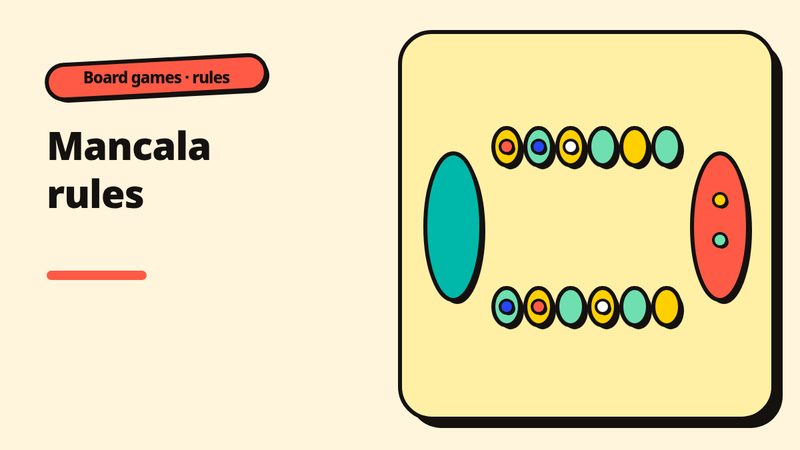
What is on the board?
The board has 2 rows of 6 small holes and one large hole at each end. Wikipedia calls the small holes houses and the large holes stores, or end zones. Yellow Mountain Imports calls the small holes pockets and the large holes mancalas or stores. This page uses pockets and stores.
Each player controls the 6 pockets in front of them. Your store is the large hole on your right. Your opponent's store is on your left, and you never drop a stone into it.
| Part | Count | Who uses it |
|---|---|---|
| Pockets | 12 (6 on each side) | The row in front of you is yours |
| Stores | 2 | Yours is on your right |
| Stones | 48 | 4 in each pocket at the start |
6 × 2 = 12 pockets. 12 × 4 = 48 stones. Both stores start empty.
Number your pockets 1 to 6, left to right. Pocket 1 is farthest from your store. Pocket 6 sits beside it. Sowing moves from 1 toward 6, then into your store.
The folding board sold as Mancala has exactly this layout, with the 48 stones included.
How to Set Up Mancala
Put the board between the two players, long side facing each of you.
- Sit so that your 6 pockets are the near row.
- Put your store on your right.
- Place 4 stones in each of the 12 pockets.
- Leave both stores empty.
4 × 12 = 48, which matches a set sold with 48 stones. Neither page names who moves first beyond "the first player." Agree on that before the first sow. Neither page prints a box age or a playing time.
How to Play Mancala: One Turn, Step by Step
On your turn you choose one pocket on your side that still has stones. You pick up every stone in it. That pocket is now empty. You then drop the stones one at a time into the next holes, moving counter-clockwise.
Counter-clockwise from your row means you sow toward your right-hand store, then into your opponent's row if you still have stones, and you skip their store.
- Pick up all the stones from one of your 6 pockets.
- Drop one stone in each following pocket, and drop one in your own store when you reach it.
- Skip the opponent's store. If stones remain, continue into the next pocket on their row, then back toward your row.
- Stop when the last stone has been dropped.
You may not start a sow from a store, and you may not start from a pocket on your opponent's side. You may not choose an empty pocket.
The last stone lands in your store
If the last stone lands in your own store, you take another turn. Wikipedia calls this an additional move and puts no limit on how many times it can chain. Yellow Mountain Imports says the same thing in fewer words: you take another turn.
A short case: pocket 6, the one beside your store, holds 1 stone. You sow that stone into your store. The last stone is in the store, so you sow again from any other pocket on your side that still has stones.
The last stone lands anywhere else
If the last stone lands in a pocket and it is not a capture, the turn passes. Your opponent then sows from their own row.
An alternative rule on the Wikipedia page sows clockwise instead. Clockwise reaches your store later, because you travel the long way around. This guide uses the counter-clockwise sow that both pages print as the main rule. Agree before the first stone if your box says clockwise.
Captures
How to capture in mancala
A capture happens only on the last stone of a sow, and only on your side.
Wikipedia's condition has two parts. The last seed lands in an empty house you own, and the opposite house contains seeds. You then take both the last seed and the opposite seeds and put them in your store.
Yellow Mountain Imports says that if your last stone lands in an empty pocket on your side, you capture that stone along with all the stones in the directly opposite pocket. It does not add the "opposite pocket must already hold stones" clause. On a standard set the result matches whenever the opposite pocket has stones. If the opposite pocket is empty, Wikipedia does not capture, and the last stone stays where it landed. This guide follows that condition.
Worked capture. Your pocket A is empty. The pocket just before A, farther from your store, holds 1 stone. Call that pocket B. The pocket directly opposite A holds 5 stones. You pick up the 1 stone in B and drop it into A, which was empty. That is the last stone. A is yours, and the opposite pocket has stones. You take the 1 and the 5. 1 + 5 = 6 stones go into your store. A and the opposite pocket are both empty after the capture.
A last stone that lands in an opponent's pocket is not a capture, even if that pocket was empty. You only capture on your own side.
A last stone that lands in a pocket of yours that already had stones is not a capture either. The new stone just sits there, and the turn ends unless that landing was your store.
How the game ends
When one side is empty, the game ends. All 6 pockets on that side have no stones, so that player cannot sow. The empty side can be yours or your opponent's.
Wikipedia then has one more step. The player who still has stones moves all of those remaining stones into their own store. After that, each store is counted. The higher total wins. A tie is allowed: the page says the game can end in a draw.
Yellow Mountain Imports does not print that sweep. Its winning section says the game ends when one side is empty, and each player counts the stones already in their store. If you are using that sheet alone, stones left on the board are not added. If you are using the Wikipedia Kalah rules, they are. Say which page you are following before you start, because the totals change.
The two printed pages do not say the same thing. The rows below are the differences that change a result.
| Question | Wikipedia Kalah | Yellow Mountain Imports |
|---|---|---|
| Opposite pocket is empty | No capture. The last stone stays in your pocket | That extra condition is not printed |
| Stones left at the end | The player who still has stones sweeps them into their store | Count only the stones already in the two stores |
| Equal stores | A draw is allowed | A tie is not discussed |
Worked ending under the Wikipedia rule. One player has just emptied their 6 pockets. The other player still has 3 stones in one pocket and 2 in another, which is 5 stones on the board. Stores before the sweep are 21 and 22, and the player about to sweep is the one with 21. 21 + 22 + 5 = 48, so every stone is already accounted for. Those 5 stones move into the store that held 21. 21 + 5 = 26. The other store stays 22. 26 + 22 = 48. 26 beats 22.
A draw under the same rule is 24 each. 24 + 24 = 48. Neither store is ahead.
A first game, one lap
Both rows hold 4 stones in every pocket. Stores are 0. Number the near pockets 1 to 6, with pocket 6 beside your store. Sow the 4 stones from pocket 3. The four drops are pocket 4, pocket 5, pocket 6, and the store. The last stone is in your store, so you take another turn.
Your row is now 4, 4, 0, 5, 5, 5. Your store holds 1. Your opponent's 6 pockets are still 4 each.
On that second sow, take the 5 stones in pocket 6. The first drop lands in your store. The next 4 land in the first 4 pockets of your opponent's row, in sowing order. The last stone is on their side, so the turn ends. Your store now holds 2. Their store is still empty. Nothing in this lap captures, because the last stone of the second sow is not on your side.
Your pockets are then 4, 4, 0, 5, 5, 0. That is 18 stones. Their row holds 28, because 4 of their pockets went from 4 to 5 and 2 stayed at 4. 18 + 28 + 2 = 48.
Player count
The board in both sources is built for 2 players. There is no 3-player variant and no solo puzzle on either page. With 2 players, each of you owns 6 pockets and one store, and 24 of the 48 stones start on your side. 6 × 4 = 24.
A 4-player board is a different game. Both pages describe 2 players only, so no 4-player rules are added here.
Common Rules Questions
Do you drop a stone in the opponent's store?
No. You sow into your own store and into pockets on both sides. Their store is skipped. If a sow would reach it, you pass over it and continue in the next pocket.
When do you get another turn?
When the last stone of a sow lands in your store. You then choose another of your pockets and sow again. There is no printed cap on how many extra turns can follow. A last stone in any pocket does not give you another turn, even when that landing is also a capture.
Can you capture on the opponent's side?
No. The capture is only for a last stone that lands in an empty pocket on your side, and only when the opposite pocket has stones. You take your last stone and the stones in that opposite pocket. 1 + 5 = 6 is the small case above. Landing in an empty pocket of theirs does not take anything.
What happens to stones left on the board?
Under the Wikipedia Kalah rule, the player who still has stones sweeps them into their store once the other side is empty. In the example, 21 in the store plus 5 on the board becomes 26, and 26 against 22 decides it. Yellow Mountain Imports instead counts only what is already in the two stores. Pick one of those two endings and keep it for the whole game.
Can the game tie?
Yes, under the Wikipedia rule. Equal stores after the sweep are a draw. 24 each uses all 48 stones. The Yellow Mountain Imports page names a winner by the higher store and does not discuss a tie. Equal stores are still a tie if you are counting stores only.
How many stones are in mancala?
- Each of the 12 pockets starts with 4 stones, and 12 × 4 = 48. Both stores start empty. The stones do not leave the game. A finished pair of stores still adds to 48.
Are there different mancala rules?
Yes. The two pages this guide follows disagree on an empty opposite pocket, on the end sweep, and on draws. The table in "How the game ends" is that list. Pick one page before the first sow and keep it.
If you like mancala, try these
Backgammon · 2 players · Light
Same: 2 players, and the turn is Light. Different: the pieces move by a dice roll, and each player has 15 checkers.
Cribbage · 2 players · Competitive
Same: a 2-player race. Different: the score is pegged from cards, and the game ends at 121.
Rummikub · 2–4 players · Light
Same: it seats 2, and the turn is Light. Different: you lay numbered tiles in groups or runs instead of sowing stones.
More guides are in our board games section.
Sources
- Wikipedia, Kalah, Gameplay (6 houses a side, 4 seeds each, counter-clockwise sow, capture, extra move, end sweep, draw)
- Yellow Mountain Imports, How to Play Mancala (48 stones, 2 rows of 6, store on the right, counter-clockwise sow, another turn, count the stores)
- Wikipedia notes a clockwise sow as an alternative rule. The steps above stay counter-clockwise.
How we check rules and build the intro card: our methodology.