Domino Set Sizes: How Many Tiles in Double 6, 9, 12 and 15
As an Amazon Associate, Rulenook earns from qualifying purchases.
Domino set sizes mean the double number, not the length of a tile. A double-six set holds 28 tiles, a double-nine 55, a double-twelve 91, a double-fifteen 136.
One exception sits in the box. Some boxes carry a few extra tiles, such as spare blanks, so count before you deal.
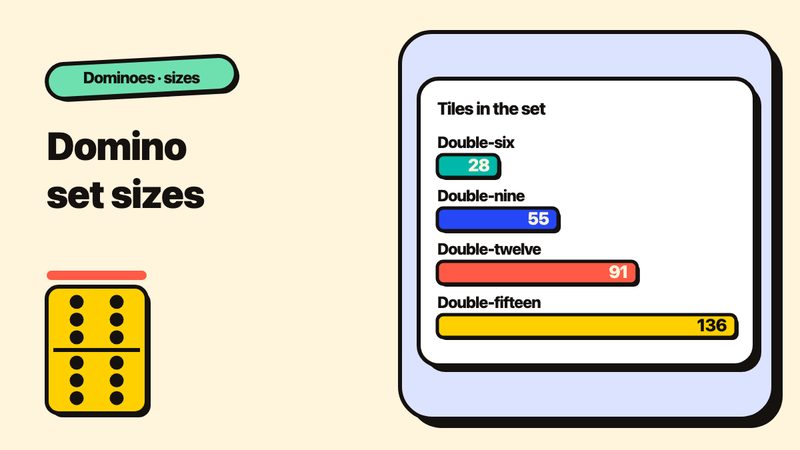
Domino Set Sizes at a Glance
Our assumptions, before the table. A full set means the tiles that belong to the game. No spare blanks, no extras.
The boneyard column counts what stays face down after 4 players take 7 tiles each. The pips column counts both halves of every tile.
| Set | Numbers on the tiles | Tiles | Doubles | Non-doubles | Total pips | Boneyard with 4 players |
|---|---|---|---|---|---|---|
| Double-six | 0 to 6 | 28 | 7 | 21 | 168 | 0 |
| Double-nine | 0 to 9 | 55 | 10 | 45 | 495 | 27 |
| Double-twelve | 0 to 12 | 91 | 13 | 78 | 1092 | 63 |
| Double-fifteen | 0 to 15 | 136 | 16 | 120 | 2040 | 108 |
One formula generates all four rows. So you can check any set you meet. Tiles = (n+1)(n+2)/2. Doubles = n+1. Non-doubles = n(n+1)/2. Pips = (n+2) × n(n+1)/2.
The boneyard column is the same subtraction. Take 28 tiles off the table. The rest is 0, 27, 63, or 108.
PAGAT names the four sizes in one line. The common value for n runs 6, then 9, then 12, then 15.
The double-six set is the one our domino rules page covers in full. It holds 28 tiles and 168 pips. The same count runs under every other double number.
A double is a tile with the same number on both halves, so a double-six set runs from [0|0] to [6|6]. It holds 7 doubles and 21 tiles with two different numbers.
How the Tile Count Works
Start with the rule that settles the count. Every pair of numbers appears once. PAGAT puts it as permutations, not combinations, and the range runs from 0 up to n.
A double-n set holds one tile for each pair. The pairs run from the blank double to the double n. Count the pairs and the tile count follows.
Count the pairs row by row. The first row holds 1 tile. The next row holds 2. The last row holds n+1. Adding the rows gives (n+1)(n+2)/2.
Worked example, double-twelve. The rows run 1 + 2 + 3 + ... + 13 = 91 tiles. The diagonal holds the doubles, 13 of them. That leaves 78 non-doubles.
The doubles are the diagonal of the grid. A double-n set has n+1 of them, one for each number from 0 to n.
Pips follow the same count. Every number from 0 to n shows on n+2 tiles.
One of those is its own double, and the other n pair it with another number. The pip total is (n+2) × (0+1+...+n).
For a double-twelve that reads 14 × 78 = 1092. A double-six set reads 8 × 21 = 168. The same two steps give you any other size.
The per-tile count follows too. Each number shows on n+2 tiles. So 8 times in a double-six set, 14 times in a double-twelve.
Second worked example, the boneyard. Four players take 7 tiles each, so 28 tiles leave the table. A double-six set has nothing left after that.
A double-nine leaves 27. A double-twelve leaves 63. A double-fifteen leaves 108.
Our check script recomputes every number on this page from one data file, the same rows as the tables. Then it prints the totals it finds.
Which Set Size Goes With Which Game
The size follows the game. Here is where the published rules name their own set.
| Game | Set it is played with | Tiles | What the rulebook says | Source |
|---|---|---|---|---|
| Standard draw and block | Double-six | 28 | The game uses a double six domino set | PAGAT draw and block pages, read 2026-11-02 |
| Two-player dominoes | Double-six | 28 | The game uses a double six domino set; 2 players get 7 tiles each | PAGAT draw page, read 2026-11-02 |
| Mexican Train | Double-twelve | 91 | A double twelve set is used, giving 91 pieces in all | PAGAT Mexican Train page, read 2026-11-02 |
| Chicken Foot | Double-nine | 55 | A double 9 set of 55 tiles, or sometimes a double 12 set of 91 | PAGAT Chicken Foot page, read 2026-11-02 |
| A double-fifteen table | Double-fifteen | 136 | not printed for a hand at this size; the listing counts 136 dominoes | Listing spec and our own count, read 2026-11-02 |
The two-player row names the set and the deal the rulebook prints. Our own rules page deals 12 tiles each to 2 players, and the draw rules print 7 each. Both numbers sit on this page, each with its own source.
The words "not printed" mark a gap. No rulebook we read states that number for that size. Read the row that fits your table.
Moving up a size changes the set, not the game. A bigger set gives you more tiles and a higher double.
The turn stays the same: match an open end, place across the chain, draw from the boneyard when nothing fits. Our domino hub sets out that turn.
A double-twelve set listing counts 91 dominoes. It adds 4 plastic trains, 1 starter piece and a storage tin. That is the size you need for a Mexican Train table.
The hand size does not travel with the set, so keep the hand your game already uses. The extra tiles of a bigger set stay in the boneyard. A deeper boneyard gives you more draws when nothing fits.
What Changes When You Move Up a Size
Our assumptions, before this table. Four rows are our own count: the tile count, the highest double, the boneyard and the pip total. We worked them out in the section above.
The row that names who leads is not our count. Each cell points at the rulebook behind it, and the double-fifteen cell says not printed.
Hand sizes come from the rulebook of the game, not from the size of the set. Two figures are in play, so we print both. The 2-player row uses 12 each, the figure on our own rules page, and 12 + 12 + 4 covers a double-six set. PAGAT's draw rules print 7 each for 2 players instead, which leaves 14 in the boneyard. Settle it in your own game before you deal.
| What changes | Double-six | Double-nine | Double-twelve | Double-fifteen |
|---|---|---|---|---|
| Tiles in the set | 28 | 55 | 91 | 136 |
| Highest double in the set | [6|6] | [9|9] | [12|12] | [15|15] |
| Who leads the first tile | Highest double | Highest double, the [9|9] | The [12|12] starts the centre | not printed |
| Boneyard, 4 players take 7 each | 0 | 27 | 63 | 108 |
| Tiles left, 2 players take 12 each (our count) | 4 | 31 | 67 | 112 |
| Total pips | 168 | 495 | 1092 | 2040 |
Official rule: the rulebook fixes the set and the deal together. PAGAT's draw page uses a double six set. It prints 7 tiles each for 2 or 3 players, and 14 stay in the boneyard of a double-six set.
Common house rule: a table that moves up a size keeps the hand size it already plays with. The extra tiles land in the boneyard. That is the arithmetic behind the boneyard row. Settle it before you deal.
In a standard game the lead stays with the highest double. Alex Cramer's guide says the player holding the highest double plays first, so the double-six cell follows his rule.
The Chicken Foot rules name the [9|9] for a double nine set, and Mexican Train starts from the centre with the [12|12]. That is a different game, not a different lead in the same one. For a double-fifteen set the lead is not printed, because no rulebook we read names one.
Common Rules Questions
How many pieces are in a 9x9 domino set?
55 pieces. A 9 by 9 set is the double-nine set under another name. It has 10 rows of tiles numbered 0 to 9. Count the rows if you have the set in front of you.
One tile for each pair, so 9 × 10 / 2 = 55. The doubles are the 10 tiles from [0|0] to [9|9]. The other 45 tiles are not doubles. Chicken Foot rules use this size.
Are there double 9 dominoes?
Yes, and they are the standard set for one popular game. A double-nine set holds 55 tiles.
The PAGAT Chicken Foot rules use a double 9 set of 55 tiles for the standard game. The same page allows a double 12 set of 91. You will find sets of this size sold on their own.
What is the difference between double six and double 12 dominoes?
The tile count and the pip cap. A double-six set holds 28 tiles, 7 of them doubles, and no half carries more than 6 pips.
A double-twelve set holds 91 tiles, 13 of them doubles. The halves run up to 12. With 4 players taking 7 tiles each, a double-six set leaves no boneyard at all. A double-twelve leaves 63.
How many dominoes do you start with for 2 people?
12 each is the count on our domino rules. That puts 24 tiles on the table, and 4 stay in the boneyard of a double-six set.
PAGAT's draw rules print 7 each for 2 players instead, which leaves 14 in the boneyard. Two hand sizes sit in play, one from the rulebook and one from our rules page. Pick one before you deal.
Do all double-six sets have exactly 28 tiles?
A complete double-six set holds 28 tiles. Some boxes carry a few extra pieces, such as spare blanks.
Count the tiles in front of you before the first deal. Leave the spares in the box.
Read next
Our domino rules hub covers the double-six set in full. It gives the deal, one turn, the scoring, and where the doubles sit on the chain.
That page also names the variants that sit next to it. The train games, the two-player deal, the score calculator and the set buying guide are not published on this site.
This page stays with the numbers, and the turns stay with the rules page. How we check numbers and name sources: our methodology.
Sources
- PAGAT, Domino Games: Basic Mechanics, https://www.pagat.com/domino/basics.html. Read 2026-11-02. The tiles hold all possible permutations of the numbers 0 to n. The common values for n are 6, then 9, then 12 and 15.
- PAGAT, Draw Dominoes: rules and variations, https://www.pagat.com/domino/line/draw.html. Read 2026-11-02. The game uses a double six domino set. Other sets can be used when you have more players.
- PAGAT, Block Dominoes: rules and variations, https://www.pagat.com/domino/line/block.html. Read 2026-11-02. The same double six set. One variation determines the lead with the highest double.
- PAGAT, Partnership Dominoes, https://www.pagat.com/domino/line/partnership.html. Read 2026-11-02. A double six set of 28 tiles. All the tiles are dealt to the four players, seven each.
- PAGAT, Mexican Train, https://www.pagat.com/domino/star/mextrain.html. Read 2026-11-02. A double twelve set is used, giving 91 pieces in all. The [12|12] goes in the centre.
- PAGAT, Chicken Foot, https://www.pagat.com/domino/tree/chickenfoot.html. Read 2026-11-02. A double 9 set of 55 tiles, or sometimes a double 12 set of 91. The highest double leads the first hand.
- Alex Cramer, How to Play Dominoes, https://alexcramer.com/pages/how-to-play-dominoes. Read 2026-11-02. A standard double six set has 28 tiles, 21 singles and 7 doubles. The player holding the highest double plays first.
- Our own arithmetic covers the tile counts, the doubles, the non-doubles, the pip totals, the boneyard columns and the two worked examples. The check script sits with the notes for this page.
- Listing data, read 2026-11-02. A double-twelve set listing counts 91 dominoes, 4 plastic trains, 1 starter piece and a storage tin. A double-fifteen set listing counts 136 dominoes.