Methodology: How rulenook.com Checks Rules, Scores and Diagrams
Every rules page on rulenook.com names the rule book it follows. Every score, count and probability on it is rerun by a script before the page goes live. No exceptions. No exceptions. This page explains which sources we use, what the scripts check, how the diagrams are built and how we fix mistakes.
Who writes here?
Who writes here. Edwina Larkspur is the pen name our editors use for every rules page on rulenook.com. She isn't a real tournament director, and we don't claim club or tournament experience we don't have.
Pages are drafted with AI assistance. An editor then checks each rule against the published rule book we cite and reruns every score, count and probability through the scripts on our methodology page. Where tables disagree, we label the official rule and the common house rule separately. Spot an error? Email [email protected] and we'll fix it and log the change.
Which sources do we follow?
Where a game has a governing body, its rule book wins. For cribbage that's the 2025 edition of the ACC rules, cited by rule number, such as rule 1.4 on boards. Where there's no governing body, we follow 1 named published source per game, such as Bicycle for gin or pagat.com for 500 Rum, and say so at the bottom of the page.
| Game | Primary source | Notes |
|---|---|---|
| Cribbage | American Cribbage Congress, Official Rules (2025) | Rule numbers cited where they matter |
| American mahjong | National Mah Jongg League publications | We never reproduce the annual card. Some pages rely on published secondary summaries and are flagged for a rule book check |
| Hong Kong and Chinese mahjong | No single rule book | Scoring shown as typical practice, labeled as such |
| Gin, rummy, canasta, crazy eights, spades, euchre | Bicycle published rules | No governing body; partnership spades scoring labeled as common practice |
| 500 Rum, Liverpool, casino, Hand and Foot, cribbage variants | John McLeod's pagat.com | Hand and Foot also checked against Bicycle; variants named when sources disagree |
| Tile, card and board sizes | Retailer and maker listings | Listed specs only. We don't test products |
Web pages change. We keep a dated snapshot of each web source we cite, with a checksum, so a later change to the page doesn't silently change ours.
How do we check scores and counts?
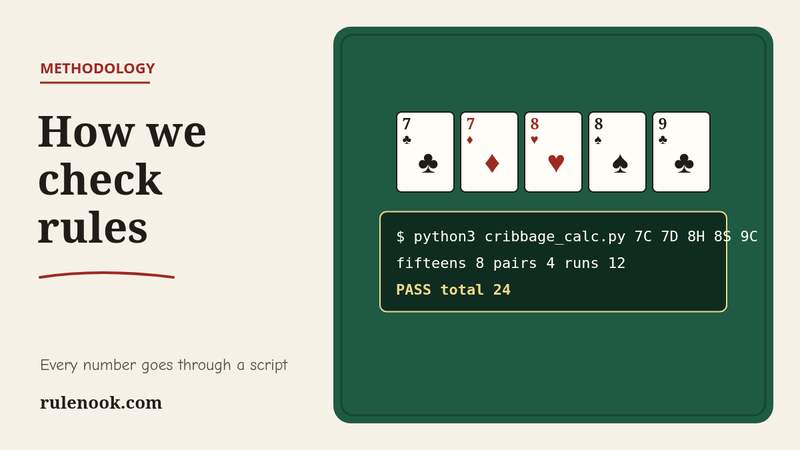
Every number in a worked example goes through a script. Every one.
The cribbage odds on our scoring chart come from scoring all 12,994,800 combinations of hand and starter, which is 270,725 possible 4-card hands times 48 starters. Nothing is sampled.
The average hand is 4.77 points and the median is 4. Exactly 4 totals from 0 to 29 can't be reached at all: 19, 25, 26 and 27. The expected value is typed in by an editor working it out by hand; the script computes it independently; the two must match.
| What | How it's checked |
|---|---|
| Cribbage hands and cribs | A scoring function counts fifteens, pairs, runs, flushes and his nobs for any 4 cards plus starter |
| Cribbage odds | Every possible hand and starter is enumerated, not sampled |
| Cribbage pegging | A separate pegging function scores each card played, so it can't share a bug with the hand scorer |
| Mahjong tile counts | Set totals (136, 144, 152, 166) are rebuilt from suits, honors, flowers and jokers |
| Spades, gin, canasta and rummy scoring | Each worked score sheet is recomputed hand by hand |
| Sizes and conversions | Every inch and millimeter figure is converted by script, not by eye |
If a script disagrees with the text, the text is wrong until proven otherwise. For mahjong, the script rebuilds the 136, 144, 152 and 166-tile counts from 34 tile types, 4 of each. Then it adds 8 flowers, 8 jokers and the spares each seller lists. The totals must match.
How our rule diagrams are made
Rule diagrams on this site are generated by script from the same data as the text, never drawn by hand or edited after the fact. It takes 6 steps.
-
Data first: every card, tile and count in a figure comes from a data structure in a script. The same data renders the table next to it.
-
Assertions: before an image is generated, the script checks it. Cribbage hands go through the scoring function and pegging through the separate pegging function. Mahjong figures are checked by summing their parts and by the rule of 4 of each tile. The pips drawn on a card must equal its value, so a 7 shows 7 pips and a 5-dot tile shows 5 dots. No card or tile may appear twice.
-
Two-way check: the expected values in those assertions are hand-computed by an editor. A mismatch fails the build.
-
Report: each build writes a verification report. A single failed assertion, even 1 out of hundreds, stops the whole site from publishing.
-
Visual check: an editor reads every image for legibility, including on a phone.
-
Rerun on change: when a rule book changes, every diagram is regenerated.
Every figure has a visible caption and alt text that names the actual cards and the result. Chinese characters on mahjong tiles are converted to outlines, so they display correctly on any phone or computer, even one without Chinese fonts installed. At launch there are no photos and no AI-generated images on the site. Product images on buying guides come from Amazon's feed and are never edited.
How do we label official and house rules?
With a labeled callout. Rule 10 of the 2025 ACC rule book, for example, makes muggins optional, so our cribbage pages show it as something you agree on first.
Official rule means the cited rule book says it. House rule means a common table practice the rule book doesn't require. When 2 sources disagree on something that changes a score, the 2 versions are shown side by side, each with the source it comes from. We don't pick a winner for your table. That's your call.
How do affiliate links work here?
Some buying guides and rules pages carry Amazon links. Each sits after the step or table that creates a need for the product, never at the top of the page.
Links are marked "(paid link)" and use rel="sponsored nofollow". We haven't tested the products. Candidates are matched to listed specifications, and we don't publish prices, star ratings or "best" rankings. Index pages, the hand calculator and printable sheets, including any PDF version, carry no Amazon links at all.
What don't we publish?
- The National Mah Jongg League's annual card, or any hand from it. It's copyrighted. Buy it from the League.
- Betting or gambling strategy.
- Instructions for opening or modifying the electrics of automatic mahjong tables.
- Stories about games we played, or credentials we don't hold.
Corrections log
This log starts at launch. Each entry gives the date, the page, what changed and why, so you can see exactly when a rule or score on a page was different. Typos aren't logged. Small fixes to wording are not logged either; any change to a rule, a score, a count or a diagram is.
| Date | Page | What changed | Why |
|---|---|---|---|
| (none yet) |
Sources
- American Cribbage Congress, Official Rules (2025)
- National Mah Jongg League, Mah Jongg Made Easy (cited via secondary summaries where flagged)
- Tom Sloper, published mahjong FAQs and columns
- Bicycle (United States Playing Card Co.), published game rules
- John McLeod, pagat.com
- Wikipedia, for Hong Kong mahjong scoring conventions and card dimension comparisons
- Retailer and maker product listings, for sizes only
What to read next
Sources: this page describes the site's own process, and the source snapshots and check scripts it mentions are kept with the site's build files. Last updated 2026-10-10.