How to Play Mahjong Alone: Solo Practice With Real Tiles
As an Amazon Associate, Rulenook earns from qualifying purchases.
How to play mahjong alone: deal 13 tiles from a 152-tile set, run the Charleston, play the other three seats from the practice wall, and score every hand. Solo practice is not a new game. The rules stay the four-player rules. So a drill at one table rehearses what a real table asks of you. You can work on tile recognition, sorting, passing, calling and scoring. You cannot work on reading discards or on defense.
Pick a style first: the rules hub has the map. This drill uses the American rules.
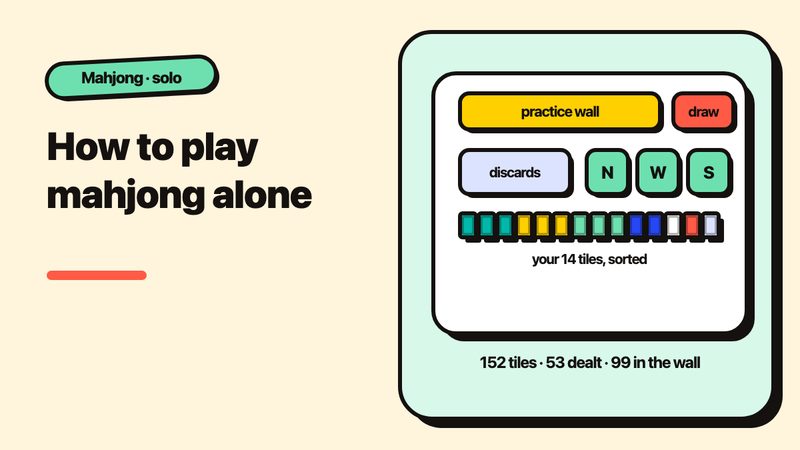
What you need to play mahjong alone
A solo drill needs less than a table of four. It needs real tiles.
| Item | Count or spec | Why the drill needs it |
|---|---|---|
| American tiles | 152 in play, 166 in the box | 14 spares (8 flowers, 2 jokers, 4 blanks) stay in the box |
| Chinese or Hong Kong set | 144 tiles, no jokers | Same drill, 4 sets and 1 pair, fan instead of card values |
| Racks or a tray | 1 lane per hand | 13 tiles need a lane that shows the groups |
| NMJL card | 1, for this year | Without it you rehearse motions, not the hand |
| Blank call card | 1 sheet | You copy the line you drill on your own card |
| Practice log | 1 page | Each drill ends with a line to check |
| Dice | 2, optional | They pick where the wall opens. No rule depends on the count |
| A second reader | Optional | Useful for a hand check, useless for discards |
An American set listing for 166 tiles also lists 4 rack and pusher units. One rack holds your sorted hand. The others stack the practice wall.
Racks and tile widths decide whether a hand fits. The tile size guide and the racks page have the numbers.
Set up your solo station
Two drills work. Drill A deals one hand. Drill B deals four hands and you play all of them.
- Build the wall. American play uses 4 walls of 19 stacks, 2 high: 19 × 2 × 4 = 152. Chinese and Hong Kong play uses 18 stacks: 18 × 2 × 4 = 144.
- Set the seats. East is the dealer with 14 tiles. The other three seats hold 13.
- Deal. In drill B, deal 13, 13, 13 and 14 and label the hands E, S, W and N. In drill A, deal only yourself.
- Log the drill so the numbers mean something later.
Table A counts the tiles. The turns column is what the wall supplies.
| Drill | Tiles in your hand | Tiles dealt out | Tiles left in the wall | Drawn each turn | Turns the wall supplies | Tiles left in the wall at the end |
|---|---|---|---|---|---|---|
| Drill A, American | 14 | 14 | 152 − 14 = 138 | 1 | 138 | 0 |
| Drill B, American | 14 | 13 × 3 + 14 = 53 | 152 − 53 = 99 | 1 | 99 | 0 |
| Drill B, Chinese or Hong Kong | 14 | 53 | 144 − 53 = 91 | 1, plus a replacement for each flower | 91 − 8 = 83 | 0 |
Our assumptions for table A:
- Discards never go back into the wall.
- American play has no dead wall, and replacement draws come from the far side of the break. The dead-wall count is not printed in our sources, so we count none.
- Chinese and Hong Kong play replaces every flower with a fresh draw, so each of the 8 flowers costs one extra draw. We assume all 8 reach a hand.
- East opens with a discard and does not draw first.
Sort your hand the way players do
Sorting is the part you can practise perfectly alone.
- Group by kind. Suits first (dots, bamboos, characters), then winds, then dragons, then flowers. Jokers sit alone.
- Group by shape. Put the 3 or more alike tiles together, then the runs of 3 in one suit, then the pairs.
- Mark the pairs. A pair of the same tile is the likeliest seat for the last set.
- Write the gap. Note the tiles that would finish each group.
- Park the jokers. A joker covers a group of 3 or more. Never a single tile, never a pair.
The hand in that picture is 14 tiles: 3 of 1 Dot, runs of 4 to 6 and 7 to 9 Dot, a pair of Green Dragons, and a pung of 2 Bamboo that the joker closes.
Run the Charleston by yourself
The Charleston is the pass before the first discard. It runs up to 7 passes. Right, across and left. Then left, across and right. Then a courtesy pass across. Passes 3 and 6 may be blind passes. A joker never passes. Our Charleston page has every pass in order.
Drill B gives you the 4 hands.
- Deal four hands and put them at the four sides of the table.
- Say the direction out loud before you move any tile. The opposite seat is the hand across from you.
- Pass 3 tiles face down and pick up only when all four hands are down.
- Blind pass on 3 and 6. Send 1, 2 or 3 of the tiles you were handed, unseen, and make the count up from your rack.
- Keep every joker in your rack through all 7 passes.
- Open the play. East discards first, with no draw.
| Pass | Direction | Tiles | What to watch |
|---|---|---|---|
| 1 | Right | 3 | Nobody picks up until all 4 hands are down |
| 2 | Across | 3 | The opposite hand receives from you |
| 3 | Left | 3 | Blind pass allowed: 1, 2 or 3 tiles unseen |
| 4 | Left | 3 | The second round runs only if nobody stopped it |
| 5 | Across | 3 | Same count as pass 2 |
| 6 | Right | 3 | Blind pass allowed again |
| 7 | Across | 0 to 3 | Courtesy pass: agree the number with the opposite hand |
What this drill teaches is the hand movement and the order. Reading a discard still needs a real table.
Play your turns and take the other three seats
Play moves to the right, counterclockwise. Replacement tiles come from the far side of the break. Those two directions run opposite ways, and that is what a solo player mixes up first.
- On your turn, draw 1 tile from the practice wall. Discard 1 face up. Say the tile name out loud.
- On another seat's turn, draw 1 tile for them. Turn it face down into the discard area.
- Call before the next draw. A call has to happen before the next player draws and racks a tile.
- Rank the calls. A Mah Jongg call beats a claim for an exposed group. Between 2 claims for a group, the player whose turn comes next takes it.
- End the drill at the wall. If the wall runs out with no winner, nobody scores. The tiles are mixed and the deal moves on.
Table B says what each drill is worth.
| Drill | Tiles used | Hands played | What you can check yourself | What you cannot check |
|---|---|---|---|---|
| Sorting one hand | 0 drawn, 14 in hand | 1 | The group order and the joker rule | Whether the shape matches the card |
| The Charleston | 18 to 21 each way | 1 | The pass order and the 2 blind passes | Whether a pass improved the hand |
| Calling | 1 discard at a time | 1 | Your call against your own card | The claim order against 3 rivals |
| Scoring | 0, reuse the hand | 1 | The payment arithmetic | Whether the hand was legal |
| All four seats | 99 from the wall | 1 round | The draw, discard and order | The wall game, since nobody wins |
Drill the calls and the card
The card is the referee. A hand is legal only if it matches one line on that year's card. Without the card you rehearse the motions, not the hand. The League owns the card and publishes a new one each spring, so we do not reprint its lines. Our rules page explains the notation.
A solo call drill works in 5 steps.
- Pick one line you want to drill and copy it onto your own blank card.
- Deal a hand that matches the shape of that line.
- Count the shape. A winning hand holds 14 tiles: 4 groups plus 1 pair.
- Write the value from your own card, not from an older card.
- Log every call. Write your call and your reason before you check the card.
Fill this sheet in from the card in your hand.
| Card year | The line I am drilling (my own copy) | This hand | Matches the line? | Value from my card |
|---|---|---|---|---|
Then log each discard you would have called on.
| Discard | My call (expose, Mah Jongg, pass) | My reason | Checked against the card |
|---|---|---|---|
Score your own hands
American scoring is a small arithmetic table. The discarder pays 2 × the value, each of the other two pays 1 ×. Drawn from the wall, each of the 3 players pays 2 ×. A hand with no joker at all is doubled again. Our scoring page has the table and the fan counts.
The worked example uses 25 points, the practice value on our scoring page. The real value is printed on your own card.
| Step | What you count | The numbers |
|---|---|---|
| 1 | The tiles | 3 + 3 + 3 + 3 + 2 = 14 tiles: 4 groups and 1 pair |
| 2 | How you won | On a discard, so one player threw the winning tile |
| 3 | The value | 25 points, read off your own card |
| 4 | Who pays | Discarder 25 × 2 = 50; the others 25 × 1 = 25 each |
| 5 | The total | 50 + 25 + 25 = 100 |
| 6 | The joker rule | This hand holds 1 joker, so no jokerless doubling applies |
| 7 | The check | Turn your card over. If the value is not printed, write not printed |
Keep the log while you drill.
| Drill # | Drill type | Hand | Card line or fan | Value | Who pays | Round total |
|---|---|---|---|---|---|---|
| 1 | ||||||
| 2 | ||||||
| 3 | ||||||
| 4 | ||||||
| 5 | ||||||
| 6 | ||||||
| 7 | ||||||
| 8 | ||||||
| Total |
In a drill there is no money on the table. You record the arithmetic, not a score anyone pays.
What a solo drill teaches, and what it does not
This is the honest limit of the practice. Read it before you start.
| Skill | Can you drill it alone? | Where the rest gets learned |
|---|---|---|
| Recognizing tiles and sorting a hand | Yes | Card notation |
| Reading the NMJL card | Half: your own copy, no checker | How the card is written |
| The Charleston | Yes, with 4 hands dealt | The 7 passes |
| Deciding whether to call | Half: you write the call, nobody competes | When a call is legal |
| Handling jokers | Yes | What a joker covers |
| Scoring and payments | Yes, on paper | The payment table |
| Reading discards | No: your discards carry no intent | A live table |
| Defense and table talk | No: nobody to mislead | A live table |
| Turn direction discipline | Yes | A real table |
Official rule vs drill house rule
Solo practice is a house convention. The left column is the American rule as we cite it; the right column is what one player does at a kitchen table.
| Item | Official rule | Common drill practice (house rule) |
|---|---|---|
| How many players | 4 players; 13 tiles each, 14 to East (rules page) | 1, and you play the other 3 seats |
| The deal | 13, 13, 13 and 14: 53 tiles dealt (setup page) | Deal 4 hands and label them E, S, W, N |
| The Charleston | Pass before the first discard, up to 7 passes (Charleston page) | You pass for all 4 seats, in order |
| Jokers | 8 jokers in play; a joker covers 3 or more (jokers page) | The same rule, same tiles |
| The NMJL card | A hand is judged against the year's card (rules page) | You copy 1 line onto a blank card |
| Scoring | Discard 2 ×, the others 1 × each; self-drawn 2 × each; jokerless doubles again (scoring page) | You write the arithmetic only |
| The wall runs out | No winner, nobody scores (rules page) | The drill ends |
| Whether a drill is a game | A game is 4 people at a table (rules page) | A drill is not a game |
Common mistakes when you practice alone
- Dealing 14 tiles to everybody. East holds 14, the others 13, so 53 tiles leave the wall and 99 stay in it. Count 13, 13, 13 and 14 first.
- Skipping the Charleston. It is the only pass before the first discard, so it is the only place this drill trains that motion. Run all 7 passes.
- Building the wall with all 166 tiles. The game plays 152. The other 14 are 8 spare flowers, 2 spare jokers and 4 blanks. Sort the box first.
- Using a joker for a single or a pair. A joker covers 3 or more and nothing else. On a lone tile it leaves 13 tiles, no plan.
- Judging a hand without a card. You can rehearse the motions and not the hand. Write not printed in the log and keep drilling.
- Mixing up the directions. The deal runs clockwise from the break, replacement draws come from the far side of it, and discards travel to the right. Say each direction out loud until it stops needing words.
- Calling a drill a game. A drill has no seat wind, no opponent and no score. Say drill, and keep the log apart.
Common Rules Questions
Is this the same as Mahjong Solitaire?
No. Solitaire is the matching game on a phone or a computer, where identical tiles are paired and cleared. This drill uses a real 152-tile set, the real Charleston and the real card, so the two do not mix.
Can I really play mahjong by myself?
You can drill it, and the drill is worth the time. What it cannot cover is reading discards and defense; the table above says where those get learned. The rules know nothing about a one-player table, so a drill is a house practice.
Can I drill with a 144-tile Chinese or Hong Kong set?
Yes, with one difference. The drill runs on the 4 sets and 1 pair shape, without jokers, and you count fan instead of card values. Our Chinese and Hong Kong page has those rules. Table A holds the 91 tiles.
What if I want to play with fewer people?
The League has short-handed rules for 2 and 3 players. They change the deal and drop the Charleston. Our page for 2 and 3 players has them. For a board game built for two, Sushi Go runs for 2.
What to read next
- Mahjong rules hub: pick the style before you drill.
- American mahjong rules: card notation, calls and the joker rule.
- How to set up mahjong: walls, the break and the deal.
- The Charleston: all 7 passes, the blind passes, the courtesy pass.
- Jokers in American mahjong: what a joker covers and what it cannot.
- How to score mahjong: the payment table and the fan counts.
- Mahjong tiles explained: 136, 144, 152 and 166, category by category.
- Chinese and Hong Kong mahjong: the 144-tile drill without jokers.
- Mahjong for 2 or 3 players: the short-handed rules.
- Choosing a set, tile sizes and racks: what to check before you buy.
Sources: our American rules, setup, Charleston, jokers, tiles and scoring pages, read 2026-11-10, for the deal, the 152 and 166 tile counts, the 7 passes, the joker rule and the payment table. The 4 sets and 1 pair shape follows our hub, Chinese and Hong Kong, and riichi pages. Table A, table B and the worked example are recomputed in our notes. Our methodology has the method.
Sources
- Rulenook G02 American mahjong rules (deal, calls, joker rule, card notation, payments), read 2026-11-10
- Rulenook G04 mahjong tiles explained (152 in play, 166 in the box, 8 flowers, 8 jokers, 14 spares), read 2026-11-10
- Rulenook G05 how to set up mahjong (walls, the break, the deal, 53 dealt, 99 left, flower replacement), read 2026-11-10
- Rulenook G06 the Charleston (7 passes, blind passes, jokers never passed), read 2026-11-10
- Rulenook G07 jokers in American mahjong (what a joker covers), read 2026-11-10
- Rulenook G09 how to score mahjong (American payment table, 25 point practice value), read 2026-11-10
- Site recomputation (table A tile accounting, table B drill accounting, worked example, figure numbers)