How to Play Codenames: Rules, Clues & FAQ
As an Amazon Associate, Rulenook earns from qualifying purchases.

Codenames at a glance
- Players
- 4–8
- Play time
- 15 min
- Age
- 10+
- Complexity
- Light
- Mode
- Team
- Publisher · Year
- Czech Games Edition · 2015 (2025 edition)
- Works for
- Groups (5+), Family (mixed ages), Quick (30 min or less)
- Less suited to
- Under 10, 2 players
Table traits · from the rulebook and player discussion
| Field | Level | Basis |
|---|---|---|
| Learning curve | LowBasisRulebook: complexity Light | Rulebook: complexity Light |
| Player interaction | HighBasisRulebook: two teams race over one shared grid | Rulebook: two teams race over one shared grid |
| Replay variety | HighBasisRulebook: 25 random words and a random key card each game; confirmed by recurring player discussion on BoardGameGeek and Reddit | Rulebook: 25 random words and a random key card each game; confirmed by recurring player discussion on BoardGameGeek and Reddit |
| Downtime | HighBasisBased on recurring player discussion on BoardGameGeek and Reddit | Based on recurring player discussion on BoardGameGeek and Reddit |
| Table talk | HighBasisRulebook: spymaster clues and team discussion | Rulebook: spymaster clues and team discussion |
Box art © Czech Games Edition
Codenames is a word game for two teams. The publisher lists it for 4 to 8 or more players, ages 10 and up. A game takes about 15 minutes. One player on each team is the spymaster. The spymaster gives one-word clues, and teammates try to find their team's words on the table.
You can learn it in minutes. This guide follows the 2025 rulebook from Czech Games Edition.
What's in the box and how to set up
The 2025 box has 200 word cards with 400 codenames. It also has 40 key cards and a card stand. The tiles are 16 agents in two colors, 1 double agent, 7 innocent bystanders and 1 assassin.
- Split into 2 teams. Make them about the same size, with at least 2 players each.
- Pick spymasters. Each team chooses 1 spymaster. Both spymasters sit on the same side, facing their teammates. Everyone else is an operative.
- Lay out 25 words. Shuffle the word cards and deal 25 in a 5 × 5 grid.
- Draw a key card. Slide a random key card into the stand. Only the spymasters may look at it.
- Hand out tiles. Each spymaster takes 8 agent tiles in their color. The 7 bystanders and the assassin go between them.
- Give out the double agent. The key card's edge shows which team starts. That team has 1 extra word to find, so it takes the double agent tile.
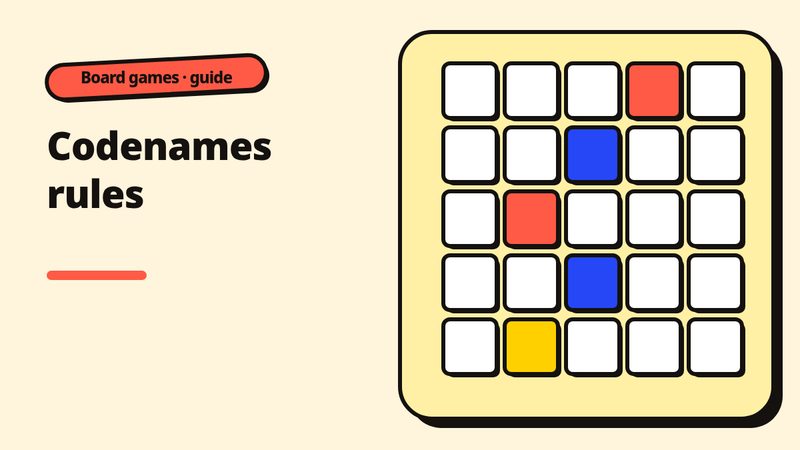
The key card shows which words belong to which team, and it also marks where the 7 innocent bystanders and the single assassin are hiding in the grid.
How a turn works
Teams take turns, starting with the team shown on the key card.
- The spymaster gives 1 clue. A clue is 1 word and 1 number. The word links to some of your team's words. The number says how many.
- The operatives talk it over. Then one of them touches a card as the guess.
- The spymaster covers the card. Use the tile that matches its color on the key.
- Keep going or stop. A right guess lets you guess again. You must make at least 1 guess each turn.
Here's an example. ROOT and BARK are red words. The red spymaster says "tree: 2." The operatives guess ROOT, which is red. Then they pick APPLE instead of BARK. APPLE is red too, so the guess counts. The spymaster just covers it and keeps a straight face.
When a guess goes wrong
- An innocent bystander ends your turn.
- The other team's word ends your turn and helps them.
- The assassin makes your team lose right away. Ouch.
The plus-one rule
While you keep guessing right, you may make 1 more guess than the clue's number. So "cold: 3" allows up to 4 guesses. The extra guess helps you pick up a word you missed on an earlier turn.
How to win
Your team wins when all of your words are covered. Often you'll win by guessing your last word. You can also win if the other team guesses your last word for you. And if the other team finds the assassin, your team wins at once.
What makes a clue valid
The clue has to be about meaning. It can't point at letters or at where a card sits on the table. So "b: 3" isn't allowed for BED, BUG and BOW.
- No forms of a visible word. While BREAK is uncovered, you can't say break, broken or breakdown.
- No parts of a compound on the table. While HORSESHOE is showing, horse and shoe are out.
- English only, unless your group would use the foreign word in an English sentence.
- No accents or tunes used as a hint.
- Sound-alikes count only when they're about meaning. Your group may agree to allow all of them.
When you aren't sure, ask the other spymaster quietly, so the operatives can't hear. If they allow it, it's valid. Simple.
An invalid clue ends that team's turn with no guesses. The other spymaster may also cover one of their own words. If nobody notices until later, the clue stands.
Expert clues
- Unlimited clue. Say "unlimited" instead of a number. Your operatives may guess as long as they keep getting it right.
- Zero clue. A clue like "feathers: 0" means none of your words relate to feathers. It also allows unlimited guesses.
Playing with 2 or 3 people
The 2025 rulebook needs 2 teams of at least 2 players. For 2 or more players working together, the publisher makes Codenames Duet. It's a cooperative version with 400 more words, and its cards can mix with Codenames.
How it compares
| Game | Players | Play time | Age | Complexity | Source |
|---|---|---|---|---|---|
| Codenames | 4–8+ | 15 min | 10+ | Light | Publisher website, rulebook |
| Ticket to Ride | 2–5 | 30–60 min | 8+ | Light | Rulebook |
| Catan | 3–4 (5–6 with expansion) | 60–90 min | 10+ | Medium | Publisher website, rulebook |
Codenames is the one for a crowd. Teams can grow as big as your living room allows, and a whole game fits into the time it takes to order pizza. Ticket to Ride and Catan seat fewer people and run longer.
Common Rules Questions
Can operatives guess a word from an earlier clue?
Yes. They can guess words from a previous turn's clue, even with their first guess. The plus-one rule exists for exactly this. The spymaster can't remind them which words they missed.
Can the spymaster react while the team is talking?
No. Spymasters keep a straight face and don't reach for a tile until a card is touched. If a guess is right by accident, act like it was planned.
Can a team stop guessing early?
Yes. After at least 1 guess, a team can end its turn whenever it likes. Stopping is often wiser than a risky last guess. No shame in it.
Are proper names allowed as clues?
One-word names are always valid. Your group can agree to allow longer names, such as New York, and even titles.
Can you give a clue with two words?
Usually not. One-word compounds like greenhouse are fine. Clues like mother-in-law or alarm clock need the other spymaster's OK. Your group can also agree to allow common abbreviations, like NASA.
If you like Codenames, try these
For a calmer game at a smaller table, read our Ticket to Ride guide. For trading and building, try Catan. For a quick card game, try Sushi Go. For a team game where everyone is on one side, try Pandemic. Everything else is in our board games section.
Sources
- Czech Games Edition, Codenames rulebook (2025 edition)
- Czech Games Edition, Codenames game page (players, age, play time and box contents)
- Days of Wonder, Ticket to Ride rules (2025 edition)
- CATAN GmbH, CATAN game page and rulebook, 6th edition
How we check rules and build the intro card: our methodology.