How to Play Mahjong: Which Book Covers the Rules You Play
As an Amazon Associate, Rulenook earns from qualifying purchases.
How to play mahjong with a book that matches your table: compare books by rules version, tile count, charts and format, and learn free. A rule book teaches the version it was written for. Count the tiles before you buy. 152 tiles with jokers point to an American book. 144 tiles point to Chinese or Hong Kong. 136 tiles point to Japanese riichi. The rules are free here. A book adds drills, charts and a reference for the table.
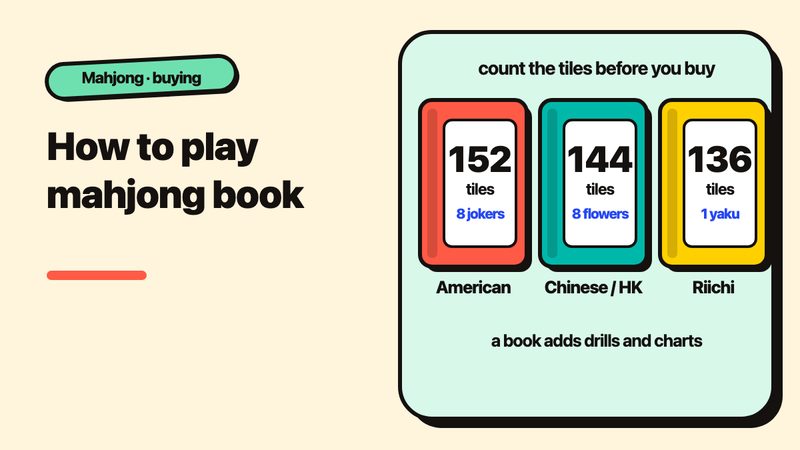
Which rules version does your table play?
Tile count settles the question faster than the cover title. Open the box. Read the label.
152 tiles with 8 jokers is the American game. 144 tiles, 8 of them flowers and seasons, is the Chinese and Hong Kong game. 136 tiles is Japanese riichi. One number tells you which family of rules a book has to teach.
| Rules version | Tiles | Jokers | Before the first draw | Winning hand | Chapters the book needs | Free rules page |
|---|---|---|---|---|---|---|
| American (NMJL) | 152 | 8 | The Charleston | Match the year's card | Tile count and jokers, the Charleston, reading the card | American rules |
| Chinese / Hong Kong | 144 | None | None | 4 sets and 1 pair | Calls, fan values, the payment table | Chinese rules, scoring |
| Japanese riichi | 136 | None | None | 4 sets and 1 pair and at least 1 yaku | Riichi, yaku, fu and han | Japanese mahjong |
| Mixed edition | As printed | As printed | As printed | As printed | Tile sets, calls, the basic flow | Mahjong hub |
The counts in this table come from our own rule pages, read 2026-11-10: tiles explained, American rules, Chinese rules and Japanese mahjong.
Two traps sit between a search and a usable book.
The first is the word mahjong in the title. Single-player tile-matching puzzles sit next to the rule books in the same search, and a puzzle book teaches nothing about a 4-player hand.
The second is the Chinese and Hong Kong row. A book can teach hands and calls without printing fan values, so the money end of the game goes unanswered.
The tile count page takes each set apart tile by tile. That tells you where your own set belongs and which row of table A applies.
Should you learn the hand before you buy the book?
Three steps, in this order.
- Read the free page for your version first. The last column of table A has the link, and one hand from start to finish shows you whether the rules feel right.
- Then buy the book that matches that version. Its drills, charts and index earn their place once you can already follow a hand.
- Keep the tiles separate from the book. A rule book assumes that you own a set already, and the set guide covers the tile count, the size and the racks.
One test settles it. If the version in the book differs from the rules your table plays, the book is only reading. When the two match, it becomes the rule book for your table.
What to check on the cover and in the contents
Thirty seconds is enough. It rules a title in or out. Table B holds 9 checks. Each one can be answered from the listing, the copyright page or the contents.
| # | What to check | Where to look | What it proves | If it is missing |
|---|---|---|---|---|
| 1 | The rules version name | Listing, copyright page, contents | Which version of mahjong the book teaches | You find out on page 2 that it is the wrong book |
| 2 | The tile count: 152, 144 or 136 | Listing or contents | Which deck the hand chapters use | Your hand arithmetic is off |
| 3 | Jokers | Listing or contents | Whether the book covers the American game | Your table uses jokers you cannot look up |
| 4 | The Charleston | Contents | Whether the pre-game pass is taught | The first 2 rounds stall |
| 5 | Scoring: a fan table or a payment table | Contents or inside pages | Whether you can work out what a hand pays | Nobody can say what it pays |
| 6 | A glossary and pinyin | Contents | Whether you can read tiles and fan names | The contents page stops you at chapter 1 |
| 7 | Exercises and answers | Contents or the appendix | Whether there is anything to practise against | You read and forget |
| 8 | The copyright year and edition | Copyright page | Which year of the rules the text follows | The rules have moved since the book was printed |
| 9 | Whether it is a single-player puzzle | The title and the listing | Whether the book is the 4-player game at all | The whole book is about a different game |
Row 8 needs a word of its own. American rules follow the card the National Mah Jongg League prints each year, so the copyright year tells you which card the text was written against. A listing with no release date shows not printed, not a guess.
One more line belongs on the list. A rule book does not bring tiles. The set is a separate purchase. Its size and rack fit sit on the tile size guide.
Books that teach American (NMJL) play
Three parameters separate this group: 152 tiles, 8 jokers, and the Charleston before the first draw. A listing that prints none of the 3 leaves you to check the sample chapter yourself. Read a missing line as a question, not a detail.
Both titles above print the rules version and nothing about the setup. Confirm the tile count, the joker rule and the Charleston before a book leaves the shelf.
Books that teach Chinese and Hong Kong play
The tiles are the easy half: 144 tiles, no jokers, and 8 flowers and seasons inside that count. The hard half is the score. Fan values decide what a hand is worth. A book without them leaves you half the game.
The scoring page carries the fan tables. A book that stops at the winning hands still leaves the money answerable somewhere.
Books that teach Japanese riichi
Riichi counts differently. The set holds 136 tiles, and a winning hand needs 4 sets and 1 pair plus at least 1 yaku. The score comes from fu and han. A Hong Kong fan table will not help you read a riichi result.
Our Japanese mahjong page sets out the same 136 tiles: the wall, the calls and the point tables.
Books that mix styles, and strategy titles
Two kinds of book end up here, and each listing says which kind it is.
A mixed-style book covers more than one version of mahjong, so it usually stops short in each one. Jokers, the Charleston and a fan table are the items that differ from style to style, and the listing below prints none of the 3.
A strategy title names the strategy side of the game. This listing says American mah jongg and strategies, and its subtitle calls the book a guide for the novice player. It prints no tile count and no joker line, and the record carries no chapter list, so how much of the setup it repeats is a sample-chapter question.
Both kinds need the same check afterwards. Compare the tile count the book prints with the tile count on your table.
What the shortlist covers, and what it leaves out
Table C scans 8 listings. Each row is 1 book. Each cell is a word the listing's title prints. A cell that reads not printed means the title says nothing about that item. The rows sit in group order, and none sits above another.
| Book (listing title, shortened) | Release year | American | Chinese / HK | Japanese | Tiles | Joker | Charleston | Scoring | Glossary | Practice |
|---|---|---|---|---|---|---|---|---|---|---|
| A Beginner's Guide to American Mah Jongg | 2007 | American | not printed | not printed | not printed | not printed | not printed | not printed | not printed | not printed |
| Play Mahjong!: An All-Levels Guide | 2025 | American | not printed | not printed | not printed | not printed | not printed | not printed | not printed | not printed |
| Winning American Mah Jongg Strategies | 2012 | American | not printed | not printed | not printed | not printed | not printed | not printed | not printed | not printed |
| Hong Kong Mahjong The Faanwise Method | not printed | not printed | Hong Kong | not printed | not printed | not printed | not printed | Scoring | not printed | not printed |
| Hong Kong Mahjong For Beginners | not printed | not printed | Hong Kong | not printed | not printed | not printed | not printed | Scoring | not printed | not printed |
| Riichi Mahjong Scoring Made Simple | not printed | not printed | not printed | Riichi | not printed | not printed | not printed | Scoring | not printed | Drill |
| Riichi Mahjong Made Simple | not printed | not printed | not printed | Riichi | not printed | not printed | not printed | not printed | not printed | not printed |
| The Complete Book of Mah Jongg | 2016 | Mah Jongg | Asian | not printed | not printed | not printed | not printed | not printed | not printed | not printed |
Table C reads the listing titles only, captured 2026-11-10. The release year is the date the listing prints, and not printed means the listing carries none. Every label stops at the subtitle, so the column holds the first part of each listing title. A cell that reads not printed says nothing about the chapter inside; the sample chapter does.
The search behind those 8 rows is on the record. On 2026-11-10 we ran 9 Amazon searches: mahjong book, american mahjong book, mahjong rules book, mahjong for beginners book, mahjong strategy book, chinese mahjong book, hong kong mahjong book, riichi mahjong book and mahjong solitaire. Each search returned 10 listings, 90 in all, and 50 were different titles.
14 of the 50 were dropped before the shortlist: 3 single-player tile puzzles, 6 solo practice boards, 1 card game, 3 quick-reference cheat sheets and 1 children's title with no rules parameters. 36 candidates were left.
Their titles name 1 rules version in 14 American cases, 10 Chinese or Hong Kong cases and 6 riichi cases. The other 6 name 2 versions or none. Table C keeps 8 of those 36: 3 American, 2 Chinese or Hong Kong, 2 riichi and 1 mixed-style title. 6 of the 8 are the books in the boxes above.
Learn mahjong free, without a book
3 routes reach the same rules. Each one stops at a different point.
- The free pages on this site. The American rules page covers the 152-tile game, the Charleston and the card. How to play mahjong covers the 144-tile Chinese and Hong Kong game. How to score mahjong holds the fan tables. Japanese mahjong sets out the 136-tile riichi game.
- The publisher's own page. A publisher site carries the table of contents, and often a sample chapter. That page answers rows 4 to 7 of table B before you spend anything.
- The library. Search the catalogue by title and publisher. A branch can order a title it does not hold.
Three more free pages sit next to those. Mahjong for 2 or 3 players covers the short-handed walls. Mahjong tiles explained takes the 136, 144, 152 and 166 sets apart. The set guide covers buying one. 7 pages to read, nothing to pay.
The free page and the book cover different ground. A free rule page gives you the rule as published. A book gives you drills, chart practice and something to hold beside the tiles. Neither one replaces the other.
What to read next
- Mahjong hub: choose the style first.
- American mahjong rules: the 152-tile game, jokers and the Charleston.
- Chinese and Hong Kong mahjong: the 144-tile game and fan values.
- How to score mahjong: the fan and payment tables.
- Mahjong for 2 or 3 players: the short-handed variants.
- Mahjong tiles explained: 136, 144, 152 and 166, tile by tile.
- How to choose a mahjong set and the tile size guide: the buying parameters.
- Racks, pushers and accessories: the rest of the table.
Sources: the rules version, format and release date columns in table C come from the 8 listings scanned on 2026-11-10, one record per book.
Tile counts, jokers, the Charleston, the fan values and the yaku rule come from our published pages: tiles explained, American rules, Chinese rules, scoring and Japanese mahjong, read 2026-11-10. Table A, table B, the keyword scan behind table C and the 2 figures are recomputed from those sources. How we check numbers: our methodology.
Sources
- Amazon listing records for 8 mahjong rule books (title, itemDimensions, releaseDate), read 2026-11-10
- rulenook, Mahjong tiles explained (/mahjong/mahjong-tiles-explained/), 136 / 144 / 152 / 166 tile counts, read 2026-11-10
- rulenook, American mahjong rules (/mahjong/american-mahjong-rules/), 152 tiles, 8 jokers, the Charleston, the yearly NMJL card, read 2026-11-10
- rulenook, How to play mahjong (/mahjong/how-to-play-mahjong/), 144 tiles, 4 sets and 1 pair, read 2026-11-10
- rulenook, How to score mahjong (/mahjong/how-to-score-mahjong/), fan tables, read 2026-11-10
- rulenook, How to play Japanese mahjong (/mahjong/how-to-play-japanese-mahjong/), 136 tiles, at least 1 yaku, fu and han, read 2026-11-10
- Site recomputation (table A, table B, table C keyword scan, catalogue counts, figure numbers)