How to Choose a Mahjong Set: Tile Count, Size, Racks and Case Compared
As an Amazon Associate, Rulenook earns from qualifying purchases.
Choose the style first. Then count the box. An American (NMJL) game needs 152 tiles in play, 8 of them jokers, and 4 racks.
A Chinese or Hong Kong game needs 144 tiles and no jokers. A Japanese riichi set holds 136 tiles, and it uses point sticks instead of racks.
The style settles the count. The count settles which set you can buy. A 144-tile Chinese set cannot play American rules without 8 added jokers.
That order saves money. You lose it on a set that cannot play your game. An American box carries 14 tiles a Hong Kong table never uses.
Count first. Then match the tiles to your racks. Then read the material.
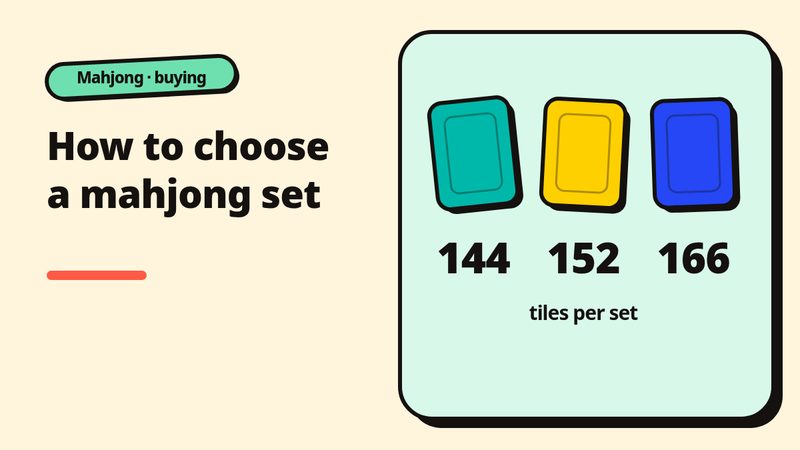
Which tile count does your game need?
Our assumptions. A 166-tile box is the common American case, and a 144-tile box is the Chinese case. Every count below comes from our own rule pages or from a listing we read.
Table A sets the 4 styles side by side.
| Style | Tiles in play | Tiles in a typical box | Jokers in play | Racks | Dice | Yearly card |
|---|---|---|---|---|---|---|
| American (NMJL) | 152 | 166 | 8 | 4, usually with pushers | 2 or 3 | 1 NMJL card per player |
| Chinese / Hong Kong | 144 | 144 | None | Optional | 2 or 3 | None |
| Japanese riichi | 136 | 136 | None | Not used, point sticks instead | 2 | None |
| One box for American and Hong Kong | 152 | 166 | 8 | 4 | 2 or 3 | 1 NMJL card per player |
Source: our rule pages (tiles explained, American rules, how to play mahjong, Japanese mahjong), read 2026-11-11, and the 4 Amazon listings on this page, read 2026-11-13.
Both American listings we read print the same contents: 36 dots, 36 bams, 36 craks, 12 dragons, 16 winds, 16 flowers, 10 jokers and 4 blank spares. Add them and you get 166.
Only 152 of those tiles reach the wall. Set aside 8 of the 16 flowers, 2 of the 10 jokers and all 4 blanks.
What stays is 108 suit tiles + 16 winds + 12 dragons + 8 flowers + 8 jokers = 152. The 14 tiles left over are spares, and they belong in the box while you play. Spares stay in the box.
Our tile count page lists the same breakdown category by category.
Two other numbers turn up in shops. A Singapore or Malaysian set adds 4 animal tiles to the 144, for 148. A riichi set often swaps one 5 in each suit for a red 5, which changes no totals at all.
Official rule: 8 jokers and 8 flowers go into play. Common house rule: a group that wants all 10 jokers, or all 16 flowers, agrees on it before the first hand. Both change how often hands come together.
What should be in the box?
Table B lists the pieces. The middle 2 columns matter: what the American game needs, and what a Chinese or Hong Kong game needs.
| Piece | American | Chinese / Hong Kong | Where it comes from |
|---|---|---|---|
| Suit tiles: 3 suits x 9 ranks x 4 | 108 | 108 | In the box |
| Winds 16, dragons 12 | 28 | 28 | In the box |
| Flowers and seasons | 8 in play, 16 in the box | 8 | In the box |
| Jokers | 8 in play, 10 in the box | None | In the box |
| Blank spares | 4 | Useful | In the box |
| Racks with pushers | 4 | Optional | American boxes only |
| Dice | 2 or 3 | 2 or 3 | In the box |
| Wind indicator | Useful | Useful | Sometimes in the box |
| Case | Hard case or soft bag | Any | In the box |
| NMJL card | 1 per player | Not used | Sold yearly by the League, never in a set |
Source: the 2 American listings and the Chinese listing read 2026-11-13 for the tile and case lines, our racks and accessories page for the racks, dice, indicator and card.
Two pieces are never in the box. The NMJL card is one. Racks for a Chinese set are the other.
One worked check ties the count to a real listing. The listing reads 166 tiles: 36 dots, 36 bams, 36 craks, 16 winds, 12 dragons, 16 flowers, 10 jokers and 4 blanks.
108 + 16 + 12 + 16 + 10 + 4 = 166. You play with 152 of them.
The travel listing on this page reads 160 tiles: 36 dots, 36 bams, 36 craks, 16 winds, 12 dragons, 8 flowers, 10 jokers and 6 blanks.
160 - 152 = 8 spares, so it still covers an American game. It holds no spare flowers though, so a lost flower tile has to be replaced before the next game.
How do you check a set before you buy?
4 checks on one listing. Take them in this order.
- Add up the contents. 108 suits + 16 winds + 12 dragons + 8 flowers + 8 jokers = 152 for an American game.
- Find the joker line. A listing that says "no jokers" is a Chinese set, whatever the title claims.
- Multiply the tile width by 19. Then compare the result with the inside length of your rack.
- List what is not in the box. The NMJL card, and the racks for a Chinese set, you buy separately.
Will the tiles fit your racks?
Our assumptions. American racks hold a wall of 19 stacks, and one set's racks are listed at 18 in. inside length. The tile widths are the ones our tile size guide lists, measured in mm from seller listings.
Table C multiplies each width by 19.
| Tile width | 19 stacks | Fits an 18 in. rack? |
|---|---|---|
| 22.2 mm (7/8 in.) | 421.8 mm, 16.6 in. | Yes |
| 23 mm (0.9 in.) | 437 mm, 17.2 in. | Yes |
| 25 mm (0.98 in.) | 475 mm, 18.7 in. | No |
| 29.5 mm (1.16 in.) | 560.5 mm, 22.1 in. | No |
Source: tile widths from the seller listings behind our size guide, read 2026-10-10, and the rack length from the rack listing on the same page. The multiplication is ours.
The rule is short. Multiply the tile width by 19, then compare with the rack's inside length. Shorter fits. Longer does not.
Our racks page works the same sum for one set's 18 in. rack.
Thickness is the second number, and listings tend to skip it. Rack ledges are cut for tiles about 13 mm thick. A 21 mm Chinese tile can sit at an angle when you push the wall out.
Measure one tile. If you have a ruler, check the width before you order.
How much table do the walls need?
The wall square follows from the same multiplication, because each wall is as long as 19 American stacks or 18 Chinese ones.
| Game | Wall | One side of the wall square |
|---|---|---|
| American, 23 mm tiles | 19 stacks | 437 mm, 17.2 in. |
| American, 25 mm tiles | 19 stacks | 475 mm, 18.7 in. |
| Chinese, 29.5 mm tiles | 18 stacks | 531 mm, 20.9 in. |
Source: the stack counts come from our setup and rule pages, and the products are ours.
Size the table before you order. A 21 in. wall square already crowds a small card table.
Table space is where large tiles lose. The Chinese listing on this page prints tiles at 1 5/12 x 1 1/8 x 7/8 in. (3.6 x 2.8 x 2.2 cm). Its 1 1/8 in. width x 18 stacks makes a wall side of 20.25 in., a bit under the 20.9 in. Chinese row in Table D. The stack count decides the answer either way.
What are mahjong tiles made of?
Modern sets are melamine, acrylic or another plastic. Table E lists the materials on this page and where each one shows up.
| Material | Where it shows up | What to check on the listing |
|---|---|---|
| Melamine | The 2 American sets and the Chinese set on this page | Engraved faces; one listing says hand-painted |
| Bone and bamboo | Vintage sets, mostly 1920s to 1960s | Tile count, because old sets often lack jokers |
Source: the material wording on the 3 listings read 2026-11-13, and our tile materials page for the vintage lines.
Material changes how a tile wears. It does not change the scoring. The 2 American listings and the Chinese listing describe melamine tiles with engraved faces. The aluminum-case set also says the faces are hand-painted.
Our tile materials page shows how to tell a bone tile from a celluloid one.
Which set fits which table?
Table F sorts 5 situations by what you need in the box.
| Situation | Look for | Watch out for |
|---|---|---|
| New to an American group | 166 tiles, 10 jokers, 4 racks with pushers, Arabic numerals on the tiles | Sets listed as Chinese or 144 tiles, which cannot hold the 152 in play |
| Family Hong Kong games | 144 tiles, readable corner numbers, hard case | Racks and jokers you will never use |
| One set for both styles | 166 tiles, and take the jokers and spares out for Hong Kong | A 160-tile travel set leaves 8 spares and no spare flowers |
| Travel and small tables | Tiles near 26 x 18 x 12 mm, a soft case, a weight on the listing | Travel racks that hold 16 tiles rather than 19 |
| Players who read small tiles slowly | Tile width and rack length both printed | Large tiles with standard racks, unless the seller confirms the fit |
The rows pull in opposite directions. Read them against your own table. Pick the row that matches your table.
A Hong Kong table has no use for a pusher and no use for a joker. A 144-tile set with a case is the cheaper answer. An American table needs the 152 in play, and the 4 racks are not optional.
Why do American sets cost more than Chinese sets?
Count the box first. A typical American set has 166 tiles against 144.
It usually includes 4 racks with pushers, which a Chinese set often leaves out. Jokers and the Arabic-numeral corner marks that match the NMJL card are made for the American market. A Chinese set cannot simply be relabeled and sold as one.
The NMJL card is separate. It is a yearly purchase on top of the set.
Sets to compare by specification
4 listings sit in 3 groups below. Group 1 holds 2 American sets, group 2 holds 1 Chinese set, group 3 holds 1 travel set.
Each box states the parameters to check on the listing. Product names, links and images load from the Amazon API. That happens when the page is built.
| Listing | Tiles in the box | Tile size | Material | Racks | Case |
|---|---|---|---|---|---|
| 1. American set, blue carrying bag | 166 | 1.2 x 0.9 x 0.5 in. | Melamine | 4 rack and pusher units | Soft carrying bag |
| 2. American set, aluminum case | 166 | 1-3/16 x 7/8 x 1/2 in. | Melamine | 4 rack and pusher units | Aluminum case |
| 3. Chinese set, numbered | 146 | 1 5/12 x 1 1/8 x 7/8 in. | Melamine | None | Travel case |
| 4. Travel American set | 160 | 26 x 18 x 12 mm | not printed | 4 travel racks, 16 tiles each | Canvas bag and gift box |
Source: the 4 Amazon item records read 2026-11-13 (title, feature bullets and productInfo). A cell that reads not printed means the record carries no such line.
American sets, 166 tiles with racks
Chinese and Hong Kong sets, 144 tiles
Travel sets
What to read next
- American mahjong rules: the 152-tile game, jokers and the yearly card.
- Mahjong tiles explained: 136, 144, 152 and 166, tile by tile.
- Mahjong tile sizes compared: the widths and heights sellers list.
- Mahjong racks, pushers and accessories: the 4 racks and the rest of the table.
- Jokers in American mahjong: where a joker may and may not go.
- How to set up mahjong: the wall the set has to fill.
- All mahjong rules
Sources: tile counts, the jokers in play, the walls of 19 and 18 stacks and the yearly NMJL card come from our published rule pages, read 2026-11-11.
Tile sizes, materials, contents lists, case types and hardware come from the 4 Amazon item records listed in the front matter, read 2026-11-13.
Tables A, C, D and G, the rack-fit sums and the contents sums are our arithmetic, rechecked against those records. Tables B, E and F carry the source line printed under each one. How we check numbers: our methodology. Last updated 2026-11-13.
Sources
- Amazon item records for 4 listings: B0D2TVXS2W, B00H2RHIAO, B0CCN3HF1Z, B0H59XW1VD (title, feature bullets, productInfo), read 2026-11-13
- rulenook, Mahjong tiles explained (/mahjong/mahjong-tiles-explained/), 136 / 144 / 152 / 166 tile counts and the spare breakdown, read 2026-11-11
- rulenook, American mahjong rules (/mahjong/american-mahjong-rules/), 152 tiles in play, 8 jokers, walls of 19 stacks, the yearly NMJL card, read 2026-11-11
- rulenook, How to play mahjong (/mahjong/how-to-play-mahjong/), 144 tiles, walls of 18 stacks, read 2026-11-11
- rulenook, Mahjong tile size guide (/mahjong/mahjong-tile-size-guide/), tile widths in mm and the 18 in. rack check, read 2026-11-11
- rulenook, Mahjong racks, pushers and accessories (/mahjong/mahjong-racks-pushers-accessories/), 4 racks, dice, wind indicator, NMJL card, read 2026-11-11
- rulenook, Mahjong tile materials (/mahjong/mahjong-tile-materials/), melamine, acrylic, bone and bamboo, read 2026-11-11
- Site recomputation (table A, table C, table D, table G, the contents sums and the figure numbers)