How to Play Japanese Mahjong (Riichi): Setup, Calls, Scoring and Winning
As an Amazon Associate, Rulenook earns from qualifying purchases.
Japanese mahjong (riichi) uses 136 tiles and 4 sets plus 1 pair to win. Setup, calls, riichi, yaku, han, fu and point payments, counted out. The trap is that another game's rules look familiar: American mahjong runs on 152 tiles with jokers, and Hong Kong mahjong runs on fan. Everything below follows the European Mahjong Association riichi rules.
What you need to play Japanese mahjong
Five things sit on the table.
| Item | Count or size |
|---|---|
| Tiles | 136 = 108 suit, 16 winds, 12 dragons |
| Dice | 2, rolled by the dealer |
| Table | Room for 4 walls of 17 stacks |
| Scoring sticks | 100, 1,000, 5,000, 10,000 points; the stake is one 1,000 |
| Mat or river tray | 1, so discards stay in order |
Tile size decides if a set fits your racks. The set below lists tiles at 1.2 x 0.9 x 0.7 in (30 x 23 x 18 mm). The tile size guide has the rest.
Seats are fixed: East, South, West, North. The set guide sorts the styles.
How the wall is built and the hand is dealt
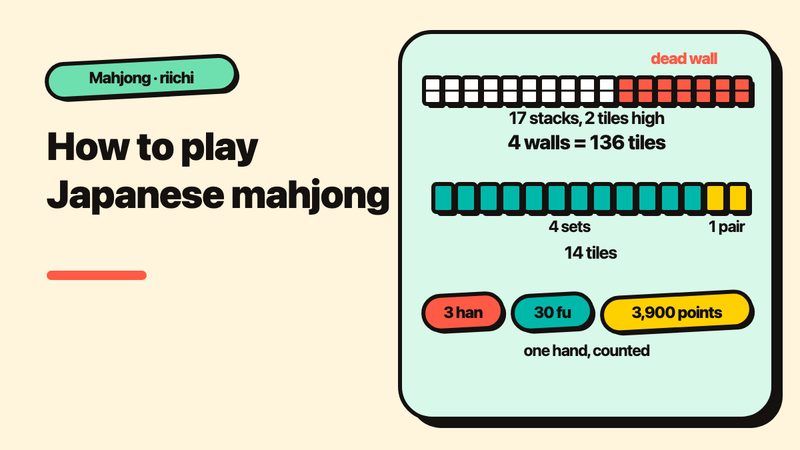
- Mix the tiles face down. Build 4 walls of 17 stacks, 2 tiles high: 17 × 2 × 4 = 136.
- The dealer rolls 2 dice and counts that many players counter-clockwise. That player breaks the wall, and the 7 stacks beside it become the dead wall.
- Deal 4 tiles at a time until everyone holds 12. Give each player 1 more, and the dealer takes 1 more.
- Turn over the top tile of the third stack in the dead wall. It is the dora indicator.
Table A compares the three wall sizes.
| Style | Stacks per wall | 4 walls | Arithmetic |
|---|---|---|---|
| Japanese riichi | 17 | 136 | 17 × 2 × 4 = 136 |
| Chinese / Hong Kong | 18 | 144 | 18 × 2 × 4 = 144 |
| American (NMJL) | 19 | 152 | 19 × 2 × 4 = 152 |
The riichi row follows the EMA wall of 17 stacks. The Chinese row is the 144-tile set on our Chinese page, and the American row the 152-tile wall on our American page.
The 136 tiles divide into three parts. The dead wall holds 14, so 122 tiles sit in the live wall before the deal. The hands hold 53 after it, leaving 69 to draw from.
How to win: 4 sets and 1 pair
A complete hand is 4 sets and 1 pair: 14 tiles. A set is a chow (3 in a row in one suit), a pung (3 alike) or a kong (4 alike), and a kong counts as one set. Chows never wrap: 8-9-1 is not a chow, and dragons and winds never take part in one.
You win by ron, taking the tile from a discard, or by tsumo, taking it from the wall. The shape must be right, and the hand must carry at least one yaku. Seven pairs and thirteen orphans skip the 4 sets and 1 pair rule.
Furiten can block a win. If one of your own discards would have completed your hand, you cannot claim a win on a discard. A self-draw still wins while furiten.
Table D lists the yaku a table needs at the start. The han values follow the World Riichi Championship list.
| Yaku | Han | Condition |
|---|---|---|
| Riichi | 1 | Closed waiting hand, 1,000-point stake |
| Ippatsu | 1 | Win before the next draw is interrupted |
| Menzen tsumo | 1 | Self-draw with a closed hand |
| Pinfu | 1 | 4 chows, a plain pair, two-sided wait |
| Tanyao | 1 | No terminals, no honours |
| Yakuhai | 1 each | Dragon, seat wind or prevailing wind |
| Chiitoitsu | 2 | 7 different pairs, closed hand |
| Chinitsu | 5 open, 6 closed | One suit, no honours |
| Yakuman | Limit hand | Thirteen orphans, 4 concealed triplets |
Riichi: what declaring it changes
A riichi declaration says the hand is waiting for 1 tile and will not change: the player says riichi, turns the discard sideways and puts a 1,000-point stick on the table.
Three conditions apply. The hand must be closed, with no called melds in it. At least 4 tiles must be left in the wall. In the EMA rules a first-turn declaration is allowed and adds daburu riichi.
The cost is real. After the declaration the hand is frozen, and a concealed kong is the only change the rules allow.
The return is 1 han for the riichi, plus ippatsu when the win comes before the next draw is interrupted, plus ura dora: the tiles under the dora indicator turn over when a riichi player wins.
The stake moves with the hand. The declarer takes the 1,000 points back after a win. Otherwise the winner collects the stick, and one left after a drawn game waits for the next winner.
Calls: chi, pon and kan
Three calls take a tile from a discard. Chi takes 3 tiles in a row from the player on the left. Pon takes 3 identical tiles from any player.
A kan comes in 3 versions: 4 tiles in your hand, 3 plus a discard, or a pon you already laid down.
Every kan has 2 consequences. You draw a replacement tile from the dead wall, which always holds 14 tiles, and a new dora indicator turns over.
Calls have a fixed priority. A win beats a pung or a kong, and a pung or a kong beats a chi. Swap-calling is not allowed.
None of this is compulsory. A hand with no calls at all is legal. But a called meld opens the hand, and an open hand can never declare riichi.
How the points are worked out
Our assumptions for the tables below:
- A hand is worth points, not fan; the points come from han and fu.
- Base points = fu × 2^(2 + han). Every payment starts there.
- A ron is 4 times the base points for a non-dealer, and 6 times for the dealer. A tsumo splits the base three ways, and the dealer pays double.
- Every payment is rounded up to the next 100. At 5 han or more the fu count stops mattering.
Table B is the fu count. Fu and han are counted separately, then looked up together. Round up to the next 10 fu, except for seven pairs.
| What you count | Fu | When it applies |
|---|---|---|
| Base | 20 | Every hand except seven pairs |
| Closed ron | +10 | Closed hand won on a discard |
| Self-draw | +2 | Not with pinfu |
| Open hand, no other fu | +2 | Nothing else to add |
| Triplet of 2 to 8 | +2 open, +4 concealed | Pung of simples |
| Triplet of terminals or honours | +4 open, +8 concealed | Pung of 1s, 9s, winds, dragons |
| Kong of 2 to 8 | +8 open, +16 concealed | Kong of simples |
| Kong of terminals or honours | +16 open, +32 concealed | Kong of 1s, 9s, winds, dragons |
| Dragon, seat wind or prevailing wind pair | +2 each, +4 for a double wind | A valued pair |
| Edge, closed or single wait | +2 | 1-2 on 3, 8-9 on 7, chow middle, pair |
| Seven pairs | 25 flat | No additions, no rounding |
Table C reads the han and the fu together. Each cell is the points a non-dealer collects on a ron.
| Han \ Fu | 20 | 25 | 30 | 40 | 50 | 60 |
|---|---|---|---|---|---|---|
| 1 | not possible | not possible | 1,000 | 1,300 | 1,600 | 2,000 |
| 2 | not possible | 1,600 | 2,000 | 2,600 | 3,200 | 3,900 |
| 3 | not possible | 3,200 | 3,900 | 5,200 | 6,400 | 7,700 |
| 4 | not possible | 6,400 | 7,700 | mangan | mangan | mangan |
The 20-fu column has no ron value: a 20-fu hand is a pinfu won by self-draw. Those hands pay 400/700 (2 han), 700/1,300 (3 han) and 1,300/2,600 (4 han) on a self-draw, each non-dealer then the dealer. A 25-fu hand is seven pairs, so 1 han and 25 fu cannot meet. From 5 han the limit ladder takes over.
Table C2 gives the limit ladder, which replaces the fu count.
| Limit hand | Han | Ron, non-dealer | Ron, dealer | Tsumo, non-dealer | Tsumo, dealer |
|---|---|---|---|---|---|
| Mangan | 5 | 8,000 | 12,000 | 2,000/2,000/4,000 | 4,000 each |
| Haneman | 6 to 7 | 12,000 | 18,000 | 3,000/3,000/6,000 | 6,000 each |
| Baiman | 8 to 10 | 16,000 | 24,000 | 4,000/4,000/8,000 | 8,000 each |
| Sanbaiman | 11 to 12 | 24,000 | 36,000 | 6,000/6,000/12,000 | 12,000 each |
| Kazoe yakuman | 13 | 32,000 | 48,000 | 8,000/8,000/16,000 | 16,000 each |
| Yakuman | Limit hand | 32,000 | 48,000 | 8,000/8,000/16,000 | 16,000 each |
A hand reaches mangan on 3 han and 70 fu, on 4 han and 40 fu, or on 5 han with any fu. The tsumo columns list the two non-dealers, then the dealer.
One hand, counted in 7 steps: 2m 3m 4m, 3s 4s 5s, 6p 7p 8p, 7s 8s 9s and a pair of 5p, won by ron on a 4m.
| Step | What you count | The numbers |
|---|---|---|
| 1 | The tiles | 3 + 3 + 3 + 3 + 2 = 14 tiles, 4 chows, 1 pair |
| 2 | How you won | Ron on a 4m, completing the 2m 3m chow |
| 3 | The han | Riichi 1 + pinfu 1 + tanyao 1 = 3 han |
| 4 | The fu | 20 base + 10 closed ron = 30 fu |
| 5 | The table | 3 han and 30 fu = 3,900 points for a non-dealer |
| 6 | Who pays | Ron: the discarder pays 3,900. Tsumo: 1,000/1,000/2,000 |
| 7 | The add-ons | The 1,000-point riichi stick, plus 300 per counter |
Step 4 is the one to slow down on. The wait on 2m 3m is two-sided, so the winning 4m adds no fu, and the pair of 5p is no dragon and no wind, so pinfu counts: 3 han, not 2.
How a hand ends and a game ends
A hand ends 3 ways: someone wins, the wall runs out, or the table calls an early draw. The early draws are nine different terminals or honours on your first turn, four players discarding the same wind, four players declaring riichi, and a fourth quad that leaves no winning discard. On a ron the discarder pays the whole hand; on a tsumo the 3 opponents split it and the dealer pays double.
At an exhaustive draw the 14 dead wall tiles are never used. The nōten players pay the tenpai players, and the exchange totals 3,000 points: 3 tenpai means the nōten player pays 1,000 to each, 2 tenpai means each takes 1,500, 1 tenpai means 1,000 from each of the other three.
Counters sit at the dealer's right hand. One goes down after a draw and after a dealer's win. Each counter adds 300 points, or 100 each on a self-draw.
The dealer keeps the deal after a win and after a tenpai draw. Otherwise the deal passes to South, and the seat winds rotate.
A full game is 2 rounds, East then South. The EMA rules start every player with 30,000 points; the usual range is 20,000 to 30,000. Under those rules the game continues below zero, and many tables end it at zero.
What changes when your table plays riichi
Table E compares the rules, not the tiles; tile counts and joker rules sit on our mahjong hub.
| Rule | Japanese riichi | American (NMJL) | Chinese / Hong Kong |
|---|---|---|---|
| Yaku to win | At least 1 | The card decides | Minimum fan count |
| Riichi declaration | Yes, 1,000-point stake | None | None |
| Chow | Only from the left | Not allowed | Only from the left |
| Dora and ura dora | Yes | None | None |
| Furiten | Yes | None | None |
| Dealer after a win | Repeats | Moves one seat | Keeps the deal |
| Scoring unit | Points from fu and han | The card value | Fan, then points |
| Exhaustive draw | Tenpai and nōten pay 3,000 | Nothing | Nothing |
| Winning call | Ron and tsumo | Mah Jongg | Hu |
The American column follows our American rules page, the Chinese column our Chinese rules page, and the fan table our scoring page.
Official rule vs house rule
Riichi has no single rule book, so tables change things on purpose. Each row names a published rule and the change we found.
| Item | Official rule | Common house rule |
|---|---|---|
| Red fives | EMA 2016 dropped red fives | One red 5 per suit counts as dora |
| Ura dora | Revealed to a riichi winner | Revealed to any winner |
| Kiriage mangan | EMA: 4 han and 30 fu scores 7,700 | Paid as mangan |
| Starting points | 30,000 points each | 25,000 points each |
| Dealer after a win | The dealer repeats | The deal rotates every hand |
| Payment at a draw | The nōten penalty totals 3,000 | No payment at a draw |
| Yaku requirement | At least 1 yaku | Any 4 sets and 1 pair |
| First-turn riichi | Allowed, adds daburu riichi | Not allowed on the first draw |
Common beginner mistakes
- Winning without a yaku. Four sets and a pair is the shape, not the win. Check the yaku table first.
- Calling chi from the wrong seat. Only the player on your left can be chi'ed, and claiming a tile then discarding it is a swap-call.
- Trying to riichi after a pon or a chi. A called meld opens the hand, and an open hand can never declare riichi.
- Changing the hand after riichi. The hand is frozen from the declaration on, and a concealed kong is the only exception.
- Missing the counters and the riichi stick. Each counter adds 300 points, and the winner collects the 1,000-point stick.
- Claiming a ron while furiten. If one of your discards would have completed your hand, you cannot claim the win.
Common Rules Questions
Is Japanese mahjong the same as American mahjong?
No. The tiles and the shape are shared, but the rules are not. American mahjong runs on 152 tiles with 8 jokers and needs the hand to match the yearly card. Riichi runs on 136 tiles and needs at least 1 yaku.
How many players can play?
Four, as the EMA rules are written; the 3-player version drops the characters from 2 to 8, leaving 108 tiles, and bans chow.
Do you need a yaku to win?
Yes, at least 1. The shape alone is not enough, so a plain 4 sets and 1 pair scores nothing. Dora and ura dora add han, but are not yaku.
What is a hand worth?
Count the han, count the fu, then read the two together. The worked example above is 3 han and 30 fu: 3,900 points for a non-dealer who wins on a discard, and 1,000 from each non-dealer plus 2,000 from the dealer on a self-draw.
Read next
- Mahjong rules hub: pick the style.
- American mahjong rules: 152 tiles, jokers, the Charleston.
- Chinese and Hong Kong mahjong: the same tiles, fan scoring.
- Mahjong tiles explained: 136, 144, 152 and 166.
- How to score mahjong: American payments, HK fan tables.
- Mahjong for 2 or 3 players: short-handed walls, 3-player riichi at 108 tiles.
- Set guide, tile sizes, racks: buying parameters.
Sources: the EMA riichi rules (revised 2016) for the wall, the deal, the calls, the fu count and the points tables. Wikipedia, Japanese mahjong, Japanese mahjong scoring rules and Yaku (Japanese mahjong), read 2026-11-10. The wall arithmetic, the fu values and the worked example are recomputed in our notes. How we check numbers: our methodology.
Sources
- European Mahjong Association, Riichi: Rules for Japanese Mahjong (revised 2016), sections 1.3, 1.4, 2.4, 2.5, 2.6, 2.7, 2.8, 3.2, 3.3.1, 3.3.5, 3.3.14, 3.4.2, 3.4.9, 3.4.10, 3.4.11, 4.1.1, 4.1.2, 4.2, 6 (scoring tables), read 2026-11-10
- Wikipedia, Japanese mahjong, en.wikipedia.org/wiki/Japanese_mahjong (136 tiles, four walls of 17 stacks, dead wall of 7 stacks, dora indicator, furiten), read 2026-11-10
- Wikipedia, Japanese mahjong scoring rules, en.wikipedia.org/wiki/Japanese_mahjong_scoring_rules (fu counting, han and fu points table, limit ladder, tenpai and noten payments, counters), read 2026-11-10
- Wikipedia, Yaku (Japanese mahjong), en.wikipedia.org/wiki/Yaku_(Japanese_mahjong) (yaku names and han values, World Riichi Championship ruleset), read 2026-11-10
- Rulenook pages G02 (American rules), G03 (Chinese and Hong Kong rules), G08 (2 and 3 players), read 2026-11-10
- Site recomputation (table A wall arithmetic, table B fu values, table C points table, table C2 limit ladder, worked example, figure numbers)