Domino Rules for 3 Players: Deal, Turns and Scoring
As an Amazon Associate, Rulenook earns from qualifying purchases.
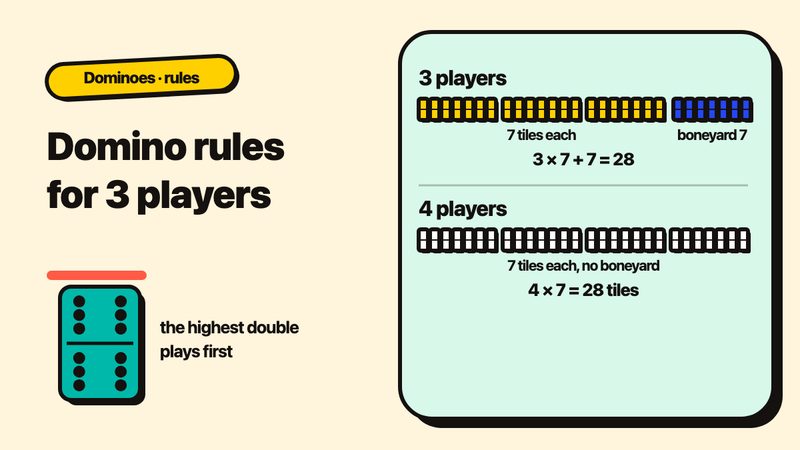
Domino rules for 3 players: 7 tiles each and 7 in the boneyard in the published draw rules. The block rules deal 5 each. They leave 13 over.
A 2-player game deals 7 each, and its boneyard holds 14. A 4-player draw game deals 6 each, with 4 left over.
One exception runs through every version. The last 2 tiles in the boneyard are never drawn. A hand can end before the set is used up.
Three-Player Deal: How Many Tiles Each
Our assumptions, before the table. A double-six set holds 28 tiles and 168 pips. Every tile carries 6 pips on average. That is 168 ÷ 28.
A hand of n tiles averages 6n pips. Rule pages were read on 2026-11-11.
| Deal | Tiles each | Boneyard | Set check | Average pips in your hand | Pips left in the boneyard | Where it comes from |
|---|---|---|---|---|---|---|
| Published draw rules, 3 players | 7 | 7 | 3 × 7 + 7 = 28 | 42 | 42 | PAGAT draw rules |
| Published block rules and draw guide, 3 players | 5 | 13, not used in block | 3 × 5 + 13 = 28 | 30 | 78 | PAGAT block rules; Alex Cramer's guide; PlayBoardGames |
| Published partnership rules, 4 players | 7 | 0 | 4 × 7 + 0 = 28 | 42 | 0 | PAGAT partnership rules |
| Published draw rules, 4 players | 6 | 4 | 4 × 6 + 4 = 28 | 36 | 24 | PAGAT draw rules |
| All 28 tiles dealt, 3 players | 9 + 9 + 10 | 0 | 9 + 9 + 10 = 28 | 54 + 54 + 60 | 0 | Arithmetic only, no rule page prints this deal |
Read the pip columns together and check that the set balances. The 3-player draw deal splits 168 into 42 + 42 + 42 for the hands, plus 42 in the boneyard.
The block deal splits the same 168 into 30 + 30 + 30 and 78. The 4-player partnership deal is 42 × 4 = 168.
The same formula moves to a bigger set. A double-nine holds 55 tiles and 495 pips. Three hands of 7 carry 63 pips each. The 34-tile boneyard carries 306.
A double-twelve holds 91 tiles and 1,092 pips. Three hands of 7 carry 84 pips each. The 70-tile boneyard carries 840. You can check the counts on our domino set sizes page.
The double-six set in the box below counts 28 tiles and 4 wooden racks.
You can use three racks for the three hands. The fourth holds the boneyard.
The set, the chain and one turn are on our domino rules hub. The two-player page holds the 7 + 7 + 14 deal.
Our domino set buying guide sorts the sizes by game.
Setup for Three Players: Shuffle, Deal and Open
- Shuffle all 28 tiles face down. PAGAT's default is clockwise for North America, North and West Europe and Russia. It is counterclockwise for South and East Europe, Asia and Swiss games.
- Deal the hands, then push the rest face down to one side. That pile is the boneyard. Count the pile after the deal. The draw rules leave 7 tiles. The block rules leave 13.
- Find the lead. The player holding the highest double plays first. If nobody holds a double, you shuffle and deal again. PAGAT's Puerto Rico variation names the holder of the [6|6] instead. That double has to go down first.
Official rule: the highest double leads, and a table with no double reshuffles (Alex Cramer's guide). Common house rule: you draw for the lead, or the last winner opens the next one.
That reshuffle rule almost never fires with 3 players. All 7 doubles would have to land in the 7-tile boneyard. There are C(28,7) = 1,184,040 ways to pick 7 tiles from 28. Exactly 1 holds all 7 doubles. The odds sit at about 0.000084%.
A 7-tile hand without a double is far more common. C(21,7) = 116,280 of those 1,184,040 hands hold no double, or 9.82%. So a hand holds a double about 90.18% of the time.
The same count gives 1.75 doubles per 7-tile hand, 7 × 7 ÷ 28. The boneyard holds 1.75 as well, since 7 − 3 × 1.75 = 1.75. Each tile lands in a 7-tile boneyard 25% of the time. That is 7 ÷ 28.
How a Three-Player Turn Works
- Play a tile that fits. Check both open ends of the chain before you lay it. A double goes across the chain, not along it. It is not a spinner.
- Draw when nothing fits. Keep drawing until you can play. Stop when the boneyard is down to 2 tiles. Those last 2 tiles are never drawn. A player with no playable tile passes.
- In the block variant nobody draws. A player who cannot play passes. The boneyard stays face down for the whole round.
- Play around the table. Three hands mean three turns a round. If you pass, the turn goes to the next player.
Official rule: you draw from the boneyard until you can play, and you stop at 2 tiles left (PAGAT draw rules). Common house rule: you draw one tile and hold it for your next turn.
One difference from a 2-player game sits in the middle of the table. The 3-player draw deal leaves 7 tiles in the boneyard. The 2-player deal leaves 14. A 3-player boneyard is half as deep.
Count a double as both halves. The [6|6] carries 12 pips, and the [0|0] carries none.
How a Three-Player Round Ends and Scores
Our assumptions, before the table. The winner takes the pips left in the other two hands. Alex Cramer's guide prints that count. PAGAT's draw rules credit the lowest scorer. The credit is the losers' total less his own total.
The two counts agree when a player goes out. They differ only in a blocked hand.
| What happens | Points | Source |
|---|---|---|
| A player plays the last tile | The hand stops, and the winner takes the pips left in the other two hands | PAGAT draw rules; Alex Cramer's guide |
| The table blocks | The player with fewer pips wins the hand | PAGAT draw and partnership rules; PlayBoardGames |
| A blocked hand with equal pip totals | Nobody scores | PAGAT draw and block rules; PlayBoardGames |
| The match target | 61 points in a 3- or 4-player game, 100 in a 2-player or partnership game | PAGAT draw rules; PAGAT block rules |
| A player goes out mid-round | Play stops as soon as one player plays the last tile | PAGAT draw rules |
Worked example 1, a hand that finishes.
The two players left hold [3|5] and [2|2]. You count both halves, so 3 + 5 + 2 + 2 = 12 pips. The winner scores 12. The winner holds nothing, so both counts land on 12 − 0 = 12.
Worked example 2, a blocked hand.
A holds [6|6], which is 12 pips. B holds [2|3], which is 5 pips. C holds [4|4], which is 8 pips. B has the fewest pips, so B wins the hand.
The score depends on the count you settled. Cramer's count gives B the pips in the other two hands, 12 + 8 = 20. PAGAT's count gives the losers' total less B's own, 20 − 5 = 15.
Worked example 3, a tie.
A holds 8 pips, B holds 8 pips and C holds 8 pips. Equal pip totals mean nobody scores. The hand is dealt again.
Cramer's guide breaks a tie by giving the hand to the player holding the single lowest tile. Settle that rule before the first deal.
A 3-player game runs to 61 points, and that target lets a cribbage board hold the total. Our domino score calculator turns your hand into a number.
Four Players at the Same Table
The 4-player rows in the deal table come from two rule pages. The published draw rules deal 6 each and leave 4 in the boneyard. The published partnership rules deal all 28 tiles, 7 each. That table has no boneyard.
The pip check still lands on 168. Six tiles each average 36 pips, so 36 × 4 = 144, and the 4-tile boneyard carries 24. The partnership deal is 42 × 4 = 168.
On a bigger set the 4-player boneyard comes back. A double-nine leaves 27 tiles, 55 − 28. A double-twelve leaves 63, 91 − 28. The counts sit on our domino set sizes page.
In the partnership game the player holding the [6|6] leads the first deal of a session. That double has to go down. The lead passes to the right after it.
A 4-player draw game leads differently. The first round goes to whoever was dealt the highest double. The heaviest tile leads when nobody was dealt a double (PlayBoardGames).
Other games use the same set with other rules. Texas 42 deals 7 each in fixed partnerships and scores tricks. Mexican Train starts from the centre on a double-twelve set. Chicken Foot plays on a double-nine set of 55 tiles.
Official Rules vs Common House Rules
Our assumptions, before the table. The published column quotes the rule pages named in each cell, read on 2026-11-11. The house column holds agreements we did not find printed. The last column is our own choice.
Settle the differences before the first deal.
| Rule | Published rule | Common house rule | What this page uses |
|---|---|---|---|
| Tiles each, 3 players | 7 each in the draw rules, 5 each in the block rules (PAGAT draw and block rules; Cramer's guide; PlayBoardGames) | 9 each, leaving 1 tile over | 7 each, with the 5 each deal as the printed alternative |
| Who leads the first tile | The highest double leads, and a table with no double reshuffles (Alex Cramer's guide). PlayBoardGames opens with the highest double dealt, and the heaviest tile leads without one | Draw for the lead, or the last winner leads | Highest double, and a reshuffle if nobody holds one |
| Tiles left in the boneyard | 7 tiles remain after 7 each (PAGAT draw rules) | 1 tile remains after 9 each | Count the boneyard after the deal |
| Stuck with no tile to play | Draw until you can play (PAGAT draw rules). Block rules pass instead (PAGAT block rules) | Draw one tile and keep it for your next turn | Draw until you can play |
| The last 2 tiles | The last 2 tiles are never drawn (PAGAT draw rules) | Draw down to the last tile | Stop at 2 tiles |
| Drawing while you can play | Legal in the draw rules, illegal in the Puerto Rico variation (PAGAT draw rules) | Not allowed, whatever the page says | Mixed: draw rules here, Puerto Rico there |
| The winner's count | The winner takes the pips in the other two hands (Alex Cramer's guide). PAGAT subtracts the winner's own total | Only the losing tiles count, and the score doubles on a double out | The other two hands, and settle the subtraction first |
| A blocked hand | The player with fewer pips wins it and scores (PAGAT draw and partnership rules; PlayBoardGames) | A blocked hand scores nothing and is dealt again | Fewer pips wins it |
| A tie | Nobody scores (PAGAT draw and block rules; PlayBoardGames). Cramer's guide gives it to the player holding the lowest single tile | Split the pips or play the hand again | Nobody scores, then deal again |
| Target score | 61 points in a 3- or 4-player game, 100 in a 2-player or partnership game (PAGAT draw rules; PAGAT block rules) | 50 points for a short game | 61 points |
| Doubles on the chain | A double goes across the chain and is not a spinner (PAGAT draw and block rules; Alex Cramer's guide). The partnership rules play doubles at right angles | Some tables allow a double on either end | Across the chain, and it counts for both halves |
Two rows deserve a second look. A blocked hand scores in every rule page we read, so do not redeal it by accident. A tie scores nothing under the printed rules, though Cramer's guide hands the deal to the lowest single tile.
Keeping the Score
Print the sheet and keep it beside the boneyard. Ctrl+P on Windows and ⌘P on a Mac turn the table below into a page you can hand out.
Print one sheet for the table. Print one for each player if you keep separate totals. The target is 61 points.
| Deal # | Who won | Pips taken | Running total |
|---|---|---|---|
| 1 | |||
| 2 | |||
| 3 | |||
| 4 | |||
| 5 | |||
| 6 | |||
| 7 | |||
| 8 | |||
| 9 | |||
| 10 | |||
| Total |
One line per hand and 4 columns to fill: the deal number, who won, the pips taken and the running total. A hand that finishes goes in with the other two hands counted. A blocked hand goes in with the count you agreed on. That is 20 or 15 above. A tie goes in with a 0, because nobody scores.
Common Rules Questions
How many dominoes do you deal for 3 players?
7 tiles each and 7 in the boneyard is the published draw deal. PAGAT's draw rules print 7 each for 3 players, and the block rules print 5 each with 13 left over. Alex Cramer's guide and PlayBoardGames also deal 5 each. One set of 28 tiles covers all of them.
Do you need a boneyard for 3 players?
Yes, in the draw rules. The 3-player draw deal leaves 7 tiles face down in the boneyard, and a stuck player draws from it. The block rules deal 5 each and leave 13 tiles nobody uses. A 4-player partnership game deals all 28 tiles. That table has no boneyard.
What happens when no one can play in a 3-player domino game?
The hand is blocked. The player holding the fewest pips wins it and scores. PAGAT's draw rules, the partnership rules and PlayBoardGames all print that rule. If two players tie for the fewest pips, nobody scores. The hand is dealt again.
Who plays the first domino in a 3-player game?
The player holding the highest double leads. Alex Cramer's guide says that. A table where nobody holds a double shuffles and deals again. PAGAT's Puerto Rico variation names the holder of the [6|6] instead. That double has to go down first.
How do you score a 3-player domino game?
The winner takes the pips left in the other two hands, and the target is 61 points. A blocked hand goes to the player with the fewest pips. Equal pip totals mean nobody scores. Cramer's guide counts the other two hands, while PAGAT's draw rules subtract the winner's own.
Read next
Our domino rules hub holds the double-six set, the chain and one turn. The domino set sizes page lists the tile count of each set.
Sources
- PAGAT, Domino Games: Basic Mechanics, https://www.pagat.com/domino/basics.html. Read 2026-11-11. The dealing direction, the boneyard, the double numbers.
- PAGAT, Draw Dominoes: rules and variations, https://www.pagat.com/domino/line/draw.html. Read 2026-11-11. The deal for 2, 3 and 4 players, the last 2 tiles, the scoring count, the tie, the point targets, the Puerto Rico variation.
- PAGAT, Block Dominoes: rules and variations, https://www.pagat.com/domino/line/block.html. Read 2026-11-11. The 3-player deal, the unused boneyard, passing, the 61 point target.
- PAGAT, Partnership Dominoes, https://www.pagat.com/domino/line/partnership.html. Read 2026-11-11. All 28 tiles dealt 7 each, no boneyard, the [6|6] leading the first deal, the blocked game, the tie.
- Alex Cramer, How to Play Dominoes, https://alexcramer.com/pages/how-to-play-dominoes. Read 2026-11-11. The 28 tile set, the highest double leading, the reshuffle, the winner's count, the tie.
- PlayBoardGames, Dominoes rules questions, https://playboardgames.org/play/dominoes. Read 2026-11-11. 28 tiles and 168 pips, 5 tiles each with 3 or 4 players, the blocked hand.
- Listing data, read 2026-11-11. A double-six set listing: 28 tiles, 4 wooden racks, a plastic box, instructions and a carrying case.
- Our own arithmetic covers the pip columns, the set checks, the three worked examples, the 1,184,040 deals of 7 tiles from 28 and the 116,280 hands without a double.
- How we check numbers and name sources: our methodology.