Mexican Dominoes Rules: Setup, Trains, Doubles and Scoring
As an Amazon Associate, Rulenook earns from qualifying purchases.
Mexican dominoes rules need one set, one station and one chain. A double-twelve set holds 91 tiles, 0 to 12. Each player takes 15, and the rest waits face down as the boneyard. The highest double opens the station in the middle. Every player builds a train of their own, plus one shared train open to all. Play 1 tile per turn and cover every double. Count the pips you cannot lay. Lowest total after 13 rounds wins.
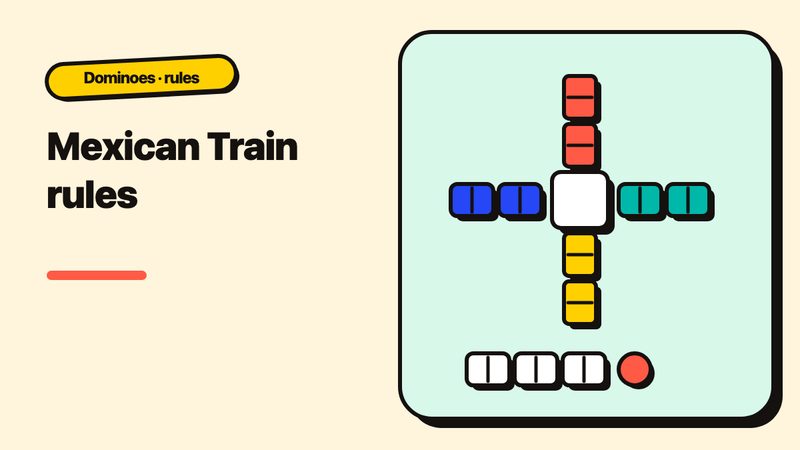
What you need to play
One set of dominoes, 1 marker per player, and paper for the score. A double-twelve set holds every pair from 0 to 12.
That is (13 × 14) / 2 = 91 tiles. Wikipedia calls a double-twelve the standard set. It fits up to 8 players.
You also need markers: 1 per player, plus 1 for the shared train. PAGAT records the old habit. A penny each, and a nickel for the Mexican Train.
Wikipedia lists the sets: double-six is 28 tiles for 2 players, double-nine is 55 for 2 to 7, double-twelve is 91 for 2 to 8.
Tiles each come from PAGAT. Table A does the arithmetic for the double-twelve set.
| Players | Tiles each | Tiles in hand | Boneyard | Check |
|---|---|---|---|---|
| 2 | 15 | 30 | 61 | 91 − 30 = 61 |
| 3 | 15 | 45 | 46 | 91 − 45 = 46 |
| 4 | 15 | 60 | 31 | 91 − 60 = 31 |
| 5 | 12 | 60 | 31 | 91 − 60 = 31 |
| 6 | 12 | 72 | 19 | 91 − 72 = 19 |
| 7 | 10 | 70 | 21 | 91 − 70 = 21 |
| 8 | 10 | 80 | 11 | 91 − 80 = 11 |
| 9 | 8 | 72 | 19 | 91 − 72 = 19 |
| 10 | 8 | 80 | 11 | 91 − 80 = 11 |
Table A: tiles each follow PAGAT. 15 up to 4 players, 12 for 5 or 6, 10 for 7 or 8, and 8 for 9 or 10. Wikipedia's table lists other counts for Galt 1994 and Bauguess. Rulenook recomputes each row. PAGAT's table runs to 10 players. Wikipedia seats 8 on a double-twelve. A table of 9 to 12 players uses double-fifteen (136 tiles), and 13 players use double-eighteen (190 tiles).
This Spin Master Mexican Train set listing names 91 dominoes, 9 plastic trains, a scorepad and an aluminum case.
Set up the table and open the station
Shuffle every tile face down. Deal each player the same number of tiles. Turn the rest face down in the middle as the boneyard.
The centre tile is the engine. It opens the station, and every private train starts there.
PAGAT's ladder runs 12-12 in round 1, then 11-11, then 10-10. It ends on the double blank in round 13. Wikipedia gives the same ladder.
If nobody holds the double you need, the boneyard supplies it. PAGAT says players draw equally until the double turns up.
The 1994 Galt rules work the other way. The first player places their own highest double. If no one has a double, everyone draws 1 tile until one shows.
Who opens the station changes from hand to hand. Wikipedia says the first player should change each hand, so every player gets the same number of chances.
Your first turn
The player who placed the starting double goes first. Then play moves clockwise.
The first turn is the one exception to the normal rule. PAGAT lets you play as many tiles as you like. They must form 1 valid train.
Other rule sets, Bauguess among them, play 1 tile per turn from the start.
Check your hand against the engine. If you hold a tile with a 12, you start a train. Lay it beside the engine, pointing at your seat.
If you hold nothing that matches, you do not draw. PAGAT is explicit.
You place your marker where your train would have started. From the second turn on, any player may play there. That starts the train for you.
Two things stay off limits on the first turn. You cannot play on another player's train. You cannot start the Mexican Train.
One edge case runs the other way. If a player lays every tile on the first turn, the round goes on. PAGAT says play continues until everyone has had a first turn. Only then are the scores counted.
Turns after the first
After the opening, one tile per turn, and only on a train open to you. Two exceptions ride on top. A double needs an extra tile.
Three trains are open to you. Your own train is the first.
The second is any train with a marker on it. Its owner could not play on it last turn. The third is the Mexican Train, the caboose, open to everybody.
The Mexican Train can start from the second turn. Anyone may open it with 1 tile that matches the engine.
When nothing matches, draw exactly 1 tile from the boneyard. Play it if it fits.
If it does not fit, you pass. Mark your own train. The same goes when the boneyard is empty.
PAGAT is strict about that order. You must play a tile when you can. You may not draw while you hold a tile that fits.
Markers come off in one case only.
When the owner plays on their own marked train, the marker is removed. The train is private again.
If the owner adds a tile to another marked train, every marker stays where it is.
Doubles have to be covered
A double is never left alone. From your second turn on, playing a double means you owe 1 extra tile straight after.
PAGAT allows that tile to go anywhere you may legally play. It need not go on the double you just laid.
If the extra tile is another double, you owe a third tile.
If you cannot find one, draw from the boneyard. If the drawn tile does not work either, you pass. Put a marker on your train.
Then the duty moves. If a train still ends in an exposed double, the next tile has to go on that double. PAGAT calls this satisfying the double. The duty falls first on the player after you.
If that player can satisfy it, they must. That goes for a private train they could not touch on an ordinary turn.
If they cannot satisfy it from hand, they draw a tile. If it does not match, they pass and mark their train. The duty moves on.
Several doubles in one turn mean several duties. Each exposed double has to be satisfied in the order they were played.
One exception closes the game. If the double is the very last tile in your hand, you may go out with it. PAGAT says the game ends immediately and is scored.
Doubles do not branch here. PAGAT notes that a double never creates a junction. No tile can go on its far side. Wikipedia lists branching doubles as a variation, often angled at 45 degrees.
How a round ends and how you score
A round ends when one player empties their hand, or when the boneyard is empty and nobody can play. The first-turn exception still applies.
Scoring is a penalty count. PAGAT says each player scores the spots on the dominoes left in hand.
Wikipedia puts the same rule in numbers. The player out scores 0. Everyone else counts the pips still in hand.
A full session is 13 rounds. The engine ladder runs 12-12, 11-11, 10-10 down to 0-0. The winner has the lowest total after 13 rounds.
Ties have 2 steps. Wikipedia gives them: the player with the most 0-point rounds wins. If that is still level, the player with the lowest round total other than 0 wins.
Table B shows 3 rounds of a 4-player game.
| Engine | Player | Tiles left | Pips left (score) | Running total |
|---|---|---|---|---|
| [12|12] | A | went out | 0 | 0 |
| [12|12] | B | [6|3] [4|4] [1|2] | 20 | 20 |
| [12|12] | C | [7|7] [2|5] | 21 | 21 |
| [12|12] | D | [0|3] [1|1] [6|4] [9|2] [8|8] | 42 | 42 |
| [11|11] | A | [5|5] [3|6] | 19 | 19 |
| [11|11] | B | [8|8] [2|2] [0|7] | 27 | 47 |
| [11|11] | C | [4|8] [3|3] | 18 | 39 |
| [11|11] | D | went out | 0 | 42 |
| [10|10] | A | [9|1] [6|6] [2|4] | 28 | 47 |
| [10|10] | B | went out | 0 | 47 |
| [10|10] | C | [1|8] | 9 | 48 |
| [10|10] | D | [5|7] [0|0] | 12 | 54 |
Table B: rounds 1, 2 and 3 run on 12-12, 11-11 and 10-10. Rulenook recomputes all 12 rows. A and B finish level at 47, and each has 1 zero round. The second tie-break decides it: A's lowest non-zero round is 19 against B's 20.
The other way of scoring is a house variant.
PAGAT records it: the player who ran out scores every point in the other hands. Pick one before the first round. The two produce opposite results.
Published rules vs common house rules
There is no single, definitive rule set, Wikipedia says so itself. The page merges 3 published sets: Parsons (Puremco, 1994), Galt (Cardinal, 1994) and Bauguess (2007, revised 2012).
Our assumptions: the running text follows PAGAT's summary. Table C names the rule set behind each line. The type column says which side of the line it sits on.
| Question | Published rule | Common house rule | Type | Source |
|---|---|---|---|---|
| How many tiles each? | PAGAT: 15 to 4 players, 12 for 5 or 6, 10 for 7 or 8. Galt 1994 adds 11 for 7 or 8 | 15 each, whatever the player count | Mixed | PAGAT, Wikipedia |
| Who opens the station? | PAGAT: the round's double is set aside in the centre. Galt 1994: the first player plays their highest double | The same seat every round | Mixed | PAGAT, Wikipedia |
| First turn, how many tiles? | PAGAT: as many as form a valid train. Bauguess: 1 tile | 1 tile per turn | Mixed | PAGAT, Wikipedia |
| When does the marker come off? | Wikipedia: only the owner, by playing on it | Remove it when anyone adds a tile | Mixed | PAGAT, Wikipedia |
| Must a double be covered? | Yes, the next player must cover it, and the duty passes on | Covering is optional | Mixed | PAGAT, Wikipedia |
| Where does the covering tile go? | PAGAT: anywhere you may play. Wikipedia: on the double | On any train | Mixed | PAGAT, Wikipedia |
| Does a double branch? | PAGAT: a double never creates a junction | Branch it at 45 degrees | Mixed | PAGAT, Wikipedia |
| Which way do you score? | Penalty: the player out scores 0, others count their pips | The player out takes the other hands | Mixed | PAGAT, Wikipedia |
| How many rounds? | 13 rounds, 12-12 down to 0-0 | Fewer when short on time | Published | PAGAT, Wikipedia |
Read 2 rows twice before the first deal: the tiles each, and the covering tile. Both change the length of a round.
Common mistakes
The first slip is reaching for the shared train too early. PAGAT rules it out in round 1, and waiting for the second turn keeps 3 choices.
The next trap is drawing while a playable tile sits in your hand. You are allowed 1 draw only when nothing fits.
A double causes the third. You owe 1 extra tile.
If you cannot find one, you mark your train and pass. Treating the double as a whole turn leaves it exposed. The next player has to cover a tile they could not touch.
Passing without a marker breaks the same chain. The marker opens your train to others and lets you sit the turn out. Without it, your train stays private.
Ending the round too early is a different mistake. It does end when somebody goes out, except when a player laid every tile on the first turn. Then everyone finishes their first turn.
Counting the leftover pips as a bonus flips the result. The score is a penalty, so fewer points is the target.
The blank is the last trap. Wikipedia notes that blank ends are sometimes wild cards, a house variant. On this page a blank matches only another 0.
Quick reference card
One table covers a whole session.
| Step | Rule |
|---|---|
| Set | Double-twelve, 91 tiles, 0 to 12 |
| Hands | 15 each to 4 players, 12 for 5 or 6, 10 for 7 or 8, 8 for 9 or 10 (PAGAT counts to 10; Wikipedia seats 8) |
| Boneyard | 91 minus the tiles in hand |
| Engine | 12-12 first, then 11-11, down to 0-0 in round 13 |
| Play | 1 tile, on your train, a marked train, or the Mexican Train |
| Stuck | Draw 1, play it if it fits, else mark your train |
| First turn | As many as form a valid train, no other train |
| Double | Owes 1 extra tile, and the next player must cover it |
| Last tile | A double as your final tile can end the round |
| Score | The player out scores 0, others count their pips; the lowest total after 13 rounds wins |
Common Rules Questions
Can you play on another player's train before starting your own?
No, not on your first turn. PAGAT says no player may play on another player's train on turn 1. Nor may anyone start the Mexican Train. From the second turn there are 3 choices. Your own train, a marked train, and the Mexican Train.
Common house rule: some tables open the shared train at once.
What happens if you can't start your own train?
Place your marker where your train would have started. PAGAT says you do not draw from the boneyard on that first turn.
From the second turn on, any player may play a tile there and start your train for you. If a later draw would have started it, you play 1 tile only.
Common house rule: draw 1 tile at once and start with it if it fits.
Can you go out on an unsatisfied double?
Yes, in one case. PAGAT has 1 exception. If the double is the last tile in your hand, you may play it and go out.
The game ends immediately and the round is scored. Every other double must be covered by the next player. That goes for a private train too.
Common house rule: some tables require the last double to be covered.
How many dominoes does each player draw?
Take a double-twelve set and deal 15 tiles each, the count for up to 4 players. A table of 2 leaves 61 in the boneyard. Domino Game Rules for 2 Players deals a double-six instead: 7 each with 14 left over, or 12 each by house rule. The 7-each deal leaves 77 on a double-twelve, not 61.
12 each covers 5 or 6 players, 10 covers 7 or 8, and 8 covers 9 or 10.
Is it luck or skill?
Both, and the rules do not settle it. They fix the shape of the session. 91 tiles and 13 rounds. A score counts the pips you could not lay.
Every decision changes 1 number in the next round, from the 61 in the boneyard to the 0 in a finished hand. Neither source gives odds.
Read next
The dominoes hub carries the plain domino rules. It covers how a set is dealt, how a chain grows, and how a player wins.
Mexican Train adds 2 things: the trains around a centre double, and the shared caboose.
Cuban partnership dominoes is a different four-player game: two partnerships, a double-nine set, and a score to 100.
Domino Set Sizes counts the tiles in every standard set.
The Domino Score Calculator totals the pips left in a hand.
Chicken Foot Rules shows the branching double that Mexican Train never plays.
Sources
- PAGAT, Mexican Train (read 2026-11-02): the 91-tile set, tiles each at 2 to 10 players, the engine ladder, the first turn, the marker, the draw rule, the double cover rule, and penalty scoring
- Wikipedia, Mexican train (read 2026-11-02): the sets by player count, the tiles each tables for Parsons 1994, Galt 1994, Bauguess and University Games 2014, the note that no single rule set is definitive, public and private trains, the double variations and the tie-breaks
- Amazon listing B000EULZDM (read 2026-11-02): title, feature bullets and product facts for the set with 9 trains
- Our own recomputation: the tiles each table, the 13 engine doubles, the 12 scoring rows, the figure labels How we check rules: our methodology.