Chicken Foot Rules: How to Play Chicken Foot Dominoes Step by Step
As an Amazon Associate, Rulenook earns from qualifying purchases.

Chicken Foot at a glance
- Players
- 2–8
- Complexity
- Medium
- Mode
- Competitive
Chicken foot rules: 2 to 8 players, a double-nine set of 55 tiles, the highest double leads the first round, and every double needs three toes filled. The rule that settles arguments is narrow. The double you just played opens nothing. Not until its 3 toes are filled. Get that wrong and the table runs 2 different games. 2 published rule sets cover Chicken Foot. They disagree on the tiles per hand and on who opens the round. Settle both first.
What You Need to Play Chicken Foot
Chicken Foot runs on a block set of dominoes. PAGAT lists a double-nine set of 55 tiles. It also lists a double-twelve set of 91 tiles.
Wikipedia counts 2 to 12 players. It calls the game "best for 4 to 7 players". The 2 standard sets cover 2 to 8 players. A double-nine seats 2 to 6. A double-twelve seats 4 to 8.
| Set | Tiles | Doubles | Rounds | Seats the deal table allows | Pips in the set |
|---|---|---|---|---|---|
| Double-six | 28 | 7 | 7 | 2 to 3 | 168 |
| Double-nine | 55 | 10 | 10 | 2 to 6 | 495 |
| Double-twelve | 91 | 13 | 13 | 4 to 8 | 1092 |
| Double-fifteen | 136 | 16 | 16 | 6 to 12 | 2040 |
| Double-eighteen | 190 | 19 | 19 | 8 to 16 | 3420 |
Table A is our arithmetic. Tiles = (n+1)(n+2)/2. Doubles = n+1. Rounds = the number of doubles. Every round opens with a different one.
Pips = (n+2) × n(n+1)/2. A double-six set carries 8 × 21 = 168 pips. The dominoes hub prints the same 168 for that set.
The seats column follows the Puremco deal table below. The double-six line comes from PAGAT. It says 2 or 3 players can use it.
Three words carry the whole game. The chicken yard is the pile left face down after your deal. The barnyard is the layout that grows on the table. A chickie is the call you make when you play a double.
A double-six set holds 28 tiles and 168 pips. It fits 2 or 3 players and no more. Seat 4 players there and the set runs out at 7 tiles each. You get no chicken yard at all, so the smallest set for your table is a double-nine.
How to Deal Chicken Foot
Deal the set face down. Give each player the number of tiles the table below prints. Puremco published the deal table that PAGAT prints. The chicken yard column is our count: set tiles − players × tiles each. The table marks the other combinations X: that set does not cover that many players.
| Set | Players | Tiles each | Chicken yard left |
|---|---|---|---|
| Double-nine | 2 | 20 | 15 |
| Double-nine | 3 | 14 | 13 |
| Double-nine | 4 | 11 | 11 |
| Double-nine | 5 | 9 | 10 |
| Double-nine | 6 | 7 | 13 |
| Double-twelve | 4 | 18 | 19 |
| Double-twelve | 5 | 14 | 21 |
| Double-twelve | 6 | 12 | 19 |
| Double-twelve | 7 | 10 | 21 |
| Double-twelve | 8 | 9 | 19 |
| Double-fifteen | 6 | 18 | 28 |
| Double-fifteen | 7 | 15 | 31 |
| Double-fifteen | 8 | 14 | 24 |
| Double-fifteen | 9 | 12 | 28 |
| Double-fifteen | 10 | 10 | 36 |
| Double-fifteen | 11 | 10 | 26 |
| Double-fifteen | 12 | 9 | 28 |
| Double-eighteen | 8 | 19 | 38 |
| Double-eighteen | 9 | 17 | 37 |
| Double-eighteen | 10 | 15 | 40 |
| Double-eighteen | 11 | 14 | 36 |
| Double-eighteen | 12 | 13 | 34 |
| Double-eighteen | 13 | 12 | 34 |
| Double-eighteen | 14 | 11 | 36 |
| Double-eighteen | 15 | 10 | 40 |
| Double-eighteen | 16 | 9 | 46 |
The smallest yard in that table is 10 tiles. That is 5 players on a double-nine with 9 tiles each. Every other cell leaves more.
Other tables hand out smaller hands. PAGAT prints a second set of numbers for that.
| Set | Players | Tiles each | Chicken yard left |
|---|---|---|---|
| Double-nine | 2 | 12 | 31 |
| Double-nine | 3 | 11 | 22 |
| Double-nine | 4 | 10 | 15 |
| Double-six | 2 | 5 | 18 |
| Double-six | 3 | 5 | 13 |
Wikipedia starts every player on 7 tiles whatever the set. It adds that 4 players on a double-twelve can draw 15. We follow the Puremco table. It scales with the set and with your table.
The first round opens with the highest double. On a double-nine set that is the [9|9]. Hold it and you play it to the centre of the table. The layout grows 4 arms from it.
Round 2 opens with the next double down. The last round opens with the [0|0]. A double-nine set gives 10 rounds. A double-twelve set gives 13.
Nobody holds the double that opens the round? Every player draws 1 extra tile. Then the check happens again. Wikipedia adds a 1-draw opening for the first game only. Everyone draws 1 tile. The highest draw leads, and the tile goes back.
A double-twelve set of 91 tiles covers 8 players. It still leaves 19 tiles in the yard. It is the same 91 tiles a Mexican Train set holds. See the double-twelve domino set on Amazon
How to Play Chicken Foot
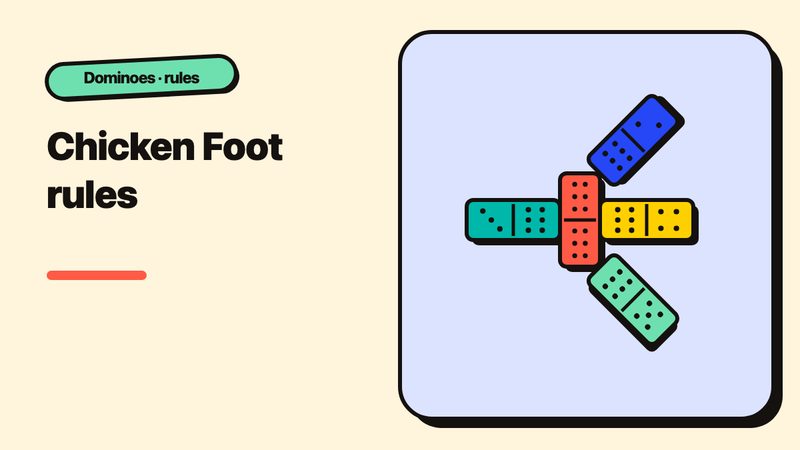
The layout is a cross. One double sits flat in the middle. 4 arms grow out of it. Every play you make lands on an open end. The numbers have to match.
- Play the starting double flat in the middle of the table. It lies crosswise, and 4 arms grow out of it.
- Play only to the open ends. Your numbers have to match. Every double lies crosswise across its arm.
- Call "chickie" when you play a double. Then fill its 3 toes before anyone plays anywhere else.
- Fill the centre double before you extend it. All 4 arms need a tile. Then any arm can take a second one.
- No fit? Draw 1 tile from the chicken yard. Play it at once if it fits.
- Yard empty and still no fit? Pass your turn.
- Nobody can play and the yard is empty? The round ends.
The 3 toes are the point of the game. A double lies across the arm. 3 tiles with the same number go on its other side. 1 lies straight, 2 at 45 degrees.
Wikipedia describes the shape. A Y with a line through the middle. The toes tilt away from the centre. The arms do not run into each other. The layout ends up looking like a tree.
The centre double is the one both rule sets explain separately. PAGAT says the toe rule covers it as well, even though it does not sit at the end of an arm. Wikipedia says all 4 sides must be filled before play continues. Either way, no arm extends until the centre is complete.
Wikipedia adds 1 more detail to the opening. The player to the left plays next. That is the player who filled the centre double last. They may lay any tile that matches an open end.
How a Round Ends and Scores
A round ends 2 ways. A player plays their last tile. Or the chicken yard is empty and nobody has a tile that fits. Both published rule sets agree on those 2 endings.
Scoring runs the other way from most domino games. Each player counts the pips left in their hand. They add them to a running total. The lowest total wins. Every pip in your hand is a penalty.
The blank double is the big number. The [0|0] is worth 50 points. 1 published variation counts it 25. Wikipedia prints the same 50.
Wikipedia also says a game cannot end in a double. Play a double as your last move and you take 50 points for it. The player still holding the [0|0] takes 50 as well.
Worked example. A round ends with 4 tiles left in hand. 1 player holds the [3|5] for 8 pips. 1 holds the [2|2] for 4. 1 holds the [0|4] for 4. The last player holds the [0|0] for 50.
That is 8 + 4 + 4 + 50 = 66 points of penalty. The 4 running totals carry them.
The game ends after the round that starts with the [0|0]. A double-nine set gives 10 rounds. A double-twelve set gives 13. That is 1 round for every double in the set.
Chicken Foot Rules vs Common House Rules
Our assumptions: the published column comes from the 2 rule pages named in the cell, both read on 2026-11-02. Where the 2 accounts disagree, both are printed. Where neither prints a rule, the house column fills the gap. The last column is what we use at the table.
A cell that reads not printed means the source is silent.
| Rule point | PAGAT, the Domino Plaza rules | Wikipedia, quoting Kelley 1999 | Common house rule | This page uses |
|---|---|---|---|---|
| Tiles per hand | The Puremco table: 20, 14, 11 or 9 on a double-nine | 7 for every player, raised to 15 for 4 players on a double-twelve | Smaller hands: 12, 11 or 10 on a double-nine | The Puremco table |
| Who opens the round | The holder of the highest double plays it | Everyone draws 1 tile from the boneyard in the first round, and the highest draw leads | The lead rotates from deal to deal | The holder of the highest double |
| Where the starting double sits | It is played to the centre to open the layout | The highest double is placed in the centre of the layout | The starting double is set aside face up before the deal | Played to the centre by its holder |
| Toes after a double | 3 more dominoes next to the double. PAGAT counts the double itself among the 4 matching tiles | 3 tiles of the same number, 1 straight and 2 at 45 degrees | A double chicken foot: 3 tiles on each side | 3 toes, 1 straight and 2 at 45 degrees |
| The centre double | The toe rule covers it as well | All 4 sides filled before any arm extends | Only 3 sides filled, which looks like a Y | All 4 arms filled first |
| One tile left | Announcing it is a courtesy, not required | not printed | The chicken little rule: you must announce it | Announce it, it costs you nothing |
| The blank double | 50 points, or 25 in 1 variation | 50 points | 25 points | 50 points |
| A blocked round | The hand blocks and everyone counts their pips | The round ends and each player sums their spots | The round is dealt again | Count the pips |
| Ending on a double | not printed | The player who played a double last takes 50 points | The double goes back to the start of the layout | The 50-point rule |
Three rules break a table faster than the rest. The first is playing a double and moving on. The 3 toes come first. The second is extending one arm too early. The centre double still has an empty side.
The third is swapping the starting double for a lower one. That is allowed only in the double-chicken-foot variation.
Chicken Foot vs Mexican Train
Mexican Train and Chicken Foot are both block domino games. Both use doubles. Both count down instead of up. The layout is what separates them.
Mexican Train gives every player a train of their own. They all grow from 1 centre double. It adds a shared train anyone may play on. That is the Caboose. It also needs markers. 1 coin per player, 1 more for the shared train.
Chicken Foot has none of that. It has 4 arms growing out of the centre double. There is no hub at all.
The double rule is where the 2 games part company. PAGAT says a double in Mexican Train does not create a junction. Chicken Foot does create one. The extra tile after a double may go anywhere there.
In Chicken Foot the double opens 3 toes. The table waits while they are filled.
Can you play Chicken Foot with Mexican Train dominoes? Yes. The double-twelve set of 91 tiles is the second set PAGAT lists. Mexican Train uses that same set.
The hub, the coins and the train markers are the extra parts. You need the tiles and nothing else.
Common Mistakes
- Playing a double and carrying on. The call and the 3 toes come first. No other play is legal until the foot is filled.
- Extending one arm while the centre double still has an empty side. All 4 arms need a tile first.
- Swapping the starting double for a lower one because it sits in the chicken yard. Only the double-chicken-foot variation allows it.
- Drawing a handful of tiles when nothing fits. You draw 1 tile. You play it if it fits.
- Counting the [0|0] as 0 points. It is worth 50. A blank half on its own is worth nothing.
- Scoring up instead of down. The pips in your hand are a penalty. The lowest total wins.
Common Rules Questions
How many dominoes do you deal in Chicken Foot?
Follow the Puremco table above. 2 players on a double-nine take 20 each. 3 take 14, 4 take 11, 5 take 9, and 6 take 7. On a double-twelve it is 18 each for 4 players. It drops to 9 each for 8.
Wikipedia starts every player on 7 tiles whatever the set. Other tables use smaller hands. 10 each for 4 players on a double-nine. Pick 1 list and stay on it for the whole game.
Do you need a double-nine or a double-twelve set?
A double-nine set of 55 tiles covers 2 to 6 players. It always leaves you at least 10 tiles in the chicken yard. A double-twelve set of 91 tiles covers 4 to 8 players. It leaves 19 to 21.
A double-six of 28 tiles works for 2 or 3 players only. 4 players would take 7 each and leave no yard at all.
What is the chicken yard in Chicken Foot, and where do you draw from?
It is the pile of tiles left face down after the deal. The tiles already on the table are the barnyard.
You cannot match an open end? Draw 1 tile from the chicken yard. Play it at once if it fits. When the yard is empty, you pass, and the next player moves.
What do you do after you play a double?
Call "chickie" or "chicken foot". Then fill 3 toes on the other side of that double. 1 tile lies straight, 2 at 45 degrees. No other play is legal until the foot is complete.
The rule covers the centre double too. That double does not sit at the end of an arm.
Can you play Chicken Foot with Mexican Train dominoes?
Yes. The double-twelve set of 91 tiles is the set PAGAT lists second. It is also the set Mexican Train uses.
The hub, the coins and the train markers are the extra parts. You need the tiles and nothing else.
Read next
The domino rules hub covers the draw games, the boneyard counts and the set sizes. It sets the published rules against house rules. Chicken Foot is the variant there. 4 arms grow from 1 centre double. It counts down instead of up.
Sources
- PAGAT, Chicken Foot: domino game rules, https://www.pagat.com/domino/tree/chickenfoot.html (read 2026-11-02): the deal table, the yard names, the starting double, the toes, the scoring and the variations.
- PAGAT, Mexican Train: domino game, https://www.pagat.com/domino/star/mextrain.html (read 2026-11-02): the double-twelve set, the trains, the markers and the double rule.
- Wikipedia, Chickenfoot (domino game), https://en.wikipedia.org/wiki/Chickenfoot_(domino_game) (read 2026-11-02): the 7-tile deal, the drawn opening tile, the 50-point rule and the 45-degree toes. It quotes Jennifer A. Kelley, Great Book of Domino Games, 1999.
- Our own arithmetic: Rulenook recomputes Table A, both chicken yard columns, the worked example and the 2 drawings.
- Product listing: the double-twelve set of 91 tiles, read 2026-11-02 through the Amazon item tool. The tile size and the case come from that listing.
- The method behind every number on this page is in the methodology notes.