42 Domino Rules: How to Play Texas 42 Step by Step
As an Amazon Associate, Rulenook earns from qualifying purchases.
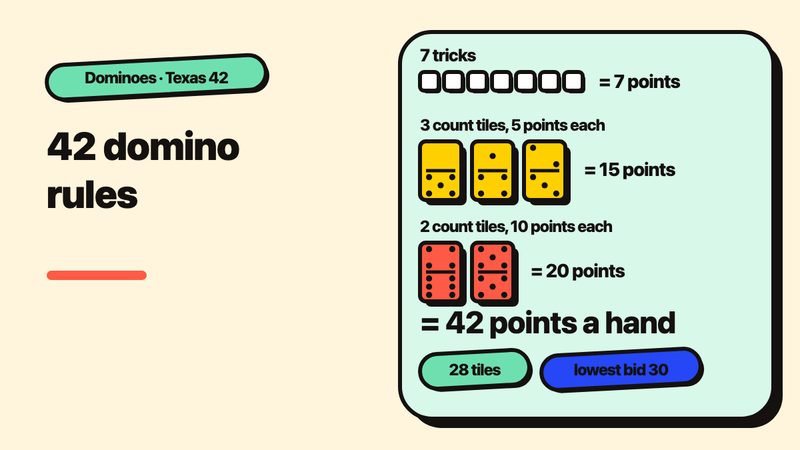
42 domino rules: 4 players, 2 fixed partnerships, and a double-six set of 28 tiles dealt 7 each. Bids run from 30 up to 42 points. Each trick is worth 1 point, and 5 count tiles add 35 more, so a hand is worth 42 points. Three published rule pages disagree where it counts, so settle the all-pass case first.
The high bidder names trumps and leads the first trick. The first team to 250 points or 7 marks wins.
What You Need to Play Texas 42
One double-six set of 28 tiles covers the table. Each player takes 7, and every tile is on the table before the first trick.
Published rule: all 28 tiles are dealt. Nothing waits in a boneyard. A Mexican Train set carries a centre double, a private train for each player and a shared train. None of it does anything here.
Tiles stand on edge in front of you. The others cannot see them. No rack is needed.
4 players sit in 2 fixed partnerships. Your partner sits across from you. The pairs stay the same all hand.
Score on paper. Celko writes that a cribbage board or paper can be used. Some tables scratch the marks into the word ALL.
None of the 3 rule pages prints a session length, a difficulty rating or an age range. Those read not printed.
The Deal: 28 Tiles, Seven Each, No Boneyard
Our assumptions: a double-six set holds 28 tiles, 7 are doubles and 21 carry 2 numbers. Every tile is dealt: 4 × 7 = 28, and 7 tricks of 4 = 28.
Sources: McLeod, Celko and Fosdick are PAGAT pages, Wikipedia the encyclopedia article.
A double-six set listing counts 28 tiles in classic size. That is the size this game asks for.
| Item | Published rule | Our check | Source |
|---|---|---|---|
| Set | a double-six set of 28 dominoes | 28 = 4 × 7 | McLeod |
| Players | 4, in fixed partnerships | partners sit opposite | McLeod |
| Tiles each | 7 | 7 × 4 = 28 | McLeod |
| Tiles left over | 0 | 28 − 28 = 0 | McLeod |
| Tricks in a hand | 7 | 7 × 4 = 28 tiles played | McLeod |
| Partnerships | 2 fixed pairs, partners opposite | one pair north-south, one east-west | McLeod |
| Deal order | the dealer's opponents, then the partner, then the dealer | 4 hands of 7 | McLeod, Celko |
| Bid order | from the dealer's left, clockwise, 1 chance each | 4 chances per hand | McLeod, Wikipedia |
The Bidding Ladder: 30 Up to 42, Then Marks
Our assumptions: a hand holds 42 points, so a bid in points runs from 30 to 42. 1 mark means 42 points, and taking all 7 tricks.
| Call | What you promise | Made | Set | Who can go over you | Source |
|---|---|---|---|---|---|
| 30 | 30 points or more | your points | 0; the other side takes 30 + its own | 31 to 42, then 84 | McLeod, Wikipedia |
| 31 to 41 | that many points or more | your points | 0; the other side takes the bid + its own | the next number up | McLeod |
| 42, 1 mark | all 7 tricks | 1 mark | the other side takes 1 mark | 84, 2 marks | McLeod, Wikipedia |
| 84, 2 marks | all 7 tricks | 2 marks | the other side takes 2 marks | 126, 3 marks | McLeod, Wikipedia |
| 126, 3 marks | all 7 tricks | 3 marks | the other side takes 3 marks | 168, 4 marks | McLeod, Fosdick |
| 168, 4 marks | all 7 tricks | 4 marks | the other side takes 4 marks | 5 marks | McLeod, Fosdick |
| Jump to 4 marks | all 7 tricks (Plunge) | 4 marks | the other side takes 4 marks | 5 marks | McLeod, Celko |
| Game | the whole game rides on it | the game | the game | nobody | Fosdick |
Every bid must beat the one before it, and all 3 rule pages print 30 as the lowest.
A bid of 1 mark or more promises you all 7 tricks. Take them and the contract holds. Miss 1 and you are set.
The opening call stops at 2 marks. Wikipedia prints 5 marks for whoever goes over that cap.
Plunge breaks the ladder. You must bid 4 marks. You may open on 4 over a lower bid.
Naming Trumps: A Suit, Doubles or No Trump
Our assumptions: a double-six set has 7 number suits, blanks, ones, twos, threes, fours, fives and sixes. A tile with 2 numbers belongs to both; a double belongs to one.
| Contract | How the tiles rank | A lead counts as | A follow can be | Source |
|---|---|---|---|---|
| Name a number, blanks to sixes | a trump and nothing else, its double the highest | the trump suit | trumps only | McLeod, Celko |
| Doubles as trump | the 7 doubles are a suit of their own, 6-6 to 0-0 | a lead of doubles | doubles, if you hold one | McLeod |
| No trump, doubles high | the double is the highest of its suit | the higher number | either of its 2 suits | McLeod |
| No trump, doubles low | the double is the lowest of its suit, so a 6-0 beats a 6-6 | the higher number | either of its 2 suits | McLeod |
Trumps are named after the bidding closes, never before. The high bidder names them.
A trump tile leaves its other suit. If threes are trump, the 5-3 is a 3 and nothing else.
A non-trump tile led counts as its higher number: the 6-5 led counts as a 6. When you follow, it can follow sixes or fives.
Published rule: when a double is led, everyone follows with doubles if they hold any. With no double in hand, any tile is allowed.
How a Trick Is Played
6 steps run every trick.
- The high bidder, the declarer, leads the first trick. Any tile will do.
- Follow the suit if you can. If you cannot, play any tile, a trump included.
- The highest trump wins the trick. With no trump, the highest tile of the suit led wins it.
- The winner leads the next trick.
- Tricks stay face up to the right of a team member.
- Under a contract to take all 7 tricks, you may stack them: the third on the first, the fourth on the second.
Step 5 keeps the count visible to both teams. Step 6 is for the 1 mark contract: McLeod prints it as a way to hide what was played.
Scoring: Count Tiles, Tricks and the 42 Points
Our assumptions: 5 tiles in a double-six set have pips that add up to 5 or 10, and the double blank has 0 pips, so it is not a count tile. Our count of the 96 hand splits shows the 2 sides add to 42.
| Where the 42 points come from | Count | Points each | Subtotal | Source |
|---|---|---|---|---|
| Tricks | 7 | 1 | 7 | McLeod, Celko |
| Count tiles with 5 pips: [0|5], [1|4], [2|3] | 3 | 5 | 15 | Celko, Wikipedia |
| Count tiles with 10 pips: [4|6], [5|5] | 2 | 10 | 20 | Celko, Wikipedia |
| Total | 42 | 7 + 15 + 20 |
A bid of 30 is easier to make than most tables assume. Our count: a side that wins k tricks with a five-point count of a and a ten-point count of b scores k + 5a + 10b.
| Tricks won | Lowest count tiles that reach 30 | Points in the hand |
|---|---|---|
| 0 | not possible: no trick won, no counter taken | 0 |
| 1 | 2 five-point, 2 ten-point | 31 |
| 2 | 2 five-point, 2 ten-point | 32 |
| 3 | 2 five-point, 2 ten-point | 33 |
| 4 | 2 five-point, 2 ten-point | 34 |
| 5 | 1 five-point, 2 ten-point | 30 |
| 6 | 1 five-point, 2 ten-point | 31 |
| 7 | 1 five-point, 2 ten-point | 32 |
A side that wins no trick takes no counter, so 0 tricks is 0 points.
Taking all 7 tricks is not the same as reaching 30 points. With 5 tricks and 3 count tiles you can reach 30. You do not need every counter.
Worked example 1, from Celko. A partnership bids 32 and takes 35 points. It scores 35, the other side 7.
Worked example 2, from Celko. The same partnership bids 32 and takes 30 points. It scores 0. The other side takes 12 + 32 = 44 points.
Worked example 3, from Wikipedia. A bid of 30 that takes 35 points scores 35. A bid of 30 that takes 26 scores 0, and the other side takes 30 + 16 = 46.
The marks game scores the same hands differently. A made bid of 30 to 42 scores 1 mark. Higher bids score the marks bid. The first team to 7 marks wins. Celko asks the winner for a lead of 2 marks.
These are not pip counts. Our domino score calculator counts ordinary pips. 42 counts tricks and count tiles.
Special Contracts: Nello, Plunge, Sevens, Splash and Low-No
| Contract | What it is | What you need | Trumps and the lead | How you win | How a loss scores | Source |
|---|---|---|---|---|---|---|
| Nello | lose every trick | a bid of 1 mark or more | no trumps, you declare the doubles order, you lead | you take no trick | the other side takes 1 mark | McLeod, Celko |
| Plunge | take all 7 tricks | 4 doubles, 4 marks bid | your partner names the trump, you lead | all 7 tricks | the other side takes the marks | McLeod, Celko |
| Splash | take all 7 tricks | 3 doubles | your partner names the trump and leads | all 7 tricks | the other side takes the marks | McLeod, Celko |
| Sevens | closest tile to 7 pips | a bid of 1 mark or more | you lead | all 7 tricks | the other side takes the marks | McLeod, Wikipedia |
| Low-No | the points version of Nello | the dealer, after all 3 others passed | you lead | you take no trick | the other side scores 42 points | McLeod, Celko |
Nello takes your partner out of the game. Her tiles go face down and she takes no part. You declare how the doubles rank: high, low, a suit of their own, or inverted.
Plunge hands the trump to your partner. She picks it without hints from you. McLeod prints that rule in it.
Sevens leaves no room for judgement. Everyone plays the tile closest to 7 pips, the closest wins, and a tie goes to the first played.
The 42 Family: Moon, 84, 88, 72, 140 and Three-Handed 42
| Game | Players | Set | Tiles each | Left over | Lowest bid | Tricks | Target | Source |
|---|---|---|---|---|---|---|---|---|
| Standard 42 | 4 | double-six | 7 | 0 | 30 | 7 | 250 points or 7 marks | McLeod, Wikipedia |
| Moon | 3 | double-six, 6 blank tiles out, double blank kept | 7 | 1 face down | 4 | 7 | 21 points | Wikipedia |
| Three-handed 42 | 3 | double-six, blank ace out | 9 | not printed | 30 | not printed | not printed | Wikipedia |
| 72 | 4 | two sets, blanks removed | 10 | 2, the widow | 40 | not printed | not printed | Wikipedia |
| 84 | 8 | two double-six sets | 7 | 0 | 60 | not printed | not printed | Wikipedia |
| 88 | 6 | two sets | 9 | 2, kept or discarded | 60 | not printed | not printed | Wikipedia |
| 140 | 6, in 3 teams | double-nine | 9 | 1 | 100 | 9 | 500 points | Wikipedia |
Moon is the 3 player member of the family. It scores tricks, not count tiles. Our Moon rules page prints that game in full. The 140 row adds up: 95 count points plus 9 tricks at 5 points make 140.
Published Rules vs Common House Rules
Our assumptions: this page follows the PAGAT McLeod line. The last column says what we use where the 3 public pages disagree. Cells reading as McLeod repeat it.
| Rule | PAGAT McLeod | PAGAT Celko | Wikipedia | Common house rule | What this page uses |
|---|---|---|---|---|---|
| Lowest bid | 30 | 30 | 30 | 30 | 30 |
| All 4 players pass | tiles thrown in, next dealer deals | as McLeod | the dealer must bid 30 | dealer bids after 3 passes | the McLeod line |
| Opening call | 2 marks, 4 for Plunge | as McLeod | 2 marks, 5 to go over | 2 marks | 2 marks |
| Opening lead | any tile, though a few want a trump | as McLeod | any tile | a trump only | any tile |
| 1 mark and above | all 7 tricks | as McLeod | all 7 tricks | 30 points is enough | all 7 tricks |
| Winning the marks game | first to 7 marks | 7 marks and a lead of 2 | 7 marks | 7 marks | 7 marks |
| Small end opening | first trick only | not printed | not printed | allowed any time | the McLeod line |
| Doubles in Nello | 4 ways to rank them | 3 ways to rank them | 3 ways | doubles high | the McLeod line |
| Splash | 2 marks in the Fimble version | 2 marks | 3 marks, 2 in some versions | 2 marks | table F |
| Plunge | 4 marks | as McLeod | 4 marks, 3 in some variants | 4 marks | table F |
| Special contracts | Nello, Plunge, Sevens, Splash (Fimble version) | Nello, Plunge, Sevens, Splash | Nel-O, Splash, Plunge, Sevens | none at all | table F |
| Trump naming | after the bidding | as McLeod | after the bidding | before the bidding | after the bidding |
The first 2 rows decide how a hand starts. Get them wrong and the table scores a hand nobody played.
Common Mistakes
6 mistakes turn a hand into an argument.
- Waiting to draw from a boneyard. 42 has none: 28 tiles are dealt 7 each.
- Reading a bid of 30 as a promise of all 7 tricks. A bid of 30 needs 30 points, and table E shows the cheapest count tiles that reach 30; 1 mark and above need all 7 tricks.
- Counting the double blank as a count tile. It has 0 pips, so it is not one of the 5.
- Forgetting that a non-trump tile can follow 2 suits. With threes as trump, the 6-5 follows sixes or fives.
- Forgetting the Nello setup. Your partner turns her tiles face down, and you declare the doubles order.
- Treating the 42 points as one side's score. 30 for one side leaves 12 for the other.
Common Rules Questions
How many players does Texas 42 take, and who is your partner?
4 players, in 2 partnerships. They stay the same for the hand. Each partner sits opposite. There is no rotating team version. The 3 player game in the same family is Moon: 22 tiles, 7 each, a target of 21 points.
How many dominoes does each player get in 42?
7 tiles each, from a double-six set of 28. Every tile is dealt, so nothing waits in a boneyard. A hand holds 7 tricks, and each trick holds 4 tiles. All 28 tiles are on the table, and nobody draws.
How many marks can you bid in 42?
The lowest bid is 30 points. 42 points is 1 mark. The opening call stops at 2 marks. Wikipedia prints 5 marks to go over it. Plunge must be bid at 4 marks. A bid of 1 mark needs all 7 tricks.
Can 3 people play 42?
Not standard 42, which is 4 players in fixed partnerships. The 3 player game in the same family is Moon: 22 tiles, 6 blank tiles out and the double blank kept, 7 each, 1 face down, a target of 21 points. Wikipedia prints a three-handed 42 as well, 9 tiles each.
What are the count tiles, and why is the game called 42?
5 tiles carry points. The [0|5], the [1|4] and the [2|3] are worth 5 points each, and the [4|6] and the [5|5] are worth 10 each. The 7 tricks add 7 more, so a hand is worth 7 + 15 + 20 = 42 points.
Read next
The domino rules hub covers the ordinary draw game and the chain.
The domino set sizes page prints tile counts and pip totals, and the domino set guide sorts them by game.
Our domino score calculator counts ordinary pips. 42 counts tricks and count tiles.
Sources
- PAGAT, Texas 42 (John McLeod), https://www.pagat.com/domino/trick/42.html (read 2026-11-10): the deal and bids.
- PAGAT, Texas 42 (Joe Celko), https://www.pagat.com/domino/trick/texas42.html (read 2026-11-10): the counters.
- PAGAT, 42 and Variations (Howard Fosdick), https://www.pagat.com/domino/trick/42_and_Variations.html (read 2026-11-10): bids.
- Wikipedia, 42 (dominoes), https://en.wikipedia.org/wiki/42_(dominoes) (read 2026-11-10): count tiles, variations.
- Amazon listing for a double-six set of 28 tiles, read 2026-11-10: count and size.
- Site recomputation: table A, table D, table E, the examples, the figure numbers. How we work: the methodology notes.