Domino Score Calculator: Scoring Rules, Pip Counts and Worked Examples
Domino scoring rules differ between two published guides. Settle that count before you add up the points. The player with the fewest pips wins the hand under both of them, and takes the points left in every other hand. The calculator turns your remaining pips into the hand score and the points still needed for 100 or 61. A blocked hand and a tie each carry their own rule.
How to use the calculator
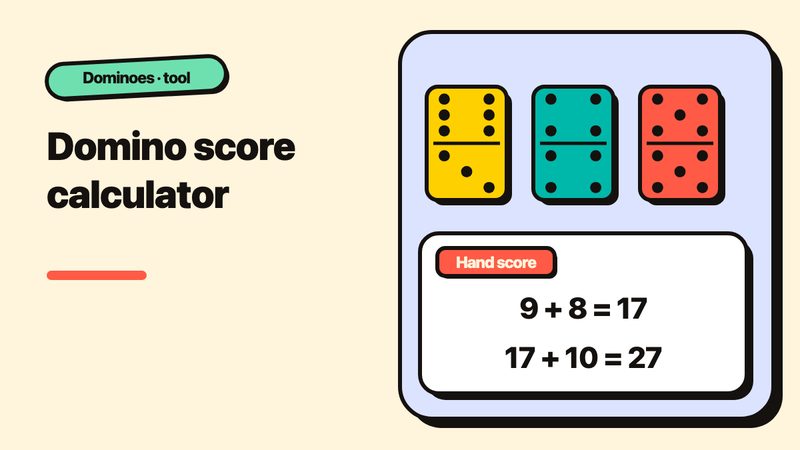
The form opens on worked example 1 below. It is a three-player draw hand. The winner has played out every tile. Change the game type and three numbers follow it. They are the tiles per player, the boneyard count and the target score.
- Choose the game type you play. Two-player draw, two-player block, three-player draw, four-player draw or four-player partnership.
- Choose the set on your table. A double-six, double-nine or double-twelve set. The tile total in the check panel follows it.
- Enter the pips left in each hand. Add up the two halves of every tile still in front of that player. Type one total per seat, and the score that seat has so far.
- Add the boneyard pips. Optional. It only feeds the tile count check.
- Read the result. You get the winner, the score of the hand, the tile count check and the points still needed to the target.
Where the tiles come from is your call. A hand ends when one player empties it. The other hands keep their pips. You count those.
Three switches change the count. Each settles a point where the published guides differ. Turn off the subtraction if you want the winner to keep their own pips. Turn off the blocked hand and a blocked game scores nothing. Turn on the double when the winner goes out with one. The score doubles.
Every calculation runs in your browser. Nothing is uploaded. Your score sheet stays on your own device.
Domino scoring rules by game type
Our assumptions, before the table. A double-six set is the default in every row. The boneyard count is our own subtraction from that set. You take the 28 tiles of the set, less the tiles on the table.
The score column follows PAGAT's wording. The source column names the rule page for each cell. All were read on 2026-11-03.
The rules hub keeps a different count. Its table gives 12 tiles each to two players and 7 each to three or four, and says so. This table uses the published rules. Two tables, two deals, so take the row that matches your table.
| Game type | Tiles per player | Boneyard tiles | How the score is counted | Target | Source |
|---|---|---|---|---|---|
| Two-player draw | 7 | 14 | The winner takes the other player's pips, less the winner's own | 100 | PAGAT draw rules |
| Two-player block | 7 | Not used | The same count as the draw game | 100 | PAGAT block rules |
| Three-player draw | 7 | 7 | The losers' pips, less the winner's own | 61 | PAGAT draw rules |
| Four-player draw | 6 | 4 | The losers' pips, less the winner's own | 61 | PAGAT draw rules |
| Four-player partnership | 7 | None, all 28 tiles are dealt | The losing team's pips, and the winning team's own tiles are ignored | 100 | PAGAT partnership rules |
Two published deals differ, so take the row that matches your table. PAGAT's draw rules deal 7 tiles each to three players and 6 each to four.
PAGAT's block rules deal 7 tiles each to two players and 5 each to three or four. Alex Cramer's guide gives 5 tiles each to three or four players as well, in the block game and the draw game. The two guides only split on the draw game with three or four players.
The turn itself is not on this page. Our domino rules hub covers the deal and one turn. It also covers drawing from the boneyard and where the doubles sit.
Official rules and common house rules
Our assumptions. The published column quotes the rule pages named in the cell. All read on 2026-11-03. The house column holds table agreements we did not find printed in a rulebook.
The last column is our own judgement, not an external standard. You can overrule it.
| Situation | Published rule | Common house rule | Our recommendation |
|---|---|---|---|
| Whose pips count | The winner is credited with the sum of the losers' scores, less his own total (PAGAT draw rules, PAGAT block rules). Alex Cramer's guide scores the dots on the opponents' unplayed dominoes and lists the subtraction as a variation | Only the losing side's tiles count, with no subtraction | Settle one count before the first hand and write it on your score sheet |
| A blocked hand | The hand scores. The player with the fewest pips wins it (PAGAT draw rules, PAGAT block rules, PlayBoardGames) | A blocked hand is dealt again and scores nothing | Score it. None of the rule pages we read leaves a blocked hand unscored |
| A tie | Nobody scores (PAGAT draw rules, PAGAT block rules). The partnership rules call it a tie | The tie is split, or the hand is played again. Alex Cramer's guide gives the hand to the player holding the single tile with the lowest count | Nobody scores, then deal again |
| The winner goes out with a double | A variation in the block rules doubles the opponents' score (PAGAT block rules) | The score stands as counted | Agree the variation before the first hand, or count it plain |
| Target score | 100 points in a two-player or partnership game, 61 in a three- or four-handed game (PAGAT draw rules, PAGAT block rules) | A short block game is settled at 50 or 25, which no rulebook we read prints | Use the published target for the game type |
Two rows deserve a second look before you deal. A blocked hand scores under every rule page we read. Do not redeal it by accident.
A tie scores nothing under PAGAT, and the partnership rules call it a tie too.
How the hand score is worked out
Start with the winner, the player holding the fewest pips. You count what the other players still hold. Then add up the pips left in every other hand. That total is the losers' pips.
PAGAT's count takes the winner's own pips off that total. The opponents-only count keeps them. The difference between the two counts is the winner's own hand.
A partnership hand counts the losing team's pips and ignores the winning team's tiles. A partnership is scored on what the other side leaves behind.
A blocked hand runs through the same formula. The fewest-pips hand is the winner. A double that finishes the hand doubles the score. A tie scores nothing.
| Case | Pips left in the hands | PAGAT's count | Opponents-only count |
|---|---|---|---|
| 1. Three-player draw, the winner goes out | A 0, B 17, C 10 | 27 | 27 |
| 2. Two-player draw, the hand is blocked | A 3, B 23 | 20 | 23 |
| 3. Two-player draw, a tie | A 18, B 18 | 0 | 0 |
| 4. Two-player block, the winner goes out with a double | A 0, B 23 | 46 | 46 |
Example 1. B holds [6|3] and [4|4], so 9 + 8 = 17 pips. C holds [5|5], so 10 pips. A played out every tile, so the losers' pips are 17 + 10 = 27. Nothing comes off the top.
Example 2. A holds [1|2], so 3 pips. B holds [6|5], [4|2] and [3|3], so 11 + 6 + 6 = 23. The blocked hand goes to A, who holds fewer pips. PAGAT's count is 23 less A's 3, which is 20. The opponents-only count is 23.
Example 3. A holds [6|6] and [5|1], so 12 + 6 = 18 pips. B holds 18 as well. Nobody scores. The hand is dealt again.
Example 4. A goes out with a double and holds no pips. B holds the same 23 as in example 2. The double doubles the opponents' score, so 23 times 2 is 46. Without the doubling variation the score is 23.
Run the same four sums in the calculator. Your total matches the tables above.
How large a hand score can get
Our assumptions. The ranges and the ceilings are our own count. Every tile in the set is sorted from low to high.
The three-player and four-player block rows use the 5 tile deal from PAGAT's block rules. The other rows use the deal in the first table.
These are ceilings. They assume the tiles that end the hand are still on the table, so a real hand scores less.
| Tiles in hand | Fewest pips | Average pips | Most pips |
|---|---|---|---|
| 5 | 8 | 30 | 52 |
| 6 | 11 | 36 | 61 |
| 7 | 15 | 42 | 69 |
The average column follows from the set. A double-six set holds 28 tiles and 168 pips. Divide and you get 6 pips a tile. Seven tiles average 42. You can check that division yourself.
The fewest column takes the lowest tiles in the set. [0|0], [0|1], [0|2], [1|1] and [0|3] give 8 pips for 5 tiles.
Add [1|2] and [0|4]. The count reaches 11 and 15 for 6 and 7 tiles. The most column takes the highest tiles instead. [6|6], [5|6], [4|6], [5|5] and [3|6] give 52 pips for 5 tiles.
| Game type | Most points in one hand | Under PAGAT's rule | Source |
|---|---|---|---|
| Two-player draw | 69 | 54 | PAGAT draw rules, 7 tiles each |
| Two-player block | 69 | 54 | PAGAT block rules, 7 tiles each |
| Three-player draw | 118 | 103 | PAGAT draw rules, 7 tiles each |
| Three-player block | 92 | 84 | PAGAT block rules, 5 tiles each |
| Four-player draw | 140 | 129 | PAGAT draw rules, 6 tiles each |
| Four-player block | 124 | 116 | PAGAT block rules, 5 tiles each |
| Four-player partnership | 118 | 118, no subtraction | PAGAT partnership rules, 7 tiles each |
The ceiling is built like this. The winner holds the lowest tiles. The tiles that stay out of the hands take the next lowest. The losers keep the highest.
In a two-player draw game that leaves the loser with 69 pips and the winner with 15. PAGAT's count is 69 less 15, which is 54.
| Set | Game type | Most points in one hand | Under PAGAT's rule |
|---|---|---|---|
| Double-nine | Two-player draw | 111 | 96 |
| Double-nine | Three-player draw | 202 | 187 |
| Double-nine | Four-player draw | 248 | 237 |
| Double-nine | Four-player partnership | 202 | 202, no subtraction |
| Double-twelve | Two-player draw | 153 | 138 |
| Double-twelve | Three-player draw | 286 | 271 |
| Double-twelve | Four-player draw | 356 | 345 |
| Double-twelve | Four-player partnership | 286 | 286, no subtraction |
The double-nine and double-twelve rows use the same deal sizes as the double-six rows above, so the sources carry over.
A two-player draw game takes at least two hands to reach 100. One hand is worth at most 69.
Check the tile count against the set
The pips in a set add up to a fixed number. The check is simple. The pips left in the hands plus the pips in the boneyard must equal the pips in the whole set. The tile counts and the pip totals below are our own count of each set.
| Set | Tiles | Total pips | Average pips per tile | Boneyard after a two-player deal of 7 each |
|---|---|---|---|---|
| Double-six | 28 | 168 | 6 | 14 |
| Double-nine | 55 | 495 | 9 | 41 |
| Double-twelve | 91 | 1092 | 12 | 77 |
Two worked checks to run. Hands hold 12 pips and 9 pips, and the boneyard holds 147. Add them and you get 168, so the count is right.
Change the boneyard to 140. The total comes to 161, which is 7 pips short of 168. The calculator tells you the missing 7.
Spare tiles in the box are not part of the game. The other set sizes, their doubles and their pip totals sit on our domino set sizes page.
Points to the target
Every hand adds to a running total. The target sits at the end of it. The calculator shows what each seat still needs, so you can see the finish.
It also shows how many hands it takes at the largest hand this game allows.
| Seat | Current score | Points still needed | Biggest hand in this game | Hands needed at the ceiling |
|---|---|---|---|---|
| A | 74 | 26 | 69 | 1 |
| B | 61 | 39 | 69 | 1 |
Our example is a two-player draw game with a target of 100. A needs 26 more points and B needs 39. The biggest hand in this game is 69. One hand is enough for either seat at that ceiling.
The average 7-tile hand holds 42 pips, which also clears 26 in one hand.
Only the score at the end of a hand counts. Nothing is added while the tiles are still being played. All Fives and Muggins score as they play. That is a different set of rules with a different target.
Read next
Our domino rules hub covers the deal, one turn and the doubles on the chain.
The domino set sizes page lists the tile count, the doubles and the pip total for each set. How we check numbers and name sources: our methodology.
Sources
- PAGAT, Draw Dominoes: rules and variations, https://www.pagat.com/domino/line/draw.html. Read 2026-11-03. Deal sizes for 2, 3 and 4 players, the scoring rule, the tie, and the 100 and 61 point targets.
- PAGAT, Block Dominoes: rules and variations, https://www.pagat.com/domino/line/block.html. Read 2026-11-03. Deal sizes, the leftover tiles left unused, the scoring rule, and the double that doubles the opponents' score.
- PAGAT, Partnership Dominoes, https://www.pagat.com/domino/line/partnership.html. Read 2026-11-03. All 28 tiles dealt 7 each, the losing team's pips, the tie, and the 100 point match target.
- PAGAT, Domino Games: Basic Mechanics, https://www.pagat.com/domino/basics.html. Read 2026-11-03. Every permutation of the numbers from 0 to n, and the pips on the halves.
- Alex Cramer, How to Play Dominoes: Block, Draw, Muggins and Five-Up Rules, https://alexcramer.com/pages/how-to-play-dominoes. Read 2026-11-03. The hand score from the opponents' tiles, the blocked hand, the tie, and a 5 tile deal for 3 or 4 players.
- PlayBoardGames, Dominoes rules questions, https://playboardgames.org/play/dominoes. Read 2026-11-03. 28 tiles and 168 pips in a double-six set, and a blocked hand going to the fewest pips.
- Our own arithmetic covers the hand pip ranges, the hand score ceilings, the set totals and the four worked examples. The working notes for this page carry the sums.
- How we check numbers and name sources: our methodology.