Cuban Dominoes Rules: Deal, Trancado and Scoring to 100
As an Amazon Associate, Rulenook earns from qualifying purchases.
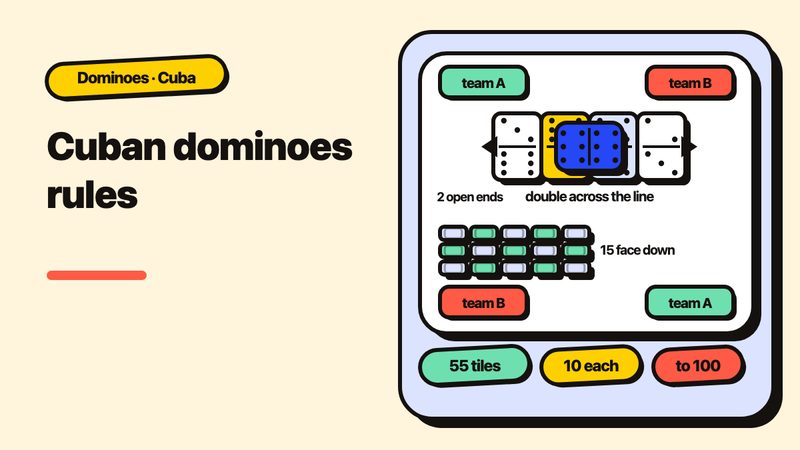
Cuban dominoes rules: four players in two partnerships deal 10 tiles each from a double-nine set of 55, and the first team to 100 points wins the game. The other 15 tiles stay face down and out of play. Play runs counter-clockwise, doubles sit across the line, and a blocked table goes to the lowest pip count. Published rule sets disagree about who opens the round, so settle that before the first deal.
What You Need to Play Cuban Dominoes
One double-nine set holds 55 tiles, numbered 0 to 9. The Spanish word for a tile is ficha.
You also want a rack each. Some tables stand the tiles up.
Paper and a pen do the scoring, one running total per team.
What you do not need matters as much: no hub, no train, no spinner, no boneyard.
The domino set sizes page prints the tile count and pip total of every set. The domino set guide sorts them by game.
A double-nine set of 55 tiles covers this deal. The listing names 55 solid hardwood tiles for 2 to 6 players.
The Deal: 10 Tiles Each and 15 Face Down
Our assumptions, before the table:
- A double-nine set holds 55 tiles, 0 to 9.
- Four players, 2 partnerships, partners opposite.
- Play runs counter-clockwise.
- The 15 tiles left out stay face down. Nobody draws them and nobody counts them.
| Set | Tiles in the set | Tiles each | Tiles out of play | Our check |
|---|---|---|---|---|
| Double-nine, partnership game | 55 | 10 | 15 | 55 = 4 x 10 + 15 |
| Double-six, partnership variant | 28 | 7 | 0 | 28 = 4 x 7 |
PAGAT records the double-six variant, with every tile in play.
Shuffle the set face down on the table. The Cuban phrase for it is darle agua, to stir water. PAGAT records that the last player to touch the pack takes their tiles last, to make cheating harder.
Each of you takes 10 tiles in turn. The 15 left on the table never come into play.
Nobody draws a replacement tile. If you cannot match, you pass, and the 15 tiles out of play never come back.
One published rule lets you ask for a redeal. Hold 5 or more doubles and you may call it before the first play. PAGAT and Miami Creation Myth print it. Table C says how often.
Who Opens the Round
No single answer exists. Three published openings disagree, so pick one before the first deal and keep it.
This page uses the version Three Guys From Miami and CoolOldGames print. Each of the 4 players draws 1 tile from the 15 that are out. The highest pip count opens the round, and those 4 tiles never play.
PAGAT prints a different version. One player from each team draws 1 tile, and the team with the higher tile opens. That team then decides which of its two players starts.
A third version comes from PAGAT and Miami Creation Myth. Draw 1 tile face down and guess whether its two ends add up to an even or an odd number. PAGAT notes that 30 of the 55 tiles have an even sum, so even is the better guess. Our own count agrees: 30 even, 25 odd.
PAGAT lists one more variant. The player holding the highest double opens the first tile. It rarely happens, because only 15 tiles sit out and the set holds 10 doubles.
After the first round, the team that won opens the next one. PAGAT and Three Guys From Miami print that.
Any tile can open the round. The Cuban word for the first tile is salida, and it need not be a double.
How a Round Is Played
Eight steps run every round.
- Shuffle face down, deal 10 tiles each, leave 15 out.
- The opener plays any tile into the middle.
- Play moves counter-clockwise, and your partner sits opposite.
- The player on your right plays next, and the chain grows from both ends.
- Each of you plays 1 tile per turn, on either end.
- Lay a double across the line, standing perpendicular to the tile it follows.
- Play any tile you can match. If you cannot, you pass and the turn moves on.
- The round ends when a player empties their hand, or the table blocks.
Two rules catch people out. A double has no special power in Cuban dominoes and does not buy you a second tile.
There is no spinner either. Only 2 ends of the chain stay open, and a tile joins on one.
Trancado: When the Table Blocks
The Cuban word for a blocked table is trancado. All 4 of you still hold tiles, and none of them fits either open end.
The player holding the fewest pips wins the round for their team. PAGAT, Three Guys From Miami, Miami Creation Myth and Mesa Cubana all print that rule.
The winning team takes the pips left in the hands of the 2 opponents. The partner's leftover tiles never count against your team, and Mesa Cubana writes that out in full.
If the 2 lowest hands tie and they belong to different teams, the round is worth 0 points. PAGAT then starts the next round with the team that did not open.
PAGAT prints one variant that changes the target. When the table blocks, the winning team counts every tile that did not come into play, the 15 included, and the game runs to 300.
Scoring: What a Hand Is Worth
Three rules do the scoring.
Only the losing team counts its own leftover tiles, and that total goes to the winning team. Three Guys From Miami and Miami Creation Myth print it that way.
The first team to 100 points wins. Other tables set the target at 150 or 200. Three Guys From Miami and CoolOldGames name 150 as the most common, and most tables play best of 3 games.
Two Cuban names sit on top of that. A pollona is a 100-point game where the other side scored nothing. A viajera, or tripollúa, is a round worth over 100 points.
Worked example 1, our own count. The losing team's 2 players hold 96 points between them. The winning team takes those 96 points and stands at 96 to 0, so the winner opens the next round.
Worked example 2, our own count. The 2 opponents hold 20 tiles worth 143 points. The winning team takes 143 and passes 100, so the game ends there.
Worked example 3, our own count. The table blocks. Your partner holds 18 points and you hold 21, while the 2 opponents hold 30 and 35. Your partner has the fewest pips, so your team wins the round and takes 30 + 35, which is 65 points. The 18 and 21 on your side are not counted.
Table B: How Many Points a Hand Can Be Worth
Our assumptions, before the table:
- The 15 tiles out of play are not counted.
- Only the 2 opponents' leftover tiles are counted.
- The expected values assume an even shuffle, not a live deal.
- The range is a boundary, not a typical hand.
| What a hand is worth | Points | How the number comes |
|---|---|---|
| The whole double-nine set | 495 | 55 tiles, sum of both ends |
| Average tile | 9.0 | 495 divided by 55 |
| Expected 10-tile hand | 90 | 10 tiles at the average weight |
| Expected 15 tiles out of play | 135 | 15 tiles at the average weight |
| Lowest score the 2 opponents can leave | 90 | the 20 lightest tiles |
| Expected score from the 2 opponents | 180 | 20 tiles at the average weight |
| Highest score the 2 opponents can leave | 270 | the 20 heaviest tiles |
Read the range as a boundary, not an average. A live deal does not hand out the 20 lightest tiles.
The 495 points match the double-nine row on our domino set sizes page.
Table C: Doubles in Your Hand
Our assumptions, before the table:
- The set holds 55 tiles, 10 of them doubles and 45 of them not.
- Each hand is 10 tiles, dealt at random.
- The last row holds 7 doubles or more.
| Doubles in your hand | Chance of that hand | Chance of at least that many |
|---|---|---|
| 0 | 0.1091 | 100% |
| 1 | 0.3030 | 89.1% |
| 2 | 0.3316 | 58.8% |
| 3 | 0.1862 | 25.6% |
| 4 | 0.0585 | 7.0% |
| 5 | 0.0105 | 1.17% |
| 6 | 0.0011 | 0.11% |
| 7 or more | 0.00006 | 0.006% |
A hand holds 1.82 doubles on average. The 40 tiles that go out hold 7.27 doubles between them.
That last column settles the redeal rule. A hand with 5 doubles or more comes up in about 1.17% of deals, and 3 or more in 25.6%. It is a rare, recorded option.
Cuban Dominoes Against the Other Variants
Our assumptions, before the table: the Cuban row follows PAGAT, Three Guys From Miami and Mesa Cubana, which agree on the partnership game.
| Variant | Players | Set | Tiles each | A round ends | A round scores | Spinner | Site page |
|---|---|---|---|---|---|---|---|
| Cuban | 4, 2 teams | double-nine 55, 15 out | 10 | hand empty or blocked | pips in the 2 opponents' hands | no | this page |
| Draw | 2 to 4 | double-six 28, boneyard | 12 at 2, 7 at 3 or 4 | hand empty or blocked | the loser's pips | no | domino rules |
| Draw, 2 players | 2 | double-six 28 | 7 or 12 | hand empty | the loser's pips | no | 2 players |
| Mexican Train | 2 to 8 | double-twelve 91 | 15 | 13 rounds | your own pips | no | Mexican Train |
| Chicken Foot | 2 to 6 | double-nine 55 | 10 | hand empty or blocked | your own pips | no | Chicken Foot |
| Moon | 3 or 4 | double-six 22 or 28 | 7 | hand empty | 1 point a trick, no pips | no | Moon |
Read the Cuban column twice. There is no boneyard, so no tile comes back, and your partner's leftovers never count against you.
Published Rules vs Common House Rules
Our assumptions, before the table: dominoes have no governing body, so every row is a published line with a name and a read date. What no source prints reads not printed. The last column is what this page uses.
| Rule | PAGAT | Three Guys From Miami | Miami Creation Myth | Mesa Cubana | CoolOldGames | Common house rule | What this page uses |
|---|---|---|---|---|---|---|---|
| Target score | 100 | 100, 150, 200 | 100 or 150 | 100 | 100, 150, 200 | 150 or 200 | 100 |
| Who opens | 1 a team draws | 4 draw 1, high opens | even or odd guess | drawn at random | 4 draw 1, high opens | the highest double | 4 draw 1, high opens |
| Blocked table | fewest pips | fewest pips | fewest pips | fewest pips | not printed | fewer pips | fewest pips |
| Blocked, 2 lowest tie | 0 points | not printed | not printed | 0 points | not printed | not printed | 0 points |
| Opens after a tie | the other team | not printed | not printed | not printed | not printed | not printed | the other team |
| 5 doubles in hand | redeal | not printed | redeal | not printed | not printed | redeal on 6 | redeal |
| Set | double-nine 55 | double-nine 55 | 55 fichas | double-nine 55 | double-nine 55 | double-six in Santiago | double-nine 55 |
| The 15 tiles out | not used | set aside | over a quarter | no boneyard | set aside | counted when blocked | out of play |
| Drawing tiles | not printed | no draw | no draw | no boneyard | not printed | a pile for 15 | nobody draws |
| Doubles | no power | no power | across the line | across the line | no power | not printed | no power |
| Spinner | not printed | no spinner | not printed | not printed | not printed | not printed | no spinner |
| Match length | not printed | best of 3 | not printed | not printed | not printed | 3 games to 2 | best of 3 |
The minority line sits outside this table. domino-play.com writes 2 to 4 players, opens on the heaviest double, and mentions a spinner. We do not use it.
Common Mistakes
Six mistakes turn a Cuban round into an argument.
- Reaching for the 15 tiles when a hand runs short. The partnership game has no draw.
- Playing a second tile after a double. One tile per turn, and a double adds nothing.
- Laying a double along the line. It goes across the line, standing perpendicular.
- Looking for a third open end. The chain has 2, and there is no spinner.
- Counting your partner's leftovers against your team. Only the 2 opponents count.
- Fixing the target at 100 without asking. 150 and 200 are both common.
Common Rules Questions
How many players play Cuban dominoes?
Four, in 2 partnerships, with partners sitting opposite each other. The set is a double-nine of 55 tiles, and the game is called domino de pareja in Cuba. PAGAT points to Aguas Calcines' 2017 book.
How many tiles are in a Cuban set, and how many does each player get?
55 tiles in the double-nine set, 10 to each player, and 15 left face down and out of play. 4 hands of 10 plus the 15 makes 55. The double-six variant gives 7 each and puts all 28 tiles in play.
What happens when nobody can play in Cuban dominoes?
The table is trancado. The player with the fewest pips wins the round for their team, and the team takes the pips left in the 2 opponents' hands. The partner's leftovers are not counted. If the 2 lowest hands tie, the round is worth 0 points.
How do you score a game of Cuban dominoes?
Only the losing team counts its own leftover tiles, and the total goes to the winning team. The default target is 100 points, 150 and 200 are also common, and most tables play best of 3 games. A 100-point shutout is a pollona, and a round over 100 points is a viajera.
Can you play Cuban dominoes with a double-six set?
Yes. PAGAT records the partnership game played with a double-six set of 28 tiles, 7 to each player, with every tile in play. Three Guys From Miami records the same tradition in Santiago. The rules stay the same, and the 15 out of play disappear.
Read next
- Domino rules hub: the draw game.
- Domino set sizes: counts and pip totals.
- How to choose a domino set: sets by game.
- Domino score calculator: the pip count of a hand.
- Mexican Train rules: a hub and trains.
- Chicken Foot rules: a cross layout.
- Moon dominoes rules: tricks, not pips.
- Dominoes for 2 players: the draw version.
How we check every number here: the methodology notes.
Sources
- PAGAT, Cuban Dominoes - domino game rules, https://www.pagat.com/domino/line/cuban.html (read 2026-11-10, page last updated 12 August 2024): the set of 55, the deal, the openings, trancado, the scoring, the double-six variant.
- Three Guys From Miami, How do you play Cuban Dominos?, https://3guysfrommiami.com/domino.html (read 2026-11-10): the targets, the opening draw, no spinner.
- Miami Creation Myth, How to Play Cuban Dominoes, https://miamicreationmyth.com/how-to-play-cuban-dominoes/ (read 2026-11-10): the even or odd opening, the redeal, the pass.
- Mesa Cubana, Double 9 Dominoes Rules, https://mesacubana.com/rules (read 2026-11-10): no boneyard, the deal, the blocked table.
- CoolOldGames, Cuban Dominoes, https://www.coololdgames.com/tile-games/dominoes/cuban/ (read 2026-11-10): the opening draw, the 15 tiles set aside.
- domino-play.com, Cuban Domino Game Rules, http://www.domino-play.com/Games/CubanDominoes.htm (read 2026-11-10): the minority line, table E only.
- Wikipedia, Dominoes, https://en.wikipedia.org/wiki/Dominoes (read 2026-11-10): the double-nine set of 55.
- Our own arithmetic covers table A, table B, table C and the 3 worked examples, set out in the methodology notes.