Moon Dominoes Rules: Bidding, Trumps and Scoring Step by Step
Moon dominoes rules: 3 players use a 22-tile set and bid tricks, 4 players use all 28 tiles in pairs, and the first player to 21 points wins. Moon belongs to the Texas 42 family, but it counts tricks instead of pips. Two choices settle the table before the first tile: which set you deal, and how high you bid.
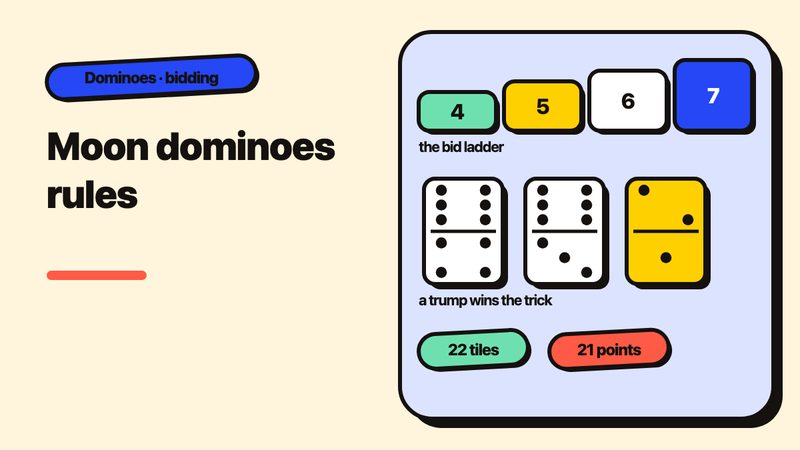
What You Need to Play Moon
One double-six set covers both versions of Moon. Three players deal 22 of those tiles. Four players deal all 28. You do not need to buy anything else.
No hub, no train and no tile holder. Moon has no track and no centre double.
A Mexican Train set carries parts. None of them does anything here. Paper and a pen do the scoring instead.
A hand holds 7 tricks. Each trick is worth 1 point. So your sheet needs one column and a running total. No cribbage board, because Moon never counts pips.
Our domino score calculator counts the pips. That is the count ordinary dominoes use. Moon does not use it.
Trumps are named out loud and written on your paper. That is the whole equipment list.
The domino set sizes page prints what each set holds. The domino set guide sorts the sets by the game your table plays.
The 3 public rule pages print no session length. They print no difficulty rating. They print no age range. Those cells read not printed.
The Moon Set: 22 Tiles, Seven Doubles and the Widow
Our assumptions, before the table. A double-six set holds 28 tiles.
Seven of them are doubles. The other 21 carry 2 different numbers.
The 3-player version removes the 6 tiles that carry a blank, from [0|1] to [0|6]. That leaves 22 tiles, 7 of them doubles.
Each player takes 7 tiles. One tile stays face down in the middle of the table.
| Set | Tiles in the set | Tiles each | Face down in the middle | Tricks in a hand | Our check |
|---|---|---|---|---|---|
| Full double-six, 4 players | 28 | 7 | 0 | 7 | 28 = 7 × 4 |
| Moon 22-tile set, 3 players | 22 | 7 | 1 | 7 | 22 = 7 × 3 + 1 |
| Moon 21-tile variant, 3 players | 21 | 7 | 0 | 7 | 21 = 7 × 3 |
Each trick in the 3-player game holds 3 tiles. 7 tricks use 21 of the 22 tiles.
The 22nd tile is the one that stays face down. PAGAT calls it the leftover tile. Follow Me 42 calls it the widow, and also a kitty.
That middle tile is not a boneyard. Nobody draws from it. Nobody looks at it while the bidding runs.
The high bidder takes it after the auction ends. Then you discard 1 tile face down, and your hand is back to 7 tiles.
One variant removes the double blank [0|0] as well. The set then holds 21 tiles. Every tile is dealt.
There is no exchange in that version. PAGAT lists it, and Follow Me 42 offers it as a switch.
The Bid Ladder: 4, 5, 6, 7 and the Shoot Contract
Our assumptions, before the table. A hand holds 7 tricks. Every trick is worth 1 point. At most 7 points sit on the table.
A made bid adds the number you bid, and nothing more. A pass costs you nothing.
| Bid | What you promise | Made | Set | Who can go over you | Source |
|---|---|---|---|---|---|
| Pass | nothing | 0 | 0 | any later bid | PAGAT Moon |
| 4 | take at least 4 tricks | +4 | −4 | 5, 6, 7, 21 | PAGAT Moon |
| 5 | take at least 5 tricks | +5 | −5 | 6, 7, 21 | PAGAT Moon |
| 6 | take at least 6 tricks | +6 | −6 | 7, 21 | PAGAT Moon |
| 7 | take all 7 tricks | +7 | −7 | 21 | PAGAT Moon |
| Shoot it over | take all 7 tricks | +21 | −21 | nobody, under PAGAT | PAGAT Moon |
| Shoot it under | take 0 tricks | +21 | −21 | nobody | Follow Me 42 only |
Every player bids once, clockwise around the table.
PAGAT picks the first bidder by chance on the first deal. It moves the bid clockwise after that. Follow Me 42 starts with the player on the dealer's left. Settle that before the first hand.
A number bid has to beat the last one. A bid of 21 stops the auction. No bid is higher than that.
Wikipedia writes that another player can shoot it over instead. That call makes their own bid worth 42 points.
The 2 players who did not bid score on their own tricks. Each of you adds 1 point for every trick you won, whether the bid was made or set.
Naming Trumps: The Nine Contracts
Our assumptions, before the table. In the 22-tile set, a number from 1 to 6 shows on 6 tiles.
One of the 7 tiles carrying that number carries a blank. It stays out. The zero suit keeps only the double blank. The set holds 7 doubles in all.
PAGAT prints 9 contracts: any of the 7 numbers, the doubles, or no trump at all. Follow Me 42 adds a 10th for the shoot it under contract.
| Contract | Trumps in this hand | Tiles that are not trumps | What the rule says | Source |
|---|---|---|---|---|
| Name 0, the blanks | 1, the [0|0] | 21 | the zero suit holds one tile | PAGAT Moon |
| Name 1 | 6 | 16 | every tile showing a 1 is a trump | PAGAT Moon |
| Name 2 | 6 | 16 | every tile showing a 2 is a trump | PAGAT Moon |
| Name 3 | 6 | 16 | every tile showing a 3 is a trump | PAGAT Moon |
| Name 4 | 6 | 16 | every tile showing a 4 is a trump | PAGAT Moon |
| Name 5 | 6 | 16 | every tile showing a 5 is a trump | PAGAT Moon |
| Name 6 | 6 | 16 | every tile showing a 6 is a trump | PAGAT Moon |
| Name the doubles | 7 | 15 | the doubles form a suit of their own | PAGAT Moon |
| No trump, follow me | 0 | 22 | the double is the highest tile of its suit | PAGAT Moon |
| Shoot it under | 0 | 22 | no trump, and the doubles rank lowest | Follow Me 42 only |
The trump count in each row is our own count on the 22 tiles. PAGAT prints 6 trumps for a named number and 1 for the zero suit.
A non-double tile can belong to 2 suits. The [5|3] sits in a 5 and in a 3.
You name a trump. Every tile with that number is a trump only. It leaves the other suit.
When the doubles are the trump, they belong to no number suit at all. The [4|4] can only follow a 4. That needs no other 4 in your hand. The [6|4] is the highest tile of the 4 suit.
Under the shoot it under contract, no trump is named. The doubles drop to the lowest rank in their suit. That way the bidder can hold doubles without taking a trick.
How a Trick Is Played
Six steps run every trick. The 4th one settles most of them.
- The highest bidder leads the first trick. Any tile will do.
- The lead is a trump. Follow with trumps if you hold any. Without one, play anything.
- The lead is not a trump. The higher number on it sets the suit. Follow that suit if you can, and play any tile if you cannot.
- A trump always wins the trick. Without a trump, the highest tile of the suit led wins it.
- The winner stacks the 3 tiles face down. Then the winner leads the next trick.
- A hand holds 7 tricks. Three players put 3 tiles on each one, so 21 of the 22 tiles reach the table.
Two rules catch people out.
A [5|3] must be played in one case. You hold no other 5 and no other 3. That goes when neither number is trump, and a 3 or a 5 is led.
A [4|4] cannot follow a 4 while you hold another 4. The doubles are a suit of their own under that contract.
Scoring: Making the Bid, Setting It, and Reaching 21
Four rules do the scoring.
Making the bid adds the number you bid. Setting it takes the same number away.
The other 2 players add 1 point for each trick they won, either way. The first player to 21 points or more wins the game. A tie on one hand goes to the higher score.
Worked example 1, from PAGAT. A bids 5 and wins 6 tricks. B wins 1, and C wins none.
A scores +5, B scores +1 and C scores nothing. The 6th trick adds no point, because the bid was 5.
Worked example 2, from PAGAT. A bids 5 and wins 4 tricks. B wins 1, and C wins 2. A scores −5, B scores +1 and C scores +2.
Worked example 3, our own count. A player sits on −5 points and bids 21. Making that bid adds 21. The new total is 16.
That is under 21, and the game goes on. PAGAT and Follow Me 42 both print that condition.
Some tables score marks instead of points. A made bid is worth 1 mark, and a set gives each of the other 2 players 1 mark. The first player to 7 marks wins the game.
Three Players or Four: The Partnership Version
Four players sit in 2 partnerships. The full double-six set of 28 tiles is dealt. That is 7 each. There is no middle tile.
The lowest bid is 4. The high bidder names the trump and leads the first trick.
The 2 partners add their tricks together. When the total reaches the bid, that team scores 1 point for each trick it won. The total can run past the bid.
If the total falls short, the team loses the bid amount. It can end up on a negative score.
Either way, the other team scores 1 point for each trick it won. A bid of 21 gives +21 for all 7 tricks. Otherwise it gives −21. The first team to 21 points wins. Some tables play best of 3.
PAGAT lists 3 house variations for that game. If the first 3 players pass, the 4th has to bid 4. Some tables allow a minimum bid of 3.
In Virginia the minimum is 5. The calls are 5 times, 6 times and 7 times. The doubles cannot be the trump there. The contract is a number or follow me.
The 21 call becomes shoot the moon. It can only be made after somebody bid 7 times. The team that shoots the moon wins the whole game, or loses it.
For 3 players, PAGAT notes that the 2 players who lost the bid often join forces against the bidder. Pushing the bidder down matters more than winning a single trick.
That stops being sensible at the end of a game, when 1 or 2 points decide it.
Moon Against Texas 42
Moon and 42 sit in the same family. Both games are trick-taking, and both use a double-six set. Both count 7 tricks in a hand. The differences sit in the scoring.
| Point | Moon | Texas 42 | Source |
|---|---|---|---|
| Players | 3 with no teams, or 4 in 2 partnerships | 4 in fixed partnerships | PAGAT Moon, Wikipedia |
| Set | 22 tiles for 3 players, 28 for 4 | 28 tiles, all dealt | PAGAT Moon, Wikipedia |
| Scoring unit | 1 point per trick, no count tiles | 1 point per trick plus the count tiles | Follow Me 42, Wikipedia |
| Points in a hand | 7 | 42 | Follow Me 42, Wikipedia |
| Bidding | 4 to 7 tricks, or 21 | 30 to 42 points, or marks | PAGAT Moon, Wikipedia |
| Target | 21 points | 7 marks or 250 points | PAGAT Moon, Wikipedia |
| Trump contracts | 9 | a suit, the doubles, or follow me | PAGAT Moon, Wikipedia |
| Special contracts | none | Nello, Plunge and Sevens | Wikipedia |
| Tricks in a hand | 7 | 7 | PAGAT Moon, Wikipedia |
The count tiles make the biggest gap. In 42 the [5|5] and the [6|4] carry points, and a hand is worth 42 points.
In Moon both tiles are worth nothing. A hand is worth 7 points. One set runs both games. The 22-tile Moon set is a double-six. 6 tiles are taken out.
Published Rules vs Common House Rules
Our assumptions, before the table. This page follows the PAGAT line for Moon.
Where the 3 public pages disagree, the table shows all 3. The last column says what we use. Anything no public source prints is marked as a house rule.
| Rule | PAGAT Moon | Wikipedia, Shoot the Moon | Follow Me 42 | Common house rule | What this page uses |
|---|---|---|---|---|---|
| Lowest bid | 4 tricks | 4 | 4, or 3 and 5 by setting | 3 or 5 | 4 |
| A bid of 21 | ends the auction, nobody bids higher | another player can shoot it over for 42 points | any shoot call ends the auction | both lines allowed | the PAGAT line |
| A 0 point contract | not printed | not printed | shoot it under, ±21 | not printed | the Follow Me 42 contract as a variant |
| Everybody passes | not printed for 3 players | not printed | redeal, or force the dealer to bid 4 | redeal | redeal |
| Not following suit | not printed | not printed | the hand ends at once and is forfeited | not printed | play the trick out and let it stand |
| The double blank [0|0] | stays in | stays in | stays in, or switch it off for 21 tiles | stays in | stays in |
| Naming trumps before the widow | some play this way | not printed | listed as an option | not printed | name trumps after the exchange |
| Marks instead of points | first to 7 marks | points only | a marks7 option | marks | points |
| A hand is worth | 7 tricks, 1 point each | 1 point per trick | 7 points | 1 point per trick | 1 point per trick |
| The 2 players who lost the bid | they often team up against the bidder | not printed | not printed | not printed | the note in the partnership section |
The lowest bid, the 21 call and the pass rule decide how the table starts. Settle them before the first hand.
Common Mistakes
6 mistakes turn a Moon hand into an argument.
Each one comes from reading Moon like an ordinary domino game. Others come from mixing 2 of the published lines.
- Counting pips on the tiles. Moon scores tricks, so the [5|5] and the [6|4] are worth 0 points, and every trick is worth 1.
- Dealing 28 tiles to 3 players. The 3-player set holds 22, because the 6 tiles from [0|1] to [0|6] stay out.
- Following a suit with a tile that carries the trump number. Once a number is trump, every tile showing it is a trump only.
- Playing the [4|4] to follow a 4 while you hold another 4. Under the doubles contract, that double is only legal when you hold no other 4.
- Scoring 6 points for a bid of 5 that took 6 tricks. A made bid scores the number you bid, and nothing more.
- Treating a 21 bid as a win from a negative score. The new total has to reach 21, so −5 plus 21 is 16, and the game continues.
Common Rules Questions
How many players does Moon take?
Three or four. Three players play a partnerless game with 22 tiles, 7 each. Four players play in 2 partnerships. All 28 tiles are dealt, 7 each.
A four-player hand still holds 7 tricks. Each one has 4 tiles. The 3-player version is the more popular one in Texas, and the 4-player version is common in the Tidewater area of Virginia.
Why does Moon use 22 tiles?
Because the double-six set holds 6 tiles that carry a blank. Remove the [0|1] through the [0|6] and 22 tiles remain: 7 doubles and 15 tiles with two numbers.
Each player takes 7. 1 tile stays face down in the middle. PAGAT and Follow Me 42 print the same removal.
A 21-tile variant drops the double blank as well. Then every tile is dealt.
What does a bid of 21 mean in Moon?
It is a contract to take all 7 tricks, worth +21 if you make it and −21 if you set it.
PAGAT says the auction ends there, because no bid is higher. Wikipedia says another player can shoot it over. That call is worth 42 points.
Follow Me 42 adds a nil contract, shoot it under. It is worth ±21 for taking 0 tricks.
How do you score Moon?
Making the bid adds the number you bid. Setting it takes the same number away. The other 2 players add 1 point for each trick they won, either way.
Nobody scores extra for taking more tricks than they bid. The first player to 21 points wins the game, and some tables score marks instead, to 7 marks.
Who names the trump, and when?
The highest bidder does, after taking the middle tile and discarding 1, and before the first trick.
PAGAT prints 9 contracts: any of the 7 numbers, the doubles, or no trump at all. Follow Me 42 adds shoot it under, where no trump is named and the doubles rank lowest in their suit.
Read next
The domino rules hub covers the ordinary draw game, the 28-tile set and how a chain grows.
The domino set sizes page prints the tile count, the doubles and the pip total of every set. The 22 tiles of Moon come out of the 28.
The domino set guide sorts the sets by game and by player count. That is the choice you face before the first deal.
Our domino score calculator scores the pip count. That is the count ordinary dominoes use. Moon counts tricks. Read that page to see the difference.
If your table plays the track game with a hub and trains, that is Mexican Train. How we check every number here: the methodology notes.
Sources
- PAGAT, Moon: domino game rules, https://www.pagat.com/domino/trick/moon.html (read 2026-11-06): the 22-tile set, the deal, the bidding, the 9 trump contracts, the play, the scoring, the target of 21 and the 4-player version.
- Wikipedia, 42 (dominoes), the Variations section, "[Shoot the] Moon", https://en.wikipedia.org/wiki/42_(dominoes) (read 2026-11-06): the 22-tile set, the minimum bid of 4, the target of 21, and the shoot it over worth 42.
- Follow Me 42, Moon Rules: Three-Hand 42, https://followme42.com/howtoplay-moon (read 2026-11-06): the widow exchange, the bid ladder, the shoot it under contract, the all-pass rule and the marks option.
- PAGAT, Texas 42: domino game rules, https://www.pagat.com/domino/trick/42.html (read 2026-11-06): the suit and rank system that Moon borrows, and the family comparison above.
- Our own arithmetic covers the tile counts and the checks in table A, the bid values in table B, the trump counts in table C and the 3 worked examples. It is set out in the methodology notes.