Mahjong Tile Materials: How to Tell Bone, Bamboo, Bakelite, Catalin and Modern Plastic Apart
Most old mahjong sets you'll find in a closet or at an estate sale are one of two things. Bone tiles joined to a bamboo back usually date from the 1920s to the 1940s; solid yellow-orange Bakelite or Catalin, mostly from the 1930s to the 1960s. Modern sets are melamine, acrylic or other plastics. You can tell the main types apart by looking, with no tests that mark the tiles.
This page helps you identify the material. It doesn't put a value on a set; for that, ask a specialist appraiser who can see the tiles.
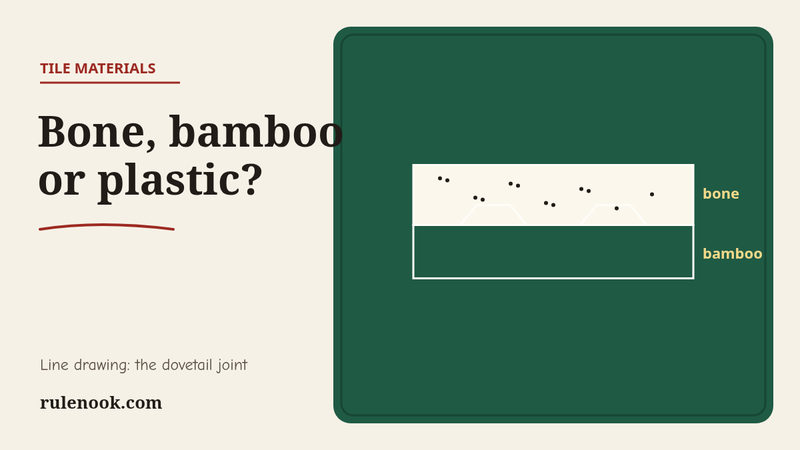
How do the materials compare?
| Material | Typical era | What you see | What you feel |
|---|---|---|---|
| Bone and bamboo | 1920s to 1940s | White or cream face joined to a brown bamboo back by a dovetail; tiny dark pores or streaks on some tiles | Two layers; light for the size |
| Solid bamboo | Inexpensive older sets | One piece of bamboo, often curved on both faces | Light; can rock on a table |
| Bakelite | Mostly 1930s to 1960s | Opaque, often butterscotch yellow; fairly sharp edges | Dense and heavy |
| Catalin | Same period | Often more rounded edges; can look slightly translucent | Dense |
| Celluloid ("French ivory") | Early 20th century | Fine, very regular parallel lines meant to imitate ivory | Light |
| Ivory | Rare | Wavy grain and a cross-hatch pattern visible in strong light | Collectors treat it as rare |
| Reconstituted fishbone | Modern, from about the 1990s | Very white, no pores, very even dovetails, sharp edges | Uniform |
| Melamine, acrylic, other plastics | Current | Uniform color; engraved and painted faces | Varies by maker |
Treat "typical era" as a starting point. Materials overlap. Sets get mixed.
How can you tell bone from ivory?
Look for pores. Bone carries the remains of its blood-vessel channels, which show up as tiny dark dots or short streaks. They may appear on only a few tiles in a set, so check all 144 or so, not just 1 or 2. A 10x hand lens helps.
Ivory has no pores. In strong light it shows a wavy grain and, often at the edges, a cross-hatch or "stacked chevron" pattern. Ivory sets are rare. Doubt the label. When in doubt, assume bone.
A legal note, not legal advice: buying and selling ivory is restricted under US federal law and in several states. If a set may be ivory, check the rules where you live before buying or selling it.
How can you tell Bakelite from Catalin?
Both are phenol-formaldehyde plastics, and both were used for American sets after the 1920s craze, with Bakelite most common in the 1930s. Collectors go by 2 rules of thumb: Bakelite tiles are opaque with sharper edges, while Catalin tiles tend to have rounder edges and can look slightly translucent when you hold 1 up to a lamp. Some Catalin sets came with a maker's label in the box, which settles it.
Skip the hot-pin, scrub and chemical tests. They scar tiles.
How do jokers and flowers help date an American set?
Jokers. Collectors use them as a dating clue. The National Mah Jongg League didn't require jokers until the early 1960s, so a Bakelite set with no real joker tiles is likely older. Many such sets were later given joker stickers on spare or flower tiles.
Count the flowers too. Older American sets often had a different number of flowers than today's 8, and that count can be matched against the requirements printed on cards from past years, from the 1930s on.
For play under today's rules you need 8 jokers in a 152-tile game. Our tile count page lists exactly what a modern game uses, so you can compare an old set's contents line by line.
What else helps you place an old set?
Western numerals: a set with Western corner numbers was made for export, and wasn't sold before 1920.
The box: with bone and bamboo sets in wooden boxes, a front panel that slides up to reveal drawers generally points to the early 1920s. A lid that slides off the top is usually later.
Fishbone: if the bone looks perfectly white, perfectly even and has no pores anywhere, it's probably modern reconstituted fishbone from about the 1990s, not antique bone.
Common questions about old sets
Can you play with an antique set today?
Yes, with care. Count all 144 to 166 tiles first. A 1920s set may lack jokers entirely. American play under today's card needs 8, usually added as stickers on blanks or spares. Old tiles can be thicker or smaller than modern ones and may not sit well in modern racks. Chinese and Hong Kong play needs no jokers, so old sets often suit it better.
How do you clean bone and bamboo tiles?
Gently, and dry. A soft dry cloth removes most dust. No water. Soaking can loosen the dovetail joint on 1920s tiles or lift 100-year-old color from the engraving. If tiles are stained or cracked, ask a conservator before trying anything stronger. Mistakes are permanent.
Is my set worth money?
We don't appraise sets. Value depends on material, completeness, condition, the box and the maker, and only someone who can handle the tiles can judge those together. What you can do yourself: identify the material with the cues above, count every tile, and note any jokers, flowers and blanks. That's the information an appraiser will ask for first.
What to read next
- How to choose a mahjong set
- Mahjong tiles explained: 136, 144, 152 and 166
- Mahjong tile size guide
- All mahjong rules
Sources: Sandy Beach and Tom Sloper, Mah-Jongg FAQ 7c (identifying tile materials, and the advice against marking tests). Tom Sloper, FAQ 7g (dating a set by material, box, Western numerals and jokers). Both read 2026-10-10. No values or appraisals are given. Last updated 2026-10-10.
Sources
- Sandy Beach and Tom Sloper, Mah-Jongg FAQ 7c: How to identify what your tiles are made of (sloperama.com, read 2026-10-10)
- Tom Sloper, Mah-Jongg FAQ 7g: Determining the age of a set (read 2026-10-10)