All Fives Dominoes Rules: Scoring, Spinners and the Muggins Rule
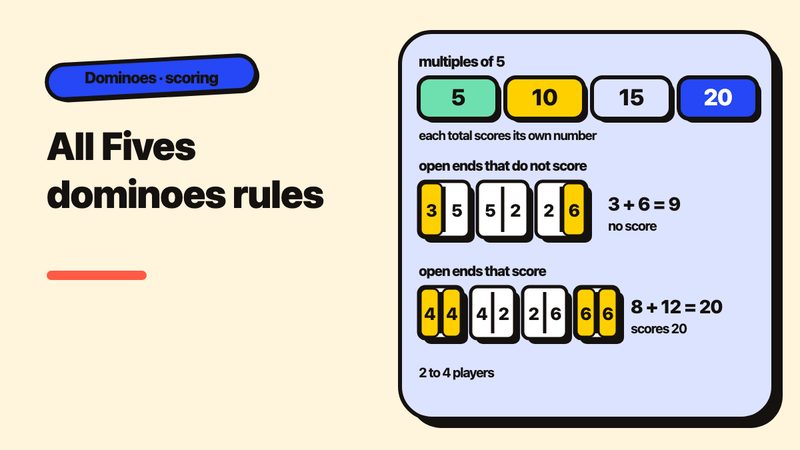
All Fives dominoes rules come down to one habit. Add the open ends, and you score when the total lands on a multiple of 5. The scale runs 5, 10, 15 and 20 without a spinner. With one, it runs to 35.
A double-six set of 28 tiles fits 2 to 4 players, and every published version of the game deals from that same set of tiles.
Two details shift with the version you play. The US rules deal 9 tiles each to 2 players and use a spinner. Muggins deals 7 and has none.
What You Need to Play All Fives
Three things go on the table: tiles, a way to count, and a layout you agree on.
The tiles are a double-six set, and PAGAT's All Fives page and its Muggins page both name 28 tiles. Wikipedia is looser. Any of the common sets works.
A double-nine holds 55 tiles. A double-twelve holds 91. If you want the tile counts, our domino set sizes page has them. So do the pip totals.
If the set is still open, our domino set guide helps. It sorts the options by game and by player count, which is the number that matters once you sit down.
Counting matters because you add the score as it is made, and PAGAT recommends a cribbage board for both versions. Paper works too.
Holsey and Tidwell describe a paper method for All Fives. Two crossing lines make a large X worth 10.
A small x in each of the 4 spaces around it adds 10 more, and a completed symbol is worth 50. A single turn worth 10 can be a small o.
Our cribbage board guide covers the peg tracks. Read it if you keep the score on a board.
The layout is the third thing to settle. It depends on which version you play. The US rules play the first double in the middle. It becomes a spinner. The layout grows out from it in up to 4 arms.
Muggins has no spinner at all. Its layout stays a single line from end to end. So the tables differ.
Setup: Deal, Boneyard and the First Tile
6 published ways to deal the tiles sit in the table below, and they differ mostly in hand size. Every one of them still uses the same 28 tiles.
Our assumptions, before the table. A double-six set holds 28 tiles. The boneyard count is 28 minus the tiles each times the number of players.
So the US deal leaves 28 minus 18. That is 10 tiles with 2 players. With 4 players it leaves 28 minus 20. That is 8.
Count them yourself before the first hand. The tile counts in the table are the published ones, and the boneyard numbers are our own count, printed on no rule page.
| Published deal | 2 players | 3 players | 4 players | Where the deal comes from |
|---|---|---|---|---|
| PAGAT All Fives, US version with one spinner | 9 each, 10 in the boneyard | 7 each, 7 in the boneyard | 5 each, 8 in the boneyard | PAGAT All Fives, read 2026-11-05 |
| PAGAT Muggins, no spinner | 7 each, 14 in the boneyard | 5 each, 13 in the boneyard | 5 each, 8 in the boneyard | PAGAT Muggins, read 2026-11-05 |
| European source quoted by PAGAT | 7 each, 14 left | 5 each, 13 left | 5 each, 8 left | PAGAT All Fives variations, read 2026-11-05 |
| Holsey, The Dominologist (2008) | 7 each for beginners or 9 each, so 14 or 10 left | 7 each or 9 each, so 7 or 1 left | 5 each or 7 each, so 8 or 0 left | PAGAT All Fives variations, read 2026-11-05 |
| Newsome and Born, Play Dominoes Like a Champion (2021) | 7 each, 14 left | 7 each, 7 left | 7 each, 0 left, no boneyard | PAGAT All Fives variations, read 2026-11-05 |
| Wikipedia | 7 each, 14 left | 7 each, 7 left | 5 each, 8 left | Wikipedia, Muggins, read 2026-11-05 |
Five players is the odd case. Newsome and Born deal 5 tiles each to 5 players. That leaves 3 tiles in the boneyard. No other source counts past 4.
Who leads the first hand is a small disagreement. Settle it before you deal. PAGAT draws the lot for the first hand in both versions.
Then the lead goes to the player who ran out of tiles, and when the last hand was blocked the lot is drawn again.
Wikipedia names the player holding the heaviest double, or the heaviest single if nobody holds a double. Any tile can be led. No double is required.
In the US version the first double played becomes the spinner. Only that double does. The next tile goes against one side of it, and the tile after that goes against the other side.
Both sides are covered before the layout grows any arms. In Muggins every double is turned across the chain. None of them is a spinner.
How a Turn Works: Matching the Open Ends
- Play a tile that fits. A tile must match the number on an open end of the layout, and if you hold one that fits, you play it.
- Draw when nothing fits. Keep drawing until you hold a tile that plays, then put it down at once, and pass when the boneyard is empty.
- Turn a double across the chain. Both halves count at the head, so [5|5] is 10 and [6|6] is 12.
- Count the open ends. The 2 ends of the layout are added, and a total that is a multiple of 5 scores that number.
Two rules in steps 1 and 2 are where tables disagree, and PAGAT's US rules make it illegal to draw while you hold a playable tile.
The same page lists drawing anyway as a house variation, and some tables even let you keep drawing after a playable tile turns up.
The US version changes which ends you add. The spinner counts until tiles sit against both of its sides, and then it drops out of the count.
Its open ends still accept tiles even after it stops counting, while a third arm adds a third end and a fourth arm adds a fourth.
Our domino rules hub explains the ordinary chain, where no double ever opens a new direction.
Scoring: How the Multiples of Five Count
The score for a move is the total of the open ends, and it counts only when that total is a multiple of 5. The values below run from 5 to 35.
PAGAT gives 35 as the ceiling for the US version. Our assumptions, before the table. The points column counts the multiple itself.
PAGAT's All Fives page and its Muggins page score a play that way. Wikipedia does too.
The board column is our own division. A total of 10 becomes 2. PAGAT prints the rule rather than the column, and a double at the head of the chain counts both halves.
The ends column is ours too. 2 ends carry at most 12 + 12 = 24, so 25 and 30 need a third end, and 35 needs a fourth.
PAGAT's 35 point example puts the [6|6], the [5|5] and the [4|4] on 3 arms, with a 5 on the fourth.
| Open ends total | Points as counted | Points on the cribbage-board scale | Ends needed | Where the row comes from |
|---|---|---|---|---|
| 5 | 5 | 1 | 2 | PAGAT All Fives; PAGAT Muggins; Wikipedia |
| 10 | 10 | 2 | 2 | PAGAT All Fives; PAGAT Muggins; Wikipedia |
| 15 | 15 | 3 | 2 | PAGAT All Fives; PAGAT Muggins; Wikipedia |
| 20 | 20 | 4 | 2 | PAGAT All Fives; PAGAT Muggins; Wikipedia |
| 25 | 25 | 5 | 3 | PAGAT All Fives |
| 30 | 30 | 6 | 3 | PAGAT All Fives |
| 35 | 35 | 7 | 4 | PAGAT All Fives |
The first 4 totals need only the 2 ends of a line, and both versions can reach them. The last 3 need 3 or 4 ends. Only a spinner game has that many.
PAGAT's Muggins page puts the ceiling for one play at 20 points. It comes from the [6|6] at one end, and the [4|4] sits at the other.
The US page puts the ceiling at 35. That needs the [6|6], the [5|5] and the [4|4] on 3 arms, and a 5 sits on the fourth.
Worked example 1, a head double. The chain head is the [5|5] and a 5 on the other side, and both halves count, so 10 and 5 add up to 15.
The player scores 15. On a cribbage board that is 3 points.
Worked example 2, a plain pair. The chain head is a 4 and a 6, so the total is 10 and the player scores 10, which is 2 points on a cribbage board.
Nothing about this move needs a double or a spinner.
Worked example 3, a move that scores nothing. The chain head is a 6 and a 3, a total of 9, and a player then lays the [6|4] against the 6.
The new head is a 4 and a 3. The total is 7. The move scores nothing either.
The scale you keep matters as much as the count, and PAGAT's US page says it is common to divide every score by 5.
Divide by 5. A total of 15 on the ends then becomes 3 points, the game fits a cribbage board, and the target becomes 61.
Its Muggins page records the other scale. There, 1 point is scored for every 5 in the total, so 10 is 2 points, 15 is 3 points, and 20 is 4 points.
If you are the player who runs out of tiles, you also get 1 extra point on that scale.
The Muggins Rule, the Spinner and the Family
The muggins rule is the one rule the game is named after. Say the number. Wikipedia states it plainly: a player who plays a scoring tile has to announce the count.
If the player stays quiet, an opponent can call "Muggins!" and the score is forfeited, and some rules let the caller take the points instead.
Wikipedia also notes that most rule books print the announcement. They leave out the call and the forfeiture. Check your table.
PAGAT's Muggins page asks for the same announcement from another direction, since each player tells the scorekeeper the total of the 2 ends so it can be pegged.
The names in this family describe the number of spinners, and the spinner decides the shape of the layout on the table. PAGAT's family page lists 3 basic variations of it. One line, or a cross.
One spinner, or none. No spinners is Muggins, and it gives a single line. Only the first double is a spinner in the US All Fives. That gives a cross.
Muggins and All Fives are more common in Britain and Europe. The same page says so. In Five Up every double is a spinner, and that gives a tree. Five Up is more common in the southwestern United States.
| Rule point | All Threes | Fives and Threes |
|---|---|---|
| What counts | Multiples of 3 (PAGAT Muggins variations) | Multiples of 5 and of 3, and both can stack (PAGAT Fives and Threes) |
| Score for a total | 1 point for every multiple of 3 | 1 point for every 5 and 1 for every 3 |
| Most in one play | 6 points, from a total of 18 | 8 points, from a total of 15 |
| The deal | The Muggins line game (PAGAT Muggins variations) | 7 each for 2 players, 5 each for 3, 5 each for 4 (PAGAT Fives and Threes) |
| Drawing | Draw from the boneyard as in Muggins | No drawing at all: a player who cannot play knocks |
| Going out | 1 extra point, or one third of the largest hand rounded | 1 point for the player who chips out, and no point when the game is blocked |
| Target | The Muggins target of 250 or 200 | Exactly 61 on a cribbage board; 31 and 121 also appear |
The totals that Fives and Threes scores are set out below, where every 5 and every 3 in the total counts as 1 point, so a total of 15 pays 8.
| Open ends total | Points scored | How the points split |
|---|---|---|
| 3 | 1 | one 3 |
| 5 | 1 | one 5 |
| 6 | 2 | two 3s |
| 9 | 3 | three 3s |
| 10 | 2 | two 5s |
| 12 | 4 | four 3s |
| 15 | 8 | three 5s and five 3s |
| 18 | 6 | six 3s |
| 20 | 4 | four 5s |
Fives and Threes is stricter at the end of a hand. The target is exactly 61. A score that would take a player past 61 is thrown away.
So a player on 58 who scores 4 stays on 58.
PAGAT's page also records that the game is often played to 31 or to 121, and that championship play deals 9 tiles each to 2 players and 6 each to 4.
The two names have a long paper trail. Wikipedia dates All Fives, Fives and Cribbage Dominoes to 1863, when 5 spots counted as 1 point and the game was played to 31 on a cribbage board.
The Muggins rules followed in 1864 in The American Hoyle, and the cribbage board was dropped there. 5 spots became worth 5 points, and the target was 200 for 2 players.
The muggins rule itself was added in the 1868 edition of The Modern Pocket Hoyle. The names have been mixed together ever since.
How a Hand Ends and Who Wins
A hand ends when one player plays the last tile in their hand. It can also block. No player can play any more.
The player who goes out wins. When the table is blocked, the player with the fewest pips left wins.
The winner then collects the pips left in the opponents' hands, rounded to the nearest multiple of 5, and the table below starts at 0.
A player can be left with no tiles at all. Our assumptions, before the table: each band is 5 pips wide and rounds to the nearest multiple of 5.
Round to 5. So 2 points rounds down to 0. And 3 points rounds up to 5. Your hand holds at most 9 tiles. A tile carries at most 12 pips.
The bands past 60 follow the same rule, and the rounding column is our own count, since PAGAT prints 2 examples and Wikipedia prints 2 more.
| Points left in hand | Rounded to the nearest 5 | Points on the cribbage-board scale |
|---|---|---|
| 0 to 2 | 0 | 0 |
| 3 to 7 | 5 | 1 |
| 8 to 12 | 10 | 2 |
| 13 to 17 | 15 | 3 |
| 18 to 22 | 20 | 4 |
| 23 to 27 | 25 | 5 |
| 28 to 32 | 30 | 6 |
| 33 to 37 | 35 | 7 |
| 38 to 42 | 40 | 8 |
| 43 to 47 | 45 | 9 |
| 48 to 52 | 50 | 10 |
| 53 to 57 | 55 | 11 |
| 58 to 60 | 60 | 12 |
The 4 published examples line up with those bands: PAGAT's losing hand of [1|2] is 3 pips, and it rounds up to 5.
Its [1|1] is 2 pips and rounds down to 0, while Wikipedia scores 25 for a hand of 27 pips and 30 for a hand of 28.
Two conventions sit side by side at the end of a hand, and PAGAT's US page says the winner takes the pips in the opponents' hands.
Wikipedia agrees, and adds that a blocked hand is often settled by subtracting the winner's own pips from the total.
PAGAT's Muggins page does the opposite, since each player rounds the pips in their own hand to the nearest 5 and subtracts that from their own total.
The target depends on the table and the scale, and PAGAT's 2 pages agree on 250 points for 2 players and 200 points for 3 or 4.
The Muggins page adds that 4 players can pair up and play for 250, and when the scores are divided by 5 for a cribbage board the target becomes 61.
A blocked hand has its own tie rule: in a 2-player or 4-player game nobody scores, and in a 3-player game 2 players tied for the lightest hand split the third player's points.
Ordinary dominoes settle a hand in a different way, where the winner takes the pips on the opponent's tiles and the winner's own tiles count for nothing.
Our domino score calculator works through that count.
Official Rules vs Common House Rules
Our assumptions, before the table: the published column quotes the rule pages named in each cell, all read on 2026-11-05.
The house column holds the table agreements we did not find printed in a rulebook, and the last column is our own choice for this page rather than an external standard, so you can change it.
Pick one version and write it down, so your table agrees. Settle the differences before the first deal.
| Rule point | Published rule | Common house rule | What this page uses |
|---|---|---|---|
| Tiles each | 9 each for 2 players, 7 for 3, 5 for 4 (PAGAT All Fives). 7, 5, 5 in Muggins (PAGAT Muggins) | One size for every table, often 7 each | The US deal of 9, 7, 5 for the spinner version and 7, 5, 5 for the line version |
| Spinner | Only the first double is a spinner in the US version (PAGAT All Fives). Muggins has none (PAGAT Muggins) | Every double opens a new arm, as in Five Up | One spinner in the US version and none in Muggins |
| Scoring unit | Score the multiple itself, so 15 for 15 (PAGAT All Fives; PAGAT Muggins; Wikipedia). PAGAT also prints the divided-by-5 scale and a target of 61 | 1 point for every 5, counted to 61 | The multiple itself, with the divided scale kept in table A |
| Announcing the count | The muggins rule: announce the count, and a silent scoring tile can be called Muggins! and forfeited (Wikipedia). PAGAT's Muggins page asks every player to announce the total for the scorekeeper | Silent scoring, and nobody calls | Announce every scoring total, and call Muggins! when a player stays quiet |
| A double at the head of the chain | Both halves count, so [5|5] is 10 and [6|6] is 12 (PAGAT All Fives; PAGAT Muggins) | Count one half, or count the double only once it is covered | Both halves count |
| Who leads | The lot for the first hand, then the player who ran out of tiles (PAGAT All Fives; PAGAT Muggins). Wikipedia names the heaviest double | The same seat leads every hand, or the player to the left of the last lead | The lot for the first hand, then the player who dominoed |
| Drawing with a playable tile | Illegal in the US version, since a player who can play must play (PAGAT All Fives). PAGAT lists drawing anyway as a variation | Draw first and keep looking for a better tile | Play when you can play |
| Score at the end of a hand | The winner takes the pips in the opponents' hands, rounded to the nearest 5 (PAGAT All Fives; Wikipedia). PAGAT's Muggins page rounds each hand and subtracts it from that player's own total | Every player subtracts their own leftover pips | The winner takes the opponents' pips, rounded to the nearest 5 |
| A blocked hand | The player with the fewest pips wins (PAGAT All Fives; Wikipedia) | The winner of the last hand wins the blocked hand | Fewest pips wins |
| A tie | Nobody scores in a blocked 2-player or 4-player game, and 2 players tied for lightest in a 3-player game split the third player's points (PAGAT All Fives) | Split the points between the tied players | The published rule, as printed in the row above |
| Target score | 250 for 2 players and 200 for 3 or 4 (PAGAT All Fives; PAGAT Muggins), or 61 on a cribbage board | 100 points for a short game | 250 for 2 players and 200 for 3 or 4 |
| The last tiles in the boneyard | Some tables never draw the last tile or the last 2 tiles, and the game is blocked when nobody can play (PAGAT All Fives variation) | The boneyard always empties | Draw until the boneyard is empty, then pass |
Two rows carry the most weight at a table. The scoring unit changes every number you write down, and the muggins rule decides whether a quiet scoring tile stands.
Common Mistakes
6 errors come up most often. Each one has a published line that settles it.
- Counting a crosswise double as one half. A [5|5] at the head of the chain is 10. A [6|6] is 12.
- Playing a scoring tile without saying the number. The muggins rule lets an opponent call "Muggins!". The score is then forfeited.
- Drawing from the boneyard while a playable tile sits in your hand. The US rules make that illegal.
- Counting the spinner after it is covered. Once tiles sit against both sides, the spinner drops out. Only the open ends count.
- Rounding the leftover pips to the nearest 10. Or rounding 3 pips up to 10. The rule rounds to the nearest 5.
- Dealing the wrong hand size. The US version deals 9 tiles each to 2 players. The line version deals 7.
The first error and the fourth share a cause. The count is made on the open ends. A double is 2 open ends until it is covered.
Common Rules Questions
How many dominoes do you deal for All Fives?
The US rules deal 9 tiles each to 2 players. They deal 7 to 3 players and 5 to 4. Muggins deals 7, 5 and 5. PAGAT prints both deals. Wikipedia prints 7 each for 2 or 3 players. The boneyard holds the rest of the 28 tiles. You draw from it when nothing fits.
Is Muggins the same as All Fives?
They are the same family. The names have been mixed for a long time. Wikipedia says Muggins is the game without a spinner. Sniff and the modern All Fives have one spinner. Five Up makes every double a spinner. PAGAT uses Muggins for the line version.
How do you score All Fives?
Add the open ends of the layout. When the total is a multiple of 5, you score that number. So 5, 10, 15, and up to 20 without a spinner. A double at the head of the chain counts both halves.
What is the muggins rule?
A player who plays a tile that scores has to announce the count. If you say nothing, an opponent can call "Muggins!" and the score is forfeited. Some rules hand the points to the caller. Wikipedia notes that most rule books print the announcement. They leave out the call. Check which version your table uses.
What happens when the hand is blocked in All Fives?
The player with the fewest pips left wins. You take the opponents' pips rounded to the nearest 5. So 27 pips counts 25. A tie for the lightest hand means nobody scores in a 2-player or 4-player game. In a 3-player game the 2 tied players split the rest.
Read next
Our domino rules hub holds the set, the chain and one turn. It also covers the doubles on it.
The domino score calculator works through the ordinary count. There you find the rule where the winner takes the opponent's pips.
The two-player page covers the standard two-handed deal. The domino set sizes page lists the tile count of every set, so you can check your own.
How we check numbers and name sources: our methodology. The scoring tools page collects the calculators in one place.
Sources
- PAGAT, All Fives: domino game rules, https://www.pagat.com/domino/cross/all_fives.html. Read 2026-11-05. Gives the US deal of 9, 7 and 5. Gives the spinner rule and the totals from 5 to 35. Gives the blocked hand, the tie rules, the targets of 250 and 200, and the divided scale with 61.
- PAGAT, Muggins: domino game rules, https://www.pagat.com/domino/line/muggins.html. Read 2026-11-05. Gives the deal of 7, 5 and 5. Gives the ceiling of 20 in one play. Gives the announcement for the scorekeeper. Also the rounding of each hand.
- PAGAT, The Fives and Threes Family, https://www.pagat.com/domino/fives_family.html. Read 2026-11-05. Gives the 3 spinner variations and the layout each one gives. Gives the naming of Muggins, All Fives, Sniff and Five Up.
- PAGAT, Fives and Threes: domino game rules, https://www.pagat.com/domino/line/fives_and_threes.html. Read 2026-11-05. Gives the deal of 7, 5 and 5. Also the knock instead of a draw. Gives the totals from 3 to 20, the point for going out, and the target of exactly 61.
- Wikipedia, Muggins, https://en.wikipedia.org/wiki/Muggins. Read 2026-11-05. Gives the muggins rule and the call. Gives the deal of 7 or 5. Also the lead from the heaviest double. Gives the rounding of 27 to 25 and of 28 to 30, and the history of the 2 names.
- Our own arithmetic covers the board-scale column in table A and the boneyard column in table B. It covers the rounding column in table D, the Fives and Threes totals table and the three worked examples. The working notes carry the sums.
- How we check numbers and name sources: our methodology.