How to Choose a Cribbage Board: Holes, Tracks, Pegs and Size
Links marked (paid link) go to Amazon. We have not tested these products; this page compares listed specifications only.
A standard cribbage board has 121 holes per track: 120 scoring holes plus 1 game hole at the end. Each player or team gets one track and 2 pegs. A 2-track board serves 2 players or 2 partnerships, while 3 players each scoring alone need a 3-track board, because nobody can share a track.
Pick the track count first. Then the layout, then the size. That order covers almost every board on the market.
How many holes are on a cribbage board?
| Board | Scoring holes | Game hole | Who it serves |
|---|---|---|---|
| 2-track | 240 (2 x 120) | 1 shared or 1 per track | 2 players, or 4 in partnerships |
| 3-track | 360 (3 x 120) | 1 shared or 1 per track | 3 players |
| 4-track | 480 (4 x 120) | 1 shared or 1 per track | 4 players; partners can share |
The American Cribbage Congress divides the 120 scoring holes into 4 "streets" of 30: holes 1 to 30, 31 to 60, 61 to 90 and 91 to 120. Most boards also group the holes in fives with a small gap between groups, which makes counting a 12-point hand fast and hard to get wrong.
The ACC also requires "long boards" for its tournaments, meaning 60 holes up and 60 holes down per track. Some older and smaller boards have only 60 holes per track, 30 up and 30 down, and on those you go around twice to finish a 121-point game. That works, but it's easier to lose your place.
How many pegs do you need?
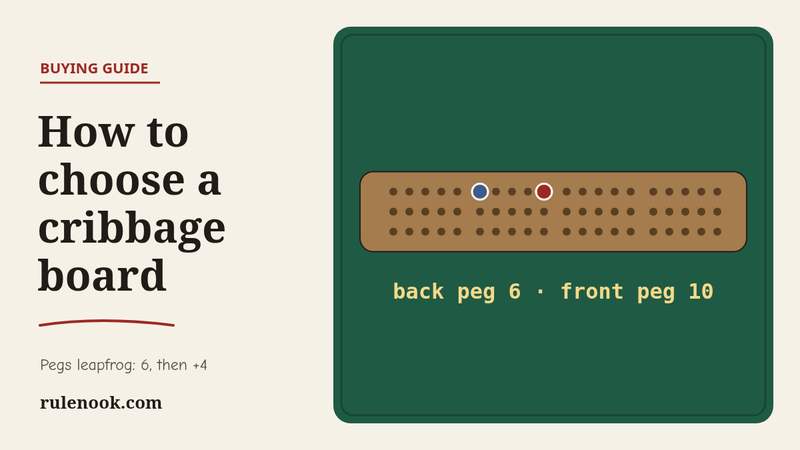
Two per player or team. They leapfrog. Your front peg shows your score; your back peg shows where you were before.
Example: you score 6, so you move your back peg 6 holes past the start. Next you score 4, and the peg now at the rear jumps 4 holes past the front one, landing on 10, and the gap between your pegs (6 to 10) shows your last score. An opponent can check it at a glance. No arithmetic needed.
Some boards add a third peg per player, or a separate row of holes, to count games won in a match. For 3 players you need 6 pegs in 3 colors.
What should you check on a listing?
- Track count: 2, 3 or 4. This decides how many people can play on it.
- Layout: a classic long board runs 60 up and 60 down. A continuous track winds 120 holes in one path, so you never turn a corner of the board.
- Holes per track: look for 120 plus a game hole, or "121". A board with 60 per track means going around twice.
- Size: listings give inches. A Drueke 3-track club board lists 17 1/8 x 7 1/4 x 3/4 in. (43.5 x 18.4 x 1.9 cm). A 2-track continuous board from House of Cribbage lists 12 in. long.
- Pegs: material and length. That Drueke board lists 2-inch plastic pegs. Metal pegs survive being dropped on a hard floor, while very small pegs are hard to grip for anyone with stiff fingers.
- Storage: a drawer or sliding lid for pegs and a deck, if you travel with it.
- Markings: a skunk line at hole 90 or 91 and clearly separated tracks help you read the score.
Which board fits how you play?
2 tracks
3 tracks
4 tracks
Do partners need a 4-track board?
Not under standard rules. Two tracks do the job. In 4-player cribbage, partners score together, so 2 tracks are enough and each team keeps one. A 4-track board helps if each player wants to see their own contribution, and it also makes switching to a 3-player game easy on a night when someone leaves early. For the full partnership rules, see 3- and 4-player cribbage.
What is the skunk line?
A mark on many boards, usually between holes 90 and 91. The ACC defines a skunk as winning by 31 or more points, so if you reach 121 while your opponent is still on 90 or below, it's a skunk. ACC scorecards record a normal win as 2 game points and a skunk as 3. Hole 90 even has a name: the stink hole.
House rule: casual games can treat a skunk as an ordinary win. Agree before you start.
What to read next
Sources: American Cribbage Congress, Official Rules (2025), rule 1.4 (long boards, 60 up and 60 down) and the glossary (streets of 30 holes). Board and peg dimensions from Cribbage Supply and House of Cribbage listings, read 2026-10-10. Hole counts and conversions are our arithmetic, rechecked by script; see our methodology. Last updated 2026-10-10.
Sources
- American Cribbage Congress, Official Rules (2025), rule 1.4 and glossary (evidence/acc_rulebook_2025.pdf)
- Cribbage Supply listing, Drueke Club CribbageMaster 3-track board (verify/sources/drueke_club_cribbagesupply.html, read 2026-10-10)
- House of Cribbage listing, 2-track continuous board, 12 in. (verify/sources/hoc_continuous_2track.html, read 2026-10-10)
- CribbageBox, Cribbage Board Guide (verify/sources/cribbagebox_board_guide.html, read 2026-10-10)