How to Play Tonk (Tunk): Deal, Melds, Drop and Scoring
As an Amazon Associate, Rulenook earns from qualifying purchases.
Tonk rules: play the Tunk card game with 5 cards each from one 52-card deck and build spreads called tonks.
Three published rule sets disagree about the deal, the wild cards and how a hand ends, so the numbers sit side by side below. The 5-card pagat set is the shortest to learn; Bicycle's Tunk deal gives 7 cards and makes deuces wild.
What do you need to play Tonk?
One deck of 52 cards. A pen and paper. That is the list.
Every published version starts from those 52 cards. They differ in what they add.
- The pagat rules use 52 cards and no joker.
- Bicycle's Tunk uses the same 52 cards. Every 2 is a wildcard.
- Wikipedia's summary uses 52 cards plus 2 jokers. Both jokers are wild.
Point values set the score of every card left in hand.
| Card | Points | Note |
|---|---|---|
| Ace | 1 | The lowest card in the rank order. A-2-3 is a run, K-A-2 is not. |
| 2 to 9 | Face value | Bicycle makes every 2 a wildcard and still scores it 2 points. |
| 10, Jack, Queen, King | 10 each | 16 cards in the deck sit at 10 points. |
Point values come from the pagat rules and Bicycle's scoring notes.
This two-deck pack in standard poker size holds 2 decks of 52 cards plus 2 jokers each, one red and one blue. Take the jokers out for the pagat set. Keep 2 for the Wikipedia set.
The playing card guide compares sizes and finishes.
Our assumptions
- One deck of 52 cards.
- Every player takes the same number of cards.
- 1 card is turned over to start the discard pile.
- The stock holds the cards not dealt or turned.
| Cards each | Players | Cards in hands | Turned card | Stock left |
|---|---|---|---|---|
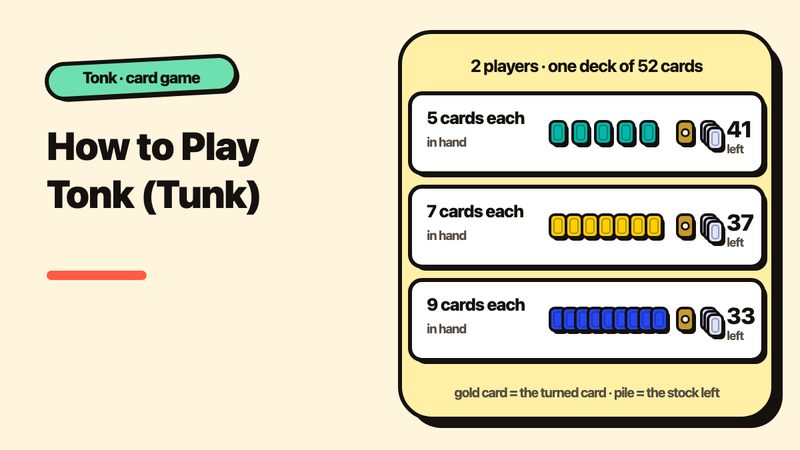
| 5 | 2 | 10 | 1 | 41 |
| 5 | 3 | 15 | 1 | 36 |
| 5 | 4 | 20 | 1 | 31 |
| 7 | 2 | 14 | 1 | 37 |
| 7 | 3 | 21 | 1 | 30 |
| 7 | 4 | 28 | 1 | 23 |
| 9 | 2 | 18 | 1 | 33 |
| 9 | 3 | 27 | 1 | 24 |
| 9 | 4 | 36 | 1 | 15 |
Stock left = 52 − cards each × players − 1. Check any row. 5 cards each for 4 players uses 20. The turned card takes 1, and 52 − 21 = 31.
The deal: 5 cards, 7 cards, or 9?
Three published deals sit side by side. The card count changes every later decision.
- The pagat rules deal 5 cards each, clockwise. Then 1 card is turned face up to start the discard pile.
- Bicycle deals 7 cards each. Then 1 card is drawn and left face up as the upcard.
- Wikipedia lists 5, 7 or 9 cards by player count, without saying which count goes with how many players. The dealer turns the first card in most variants. Some variants turn none.
Bicycle's upcard has 1 owner: the player on the dealer's left, on the first turn.
One rule is settled before the first deal. The pagat rules say a hand of 49 or 50 points must be declared at once, and every player then pays double. If 2 players hold 49 or 50, the hand is void. Deal it again.
Wikipedia lists the same rule as a house rule. Bicycle does not print it. Write it on the score pad if your table uses it.
Melds: books and runs
A spread is 1 of 2 kinds of group.
- A book is 3 or 4 cards of one rank, such as 3 spades, 3 hearts and 3 clubs.
- A run is 3 or more cards of one suit in sequence, such as 4, 5 and 6 of spades.
The ace is the lowest card in the pagat and Wikipedia rules. Bicycle prints the rank order K high down to A low, and notes that in hoyle forms of rummy the ace may rank either high or low.
A-2-3 is a run. K-A-2 is not. A table that counts the ace high calls K-A-2 a run.
The wild card differs between the versions. The pagat set has none. Bicycle turns every 2 into a wildcard. Wikipedia adds 2 jokers, both wild.
Bicycle also limits a matched set: at most 4 cards, at least 2 natural ones, because a wildcard does not count as one.
Adding a card to a spread on the table is called a hit. You may hit only on your own turn. Do it after you draw and before you discard. You may hit another player's spread.
In Wikipedia's set, a player who was hit cannot lay down a spread on the next turn. Once 4 cards of one rank are spread, that book goes to the discard pile. Wikipedia also prints a house rule: add to runs only, not to books.
How a turn works
A turn has 3 moves, in the same order in all 3 versions. Under the pagat rules, play starts on the dealer's left and passes clockwise.
- Draw. Take the top card of the stock, or of the discard pile.
- Spread or hit. Lay down a spread, or add a card to one on the table.
- Discard. Put 1 card face up on the discard pile.
Old discard cards stay face down. Nobody may dig through the pile for a second card.
Two endings come out of the last step. In the pagat and Wikipedia sets, running out wins 1 point, tonking out 2 points.
Wikipedia prints a house rule for the second ending: a tonk out needs 6 cards, laid as one spread or added by hits. With fewer than 6, it wins 1 point. Under the pagat rules a 5 card tonk out still pays 2 points.
The pagat rules also list a waiting rule. A player who has just laid a spread cannot drop for 3 turns. A player who was hit cannot drop on the next turn. Waits can stack, so 2 players can wait at once.
Dropping and being caught
Dropping means you believe you hold the lowest count. Then you show it.
- The pagat rules let you drop on your turn. Do it before you draw. Lay every card down and claim the lowest count. Anyone with the same count or a lower count catches you. You pay double to each of them. The lowest player collects 1 point.
- Wikipedia allows a drop at any time. Even straight after the deal. A dropper who is not the lowest pays every player with a lower count. A tie counts as a catch, so the dropper pays double.
- Bicycle allows a knock only with 5 unmatched points or fewer. A knocker who is not the lowest is charged double their count.
A drop is the only way to end a hand early. The other endings wait for a player to run out or for the stock to empty.
How a hand ends and how the score is counted
The pagat rules print 4 endings. We score them in points. A table can count without money.
- Tonk out, without discarding, wins 2 points from every player.
- Running out, by discarding the last card, wins 1 point from every player.
- A drop that holds the lowest count wins 1 point from every player. A caught drop pays 2 points to each player with the same or a lower count.
- When the stock runs out, the lowest count wins 1 point from every player.
Bicycle counts the same game over many hands. The cards you did not match are counted and added to your total. The first player to reach 100 points leaves the game. The last one left wins. A hand is void if the stock runs out.
The pagat rules also list a paper version from Washington state: 2 to 6 players, 4 recommended. In a 4 player game the winner takes 3 points, each loser gives up 1.
Here is a drop worked out. The dropper holds K spades, 7 diamonds, 7 clubs and the ace of hearts: 25 points, 10 + 7 + 7 + 1.
The next player holds 8 hearts, 8 clubs and 5 diamonds: 21 points, 8 + 8 + 5. The dropper is not the lowest. The 21 point hand catches the 25 point hand.
The odds: what a 5-card deal actually looks like
We counted every combination of cards for 3 deal sizes. The numbers are exact, not sampled.
Our assumptions
- An ace counts 1 point. 2 to 9 count face value, and 10, Jack, Queen and King count 10 each.
- The 5 card, 7 card and 9 card deals.
- A book is 3 or more cards of one rank. A run is 3 or more cards of one suit in sequence.
- Every combination from one 52 card deck counts once. No choices.
| Deal | Hands counted | Lowest | Highest | 49 or 50 points | 13 or fewer | 9 or fewer | Opening spread |
|---|---|---|---|---|---|---|---|
| 5 cards each | 2,598,960 | 6 (1 in 649,740) | 50 (1 in 595) | 1 in 223.1 | 1 in 447.2 | 1 in 7,140 | 4.183% (1 in 23.9) |
| 7 cards each | 133,784,560 | 10 | 70 | 1 in 10.9 | 1 in 285,864 | not possible | 13.762% (1 in 7.3) |
| 9 cards each | 3,679,075,400 | 15 | 90 | 1 in 19.7 | not possible | not possible | 29.851% (1 in 3.3) |
Three results follow from the table.
The lowest 5 card hand is 6 points, not 5. A deck holds only 4 aces. No hand can total 5.
A 49 or 50 point hand arrives about 20 times more often with 7 cards than with 5: once in 223 hands at 5 cards, once in 11 at 7.
An opening spread turns up in 4.183% of 5 card hands, 13.762% of 7 card hands, and 29.851% of 9 card hands.
Official rules vs common house rules
No publisher calls its set the official rules. Each cell names its source. not printed means that source has no rule for that point.
| Point | pagat (John McLeod) | Bicycle (Tunk) | Wikipedia and house rules |
|---|---|---|---|
| Deck | 52 cards, no joker | 52 cards | 52 cards plus 2 jokers |
| Wild card | None | Every 2 | The 2 jokers |
| Cards each | 5 | 7 | 5, 7 or 9 |
| Turned card | 1 turned over | 1 drawn as the upcard | Usually 1, sometimes none |
| Spread | Book of 3 or 4, run of 3 or more | Same 2 groups | Same 2 groups |
| Matched set limit | not printed | 4 cards at most, 2 natural | not printed |
| Ace | Lowest card | K high to A low | Lowest card |
| Hiding a spread | A house rule: it is a fault | not printed | not printed |
| Drop | On your turn, before you draw | Knock with 5 unmatched points | Any time, or only at the turn start |
| How a hand ends | Tonk out, run out, drop, or the stock empties | Unmatched points reach 100 | Cards laid down, or the stock empties |
| Scoring | Double win 2 points, plain win 1 | Unmatched points to 100 | A double win pays 2 points. A house rule: 6 cards to tonk |
| Opening 49 or 50 | Declare at once, all pay double | not printed | A house rule |
| Automatic win | House rule: 13 or fewer wins, 9 pays 3 | not printed | A house rule |
| Waiting rule | 3 turns after a spread, 1 after a hit | not printed | not printed |
Two rows cost points: the drop threshold and the scoring rule. A table that drops on Bicycle's threshold and scores on the pagat rule settles a hand 2 ways.
The house changes that come up most sit in that table. Some turn the first card, some do not. Some add jokers and score them at 0.
Common mistakes
The first mistake is treating the ace as a high card. K-A-2 is not a run, and the spread you counted does not exist.
The second is assuming that laying your cards down always pays double. Wikipedia's house rule needs 6 cards for the double; under the pagat rules a 5 card tonk out pays 2 points.
The third is waiting to claim a high opening hand. In the pagat rules only the opening hand counts. 49 points collected later is worth nothing.
The fourth is digging through the discard pile. Take the top card, or nothing.
The fifth is treating a hit as a spread of your own. You may add a card to any spread. Under Wikipedia's rules the player you helped cannot spread next turn. Under the pagat rules the next turn blocks a drop, not a spread.
The sixth is counting only the matched cards. Bicycle scores the cards you did not match.
Common Rules Questions
How do you play the Tunk card game?
The shortest published set deals 5 cards each from 1 deck of 52 cards. Build spreads of 3 or 4 cards of one rank, or 3 or more of one suit in sequence. Each turn you draw 1 card, spread, then discard 1.
A hand ends when someone lays down the last card, discards it, drops, or the stock runs out.
How many cards do you get for Tunk?
Three published answers. The pagat rules deal 5 cards each. Bicycle deals 7 cards each and turns 1 card face up as the upcard. Wikipedia lists 5, 7 or 9 cards by player count.
The deal section also shows the stock each version leaves: 41 cards for 2 players at 5 cards each, 37 at 7.
Are Tonk and rummy the same?
Tonk is a knock rummy. It sits with basic rummy, gin rummy and 500 rummy.
The difference is the shape of the hand. Tonk starts with 5, 7 or 9 cards. It ends when a player drops with the lowest count. The rummy family table places Tonk among 14 rummy games.
Can you play Tonk with two players?
Yes. The pagat rules name 2 or 3 players as the best fit. A 2 player hand of 5 cards each leaves 41 cards in the stock, more than any other deal.
Wikipedia notes a 2 player variation called double-double, where one player can finish a tonk out on the spread the other player built.
What counts as a spread in Tonk?
Two kinds. A book is 3 or 4 cards of one rank, such as 3 of a kind. A run is 3 or more of one suit in order, such as 4, 5 and 6 of spades.
The ace is the lowest card in the pagat and Wikipedia rules. Bicycle prints K high to A low. A-2-3 is a run, K-A-2 is not. Bicycle's matched set holds at most 4 cards, at least 2 natural.
Can you keep score instead of playing for money?
Yes. Bicycle's own rules are a running score. The cards you did not match are counted and added to your total, and the first player to reach 100 points leaves the game.
The pagat rules also list a paper version from Washington state for 2 to 6 players. In a 4 player game the winner takes 3 points, each loser gives up 1.
What to read next
Five pages answer the questions that come up here.
- Rummy rules: the basic game, the 10 card game this family starts from.
- Types of rummy compared, Tonk among 14 games.
- Card games for 2 players, the games that work with a pair.
- Playing cards for card games, deck sizes and finishes.
- All card game rules, the hub for the section.
Sources
- John McLeod, "Tonk" on pagat.com, read 2026-11-09: the 5 card deal, the 49 and 50 point claim, drops and catches, the 4 endings, the waiting rule, who plays first.
- Bicycle Card Company, "How to Play Tunk", read 2026-11-09: the 7 card deal, the upcard, the 2 as a wildcard, the rank order K high to A low, the knock threshold and the 100 point score.
- Wikipedia, "Tonk (card game)", read 2026-11-09: 2 jokers, the 5, 7 and 9 card deals, the 6 card tonk out rule, the drop variants.
- Our own arithmetic: the point counts, the odds of a 49 or 50 point hand, the share of opening hands with a spread and the stock arithmetic come from a Rulenook count.
How we check rules: our methodology.