How to Play Siamese Mahjong: Setup, Turns and Scoring for 2 Players
As an Amazon Associate, Rulenook earns from qualifying purchases.
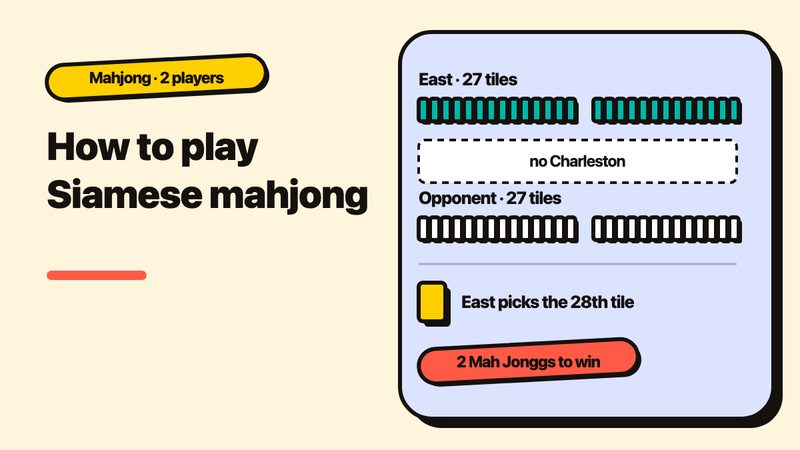
How to play Siamese mahjong: two players, two racks each, no Charleston. The published rules deal 27 tiles each. East picks a 28th tile from the wall, and that tile opens the game. One exposed hand is not a win. Two Mah Jonggs are. The score is settled at the end. The lower score pays the difference. Tables that learn this from 4-player American get the deal, the dead-hand rule and the penalties wrong.
What you need to play Siamese mahjong
Two players, four racks and one 152-tile set open the table. The rest is table space and a way to keep score.
Tiles. One American set, and only the 152 tiles that belong in the game. Our tile count page splits them up: 108 suited tiles, 16 winds, 12 dragons, 8 flowers, 8 jokers. A 166-tile box also carries 14 spares. Those stay in the box: 8 flowers, 2 jokers, 4 blanks.
Racks. Four racks, one pair per player, or two double racks. Rule 1 allows either. Rule 2B describes the double rack, with a pusher between its two walls. Rule 10 puts your remaining tiles on the slanted level of one or both racks, and your exposures stay on the rack. See our racks guide.
A die. The current rules cut the wall with 1 die, thrown by East. The 2017 version said "the dice". Agree on 1 at the table.
Cards. The current NMJL card and the current Siamese card both work (rule 17B). We do not reproduce card lines. A hand is worth what your card prints.
A score sheet. One page, 2 columns: East and the opponent. Rule 17A settles the game at the end.
Table space. Room for 4 walls of 19 stacks, 4 racks and a discard area. Rule 3 puts the discards on one side, the unpicked tiles on the other.
A 166-tile American set listing counts 36 of each suit, 12 dragons, 16 winds, 16 flowers, 10 jokers and 4 blank spares, with 4 rack and pusher units. Take the 14 spares out and the set matches this game.
How to set up a Siamese mahjong table
Setup is a 4-player setup with 2 seats taken out. The wall count is where tables argue.
Our assumptions: the current rules print 2 walls per player (rule 2A), and rule 2A prints each wall at 38 tiles. Rule 4B says both of East's walls come out first, so we count 4 walls of 19 stacks. The rules print no total. 4 × 38 = 152 is our arithmetic, and it matches the Siamese row of our 2 and 3 player page.
Table A is the whole tile ledger for one game.
| Line | Count | Arithmetic | Source |
|---|---|---|---|
| Tiles in an American set | 152 | 108 + 16 + 12 + 8 + 8 | G02, G04 |
| Spare tiles in a 166-tile box | 14 | 8 flowers, 2 jokers, 4 blanks | G04, G05, listing |
| Walls for 2 players | 4 | 2 per player × 2 players | rule 2A, 4B |
| Tiles in one wall | 38 | 19 stacks × 2 high | rule 2A, G05 |
| Tiles in the walls | 152 | 4 × 38 | our arithmetic, G08 |
| Tiles dealt to the players | 54 | 27 + 27 | rule 5 |
| Tiles left in the walls | 98 | 152 − 54 | our arithmetic |
| Tiles in hand between turns | 27 | the dealt count | rule 18 |
| Tiles in hand on your turn | 28 | 27 + 1 drawn | rule 8, 18 |
- Sort the spares out first. 14 tiles stay in the box.
- Build the walls. Each player builds 2 walls of 19 stacks, 2 tiles high. That is 38 tiles a wall, 4 walls in all.
- Cut the wall. East throws 1 die and counts from the right side of the wall, the tiles the die shows. The counted stacks move to the tail end of the first wall. Rule 3 makes the walls required for tournament play.
- Deal 27 tiles to each player. Each player takes 4 tiles at a time from East's cut wall. Six batches of 4 make 24, and 3 more reach 27. The rules do not print the order of those last 3.
- Skip the Charleston. Rule 7 says there is none. Nobody passes.
- Split your tiles as you like. Rule 6 lets you move tiles between your own 2 racks.
- East opens. East picks the 28th tile from the wall and discards it. The opponent picks or claims next.
How a turn of Siamese mahjong works
The turn itself is simple. There is no Charleston. There is no seat to argue about. The edges of this game are in the claims.
- East opens by picking the 28th tile from the wall and discarding it (rule 8). The opponent then picks or claims. The two of you alternate.
- Pick, then discard. Rule 21A says your turn does not start until a claimed tile is on your rack. Pick it up first. Expose after that.
- Move tiles between your own 2 racks whenever you like (rule 6). Exposed tiles stay where they were exposed (rule 11A).
- Exchange jokers from exposures, but never from an exposed Mah Jongg (rule 9). Rule 10C closes that door once the hand is on the rack.
- If you both want the same discard, the player closest in succession to the discarder claims it (rule 10D). A 2nd Mah Jongg does not take precedence. A double Mah Jongg does.
- Claiming two Mah Jonggs when only one of them is real kills both hands (rule 10E).
Two claims cost you more than the tile. Rule 21A says that if you claim a discard for an exposure and cannot complete it, you lose that turn. That hand is dead.
How you win in Siamese mahjong
A win takes 2 Mah Jonggs. Each one is 14 tiles that must match a line on the card you play with. In 4-player American, 1 Mah Jongg ends the hand.
Rule 14 says the game ceases when one player has declared 2 Mah Jonggs. It also ends when the wall tiles have been used and the last discard is made. Rule 10 sets the other half: a Mah Jongg is declared and exposed with 14 tiles, and the player discards to complete the turn.
Nothing pays while a hand is still hidden. Rule 10A says you are not paid for a Mah Jongg in your rack and not on it. Rule 10C follows: the jokers in an exposed Mah Jongg can no longer be exchanged.
Where you put the exposure decides whether it counts. Rule 11A says a hand is dead if the exposures do not match a card line. The tiles are interchangeable in the racks, not on the racks. Rule 11B gives you one repair: correct the location of the exposure before you discard.
The 2 racks behave like 2 players. Rule 13 says that with 1 Mah Jongg and 1 dead hand, the opponent carries on alone until their 2nd Mah Jongg or the tiles run out. Rule 12 stops the game when both hands are dead. Rule 15 closes the other route: tiles from a dead exposure cannot build another hand.
How to score a Siamese mahjong game
Nothing is paid until the game ends. Rule 17A keeps a running score for both players. At the end, the lower score pays the difference.
Table B lists every multiplier and penalty that changes a score. The card prints the value of a hand. The rows below tell you what to do with it.
| Trigger | Score change | Rule |
|---|---|---|
| 1st Mah Jongg | the card value, self-picked or not | 17B |
| 1st Mah Jongg with no joker | ×2, except a singles-and-pairs hand | 17B |
| 2nd Mah Jongg that wins the game | ×2, self-picked or not | 17C |
| 2nd Mah Jongg with no joker | ×2 again, singles and pairs excepted | 17C |
| Two Mah Jonggs on the same turn | ×2 on both hands | 17D |
| Your discard claimed for the opponent's 2nd Mah Jongg, or in a same-turn double | −25 | 17E, 17F |
| Wall game, no Mah Jongg exposed | +10 each | 17G |
| Both hands declared dead | −100 | 12 |
| Tile count error, both hands dead | −4 × the opponent's Mah Jongg, or the lowest card value | 18B |
| Mis-named discard claimed for a Mah Jongg | the card penalty, e.g. −25 or −40, plus the same card penalty again for a 2nd Mah Jongg | 19C, 19D |
Here is the same ledger as a worked example, with a 25 point hand, the value we use on our scoring page.
| Step | What happens | The numbers |
|---|---|---|
| 1 | East exposes a 1st Mah Jongg with a joker | 25, no doubling (17B), East 25 |
| 2 | East exposes a 2nd Mah Jongg and wins | 25 × 2 = 50 (17C), East 75 |
| 3 | The claimed tile was the opponent's discard | opponent −25 (17E) |
| 4 | The two scores at the end | East 75, opponent −25 |
| 5 | Rule 17A, the lower score pays the difference | 75 − (−25) = 100 |
| 6 | Checked back to the rules | 17B, 17C, 17E, 17A |
Two shorter cases follow. A jokerless 1st Mah Jongg of 25 becomes 50 under rule 17B. Two Mah Jonggs on the same turn become 50 and 50 under rule 17D.
Printable quick reference
Print this page and keep it on the table. Every line repeats a number from Table A or B.
| Item | Value |
|---|---|
| Players | 2 |
| Deal | 27 tiles each |
| Walls | 4 of 19 stacks, 38 tiles each |
| Charleston | none |
| Opening | East picks the 28th tile, then discards |
| Win | 2 exposed Mah Jonggs |
| 1st Mah Jongg | the card value |
| Jokerless | ×2 |
| 2nd Mah Jongg that wins | ×2 |
| Two Mah Jonggs on one turn | ×2 on both |
| Discard claimed for the opponent's 2nd Mah Jongg | −25 |
| Wall game | +10 each |
| Both hands dead | −100 |
| Payout | the lower score pays the difference |
When the game ends
Five endings sit in the rules. They pay out differently.
- One player declares 2 Mah Jonggs. Rule 14 ends the game, and rule 17A settles the score.
- The wall tiles are used and the last discard is made. Rule 14 ends the game here too. If no Mah Jongg was exposed, rule 17G calls it a wall game, and each player gets +10.
- Both hands are dead. Rule 12 stops the game, and the dead player gets −100.
- One Mah Jongg and one dead hand. Rule 13 lets the opponent play on alone, until their 2nd Mah Jongg or the tiles run out.
- A tile is picked from the wrong wall. Rule 20 declares one hand dead. If that player already has an exposed Mah Jongg, the other hand is dead. The opponent carries on.
A mis-named discard is a sixth ending of its own. Rule 19 puts the correct tile back if the discarder holds it, and leaves the game alone if not. Rule 19C adds the card penalty for a Mah Jongg claim.
Siamese mahjong vs standard American mahjong
Table C sets the published rules beside 4-player American. You can see which differences are written down, and which a table settles for itself.
| Rule | Published Siamese rule | Standard American, NMJL | House rule |
|---|---|---|---|
| Players | 2, facing each other (rule 1) | 4 (G02) | — |
| Racks each | 2, or 1 double rack (rule 1) | 1 (G02) | — |
| Tiles dealt | 27 each (rule 5) | 13, East 14 (G02) | — |
| Opening | East picks the 28th tile, then discards (rule 8) | East discards, no draw (G02) | — |
| Walls | 4 of 19 stacks, 2 per player (rule 2A) | 4 of 19 stacks (G05) | — |
| Building the walls | an option for social play only (rule 3) | part of the set-up (G05) | skip the walls |
| Cutting the wall | East throws 1 die (rule 4A) | East rolls 2 dice (G05) | a fixed cut |
| Charleston | none (rule 7) | 7 passes (G06) | — |
| Winning | 2 exposed Mah Jonggs (rule 14) | 1 Mah Jongg (G02) | — |
| Joker exchange | own and opponent's exposures (rule 9) | the joker page (G07) | — |
| Same discard claimed | closest in succession to the discarder (rule 10D) | call order (G02) | — |
| Payment | keep score, the lower score pays the difference (rule 17A) | each hand paid at once (G09) | — |
| Wall game | +10 each (rule 17G) | nobody pays (G09) | — |
| Penalties | −25 for a discard claimed for the opponent's 2nd Mah Jongg (rule 17E) | check the book (G09) | who tracks it |
| Dead hands | 2 dead hands end the game at −100 (rule 12) | not printed | — |
House rule: the published rules leave the discard area, the score sheet and the order of the last tiles of the deal to the table. Settle them before the first deal.
Common mistakes in Siamese mahjong
These 8 repeat because the game borrows the American tiles and none of the American habits.
- Calling one Mah Jongg a win. It takes 2 exposed Mah Jonggs (rule 14), so a single hand leaves you playing on.
- Putting both exposures on one rack. Rule 11A calls that hand dead. Use rule 11B to fix it before you discard.
- Opening with a draw. East picks the 28th tile and discards it (rule 8). The first discard comes after the pick.
- Dealing 28 to the opponent. The rules deal 27 to each player (rule 5). A wrong count after the deal is a mis-deal, and gets re-dealt (rule 18A).
- Exchanging jokers in an exposed Mah Jongg. Rule 10C closes that as soon as the hand is on the rack.
- Paying each hand as it happens. American pays each hand at once (G09). Siamese keeps score and settles at the end (rule 17A).
- Forgetting the −25. A discard claimed for the opponent's 2nd Mah Jongg costs 25 points (rule 17E).
- Picking from the wrong wall. Rule 20 declares a hand dead. With 4 walls on the table, the error is easier to make.
Common Rules Questions
Is Siamese mahjong the same as 2-player American mahjong?
No. The League's own 2-player rules keep 152 tiles, 4 walls, 13 and 14 tiles a hand and no Charleston. Siamese is a separate published game: 2 racks each, 27 tiles each, 2 Mah Jonggs to win, 1 payment at the end.
Do I need the NMJL card or the Siamese card?
Either one. Rule 17B accepts the value on the NMJL card or the Siamese card. The card changes every year, so read your own copy.
Is there a Charleston?
No. Rule 7 says there is none. You hold 27 tiles and a lot of combinations. Nobody passes before the first discard.
Can one player use a single rack?
Yes. Rule 1 allows 2 players using 1 double rack each. Rule 2B puts a pusher between its 2 walls. Rule 10 puts your remaining tiles on the slanted level. Your exposures stay on the rack.
Can 3 or 4 players play?
There are published versions for that. Royale Siamese is the 3 and 4 player game, with 2 sets and quint hands. Imperial Siamese gives every player 4 racks and 2 sets or more.
Is there a printable version?
The rules page itself prints from the browser. The quick reference table above is the short version, with the same numbers as Tables A and B.
What to read next
- Mahjong hub: pick the style before you pick a set.
- American mahjong rules: the 4-player rules the Siamese rules borrow.
- How to score mahjong: American payments, and the 25 point card value used above.
- How to set up mahjong: walls, the break and the 4-player deal.
- Jokers in American mahjong: what a joker may stand for.
Sources: the published Siamese rules (2015, Gladys Grad), rules 1 to 21, read 2026-11-11 from the 2026-02-06 web.archive.org snapshot of the rules page. We cross-checked it against the 2017-08-26 PDF, which differs on the deal, the walls, the dice and the 2nd Mah Jongg penalty.
Our own pages on American rules, tile counts, set-up and scoring. The tile ledger, the payout table, the worked example and the 2 figures are our own arithmetic, set out in our working notes for this page. How we check numbers: our methodology.
Sources
- Published Siamese rules (2015, Gladys Grad), rules page read 2026-11-11 via the 2026-02-06 web.archive.org snapshot, rules 1 to 21
- Published Siamese rules, PDF version 2017-08-26, read 2026-11-11 via the 2018-05-08 web.archive.org snapshot (version differences)
- Rulenook pages G02 American mahjong rules, G04 mahjong tiles explained, G05 how to set up mahjong, G06 charleston, G07 jokers in american mahjong, G08 mahjong for 2 or 3 players, G09 how to score mahjong, read 2026-11-11
- Amazon listing for a 166-tile American set with 4 rack and pusher units, read 2026-11-11
- Site recomputation (table A tile ledger, table B payout rules, worked example, printable quick reference, figure numbers)