Shanghai Rummy Rules: 10 Rounds or 7 Contracts, Buying and Scoring
Shanghai rummy rules: two to eight players, 11 cards each, one contract per hand, and the lowest penalty total after the last hand wins. Two rule sets differ.
Two sets of shanghai card rules are published, and they disagree about the contract list, the buy limit and the penalties. Mix them and no score can be settled. Both run side by side below. One test tells you which set you play.
What do you need to play Shanghai rummy?
A table of 4 needs 106 cards. A table of 6 needs 162, and a table of 8 needs 216. Every player takes 11 cards in both versions, so the deck count is the only equipment decision.
Our assumptions
- The stock is the face-down pile in the middle of the table.
- The discard pile sits face up beside it, and the turned card starts it.
- Buying a card costs 2 penalty cards drawn from the stock.
- Scoring counts the cards a player still holds when a hand ends.
| Players | Decks | Cards per deck | Jokers | Cards in play | Source |
|---|---|---|---|---|---|
| 2 to 4 | 2 | 52 | 2 | 106 | Wikipedia, Shanghai rum |
| 5 to 6 | 3 | 54 | not printed | 162 | Wikipedia, Shanghai rum and Contract rummy |
| 7 to 8 | 4 | 54 | not printed | 216 | Wikipedia, Contract rummy |
| 3 to 5, version B | 2 | 52 | 4 | 108 | pagat, Contract Rummy |
Two counting conventions sit in this table. Wikipedia's information box counts a deck as 54 cards, which is 52 regular cards plus 2 jokers, so 3 packs are 162 and 4 packs are 216.
The same article gives the 4 player game as 2 decks of 52 plus 2 jokers, which is the 106 in row 1. not printed means the source prints no joker count.
Version A gives a 4 player table 2 jokers. Version B gives its table 4, so the 2 deck game has half as many wild cards.
One publisher's box holds 162 cards, which is 3 decks of 54. It carries a round clicker and a score pad for the running penalty totals.
House practice: give each player a different back colour when you split the decks. The playing card guide lists deck sizes.
Two players can play version A. Its information box says 2 to 8 players. A pair needs the 106 card pack.
Setting up a hand
Three steps set the table, and both versions agree.
- Shuffle and deal. Each player takes 11 cards face down.
- Build the stock. The rest of the deck goes face down in the middle. Turn 1 card face up beside it to open the discard pile.
- Start play. The player on the dealer's left takes the first turn. The dealer passes one seat to the left after every hand.
Decide the version before the first deal. Not halfway through hand 3. Seven contracts means version B. 10 hands means version A.
There is a faster test. If anyone says Shanghai when discarding, you play version B. Version A has no call.
Version B also uses 2 decks plus 4 jokers. That is 108 cards. It seats 3 to 5 players.
The contract ladder: what each hand asks for
A contract fixes the meld you must lay down. Nothing else counts until you meet it.
Our assumptions
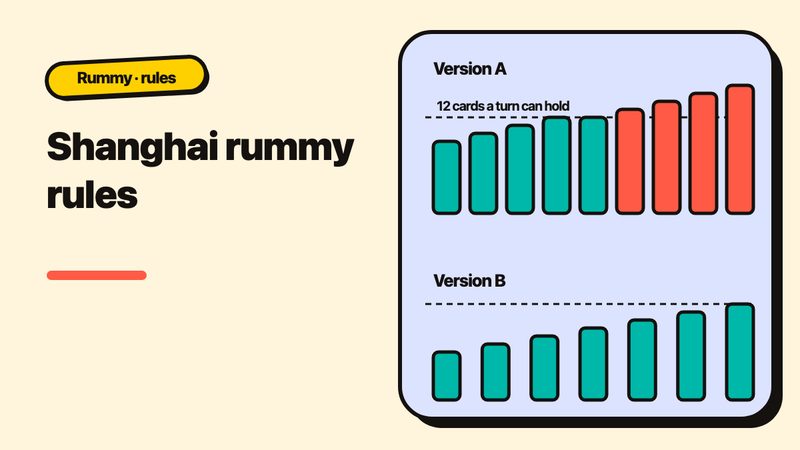
- A turn begins with 1 card drawn. A player holds at most 12 cards: 11 dealt plus 1 drawn.
- A contract can be laid down only when its meld fits inside 12 cards.
- The number beside each version A contract is a deal size, not a meld size. We count the meld from the contract.
Version A, from the Wikipedia contract table:
| Hand | Printed deal | Contract | Meld cards | Fits in 12 cards |
|---|---|---|---|---|
| 1 | 10 | 3 sets of 3 | 9 | yes |
| 2 | 11 | 2 sets of 3, 1 run of 4 | 10 | yes |
| 3 | 12 | 1 set of 3, 2 runs of 4 | 11 | yes |
| 4 | 13 | 3 runs of 4 | 12 | yes |
| 5 | 13 | 4 sets of 3 | 12 | yes |
| 6 | 14 | 3 sets of 3, 1 run of 4 | 13 | no |
| 7 | 15 | 2 sets of 3, 2 runs of 4 | 14 | no |
| 8 | 16 | 3 runs of 4, 1 set of 3 | 15 | no |
| 9 | 17 | 4 runs of 4 | 16 | no |
Version B, from the pagat Shanghai section:
| Hand | Contract | Meld cards | Fits in 12 cards |
|---|---|---|---|
| 1 | two books | 6 | yes |
| 2 | one book, one run | 7 | yes |
| 3 | two runs | 8 | yes |
| 4 | three books | 9 | yes |
| 5 | two books, one run | 10 | yes |
| 6 | one book, two runs | 11 | yes |
| 7 | three runs, no discard | 12 | yes |
Each printed number in version A is exactly 1 more than the meld it needs. That holds for all 9 rows.
The gap is the problem. Hands 6 to 9 ask for 13 to 16 cards. A turn holds 12 at most.
Version B has no gap. Its 7 contracts climb from 6 cards to 12. The last one fits exactly.
The source is inconsistent with itself. The same article says ten hands of 11 cards each. Then it prints a contract table with 9 rows, dealing 10 up to 17 cards.
Both sentences are in the published text. So both are printed here. Two setups work.
Deal the printed sizes: 10 up to 17 cards. That needs 3 decks at 8 players, because 8 × 17 = 136 and 3 decks hold 161 after the upcard. Or keep 11 cards and stop at hand 5.
How a turn works
A turn has 4 moves, and the order matters most.
- Draw. Take the top card of the stock, or the upcard if it is free.
- Meet the contract. Lay down the meld the hand asks for. All at once.
- Lay off. Add cards to melds on the table, yours or another player's. Version B allows this on the same turn as your first meld.
- Discard. Put 1 card face up on the discard pile.
Three hard rules sit under those moves. Aces count high only. So A-2-3-4 is not a run.
Liverpool rummy in the same family lets an ace run low. A run is 4 or more cards in one suit. A set is 3 or more of the same rank.
Jokers fill a missing card, and the two versions set different limits.
Version A says a meld may not hold more jokers than face cards. So 8-8-joker is legal. 8-joker-joker is not.
Version B allows 1 joker in a run or a set. You may meld several jokers in different melds.
Version A adds a swap rule. Any player may swap a joker in a meld for the real card. A player who has not melded may only swap by melding their own set that turn.
Calling "Shanghai" and buying out of turn
Both versions let you take a discard before your turn, for a price.
Buying a card out of turn. Version A calls it BUY, and version B calls it May I?.
The buyer takes the discard. Then they draw 2 more cards from the stock as a penalty. They cannot play until their own turn.
In version A the card under the discard becomes dead. Nobody can take it later.
Version B caps the buys at 2 per player per hand. Version A allows 3 buys in each of the first 8 hands, then 4 in hands 9 and 10.
If 2 players want the same discard, version A gives it to the player closest to the dealer's left. Version B gives it to the player whose turn comes first. Only the order changes.
The Shanghai call. Only version B has this call.
Discard a card that would fit a meld on the table and say Shanghai. The discard is protected. Nobody can take it, and nobody can May I? it.
If you stay quiet, another player can call Shanghai. That player adds the card to a meld, turns their hand face down and lets you draw 1 card.
A Shanghai call beats a May I? request. Agree on the call before a hand starts.
One name warning. The same pagat page describes a different non-contract game called Shanghai, a Carousel or Manipulation rummy. Not this game.
How a hand ends and how the cards are scored
When a player goes out, the hand ends there. Every other player adds the value of the cards in hand. The player who went out adds nothing. After the last hand, the lowest total wins.
Version A penalty values come from Wikipedia. Version B values come from pagat.
| Card | Version A | Version B |
|---|---|---|
| 2 | 20 | 5 |
| 3 to 7 | 5 | 5 |
| 8 to 9 | 5 | 10 |
| 10 to K | 10 | 10 |
| Ace | 15 | 20 |
| Joker | 25 | 50 |
The same hand scores 2 ways. You are caught holding K, 7, A, 2 and a joker.
Version A gives 10 + 5 + 15 + 20 + 25 = 75. Version B gives 10 + 5 + 20 + 5 + 50 = 90.
Same 5 cards, 15 points apart. Name the version before the first hand.
Version A also fixes the last hand. You must lay out every card you hold. You cannot win by discarding your way out.
Version B's last contract is three runs with no discard. That settles the same point.
Two rule sets side by side
The rules for shanghai rummy come in two printed sets, and neither is an official rulebook. Both are published versions that other tables copy. They disagree in more than one place.
| Point | Version A, Wikipedia citing Katz 2004 | Version B, pagat citing Mark Allen Davis | Common house change |
|---|---|---|---|
| Hands | 10 claimed, 9 contracts printed | 7 contracts | Play a set number of hands |
| Cards dealt | 11 in every hand | 11 in every hand | 10 in the early hands |
| Decks and jokers | 2 to 4 packs of 54 | 2 packs of 52 plus 4 jokers | 3 packs for every table |
| Ace | High only | High only | High and low |
| Jokers in one meld | No more jokers than face cards | 1 joker per run or set | 1 joker per meld |
| Buys per hand | 3, then 4 in hands 9 and 10 | 2 | 2 or 3 |
| Shanghai call | None | Yes | Used in both |
| Penalty table | 2 is 20, ace is 15, joker is 25 | 2 is 5, ace is 20, joker is 50 | Face value, ace is 15 |
| Last hand | Lay out every card | Three runs, no discard | Same as the version |
The house column lists the changes we hear most often. No source fixes them: they are choices.
The Tahelia Powe variant deals 10 cards and adds a four books of 3 contract before the 7th hand. It ends with three runs and calls the buy a buy, with no Shanghai call.
The Deb Kolsov variant lists 10 different contracts, ending with three runs of 5.
Official rules vs common house rules
The honest question is which set your table uses, and where it bends. This is the line between published wording and house changes.
Our assumptions
- We set the version first, then play that version to the end.
- Where a house rule changes a number, we write the change down before the first deal.
| Point | Published wording | Common house change | Settle it |
|---|---|---|---|
| Cards dealt | 11 in both versions | 10 in the early hands | Write it down |
| Decks and jokers | 106 for 4 players, 108 in version B | 3 decks for every table | Count the jokers first |
| Ace | High only | Low counts as well | Decide it at hand 1 |
| Jokers in one meld | Version A: no more than face cards. Version B: 1 | Unlimited | Pick one limit |
| Buys per hand | 3 then 4, or 2 | 2 or 3 | Say the number aloud |
| Penalty table | Version A or version B | Face value, ace is 15 | Print the table on the pad |
| Last hand | Version A: lay out every card. Version B: three runs | Discard to finish | Keep the version rule |
| Shanghai call | Version B only | Used in every version | Announce it before the deal |
Three changes break a hand more than the rest. Scoring with the wrong penalty table changes every total. Buying without the 2 penalty cards hands out free cards. Melding before you draw breaks the turn order.
Common mistakes
The first break is treating a 10 hand game as a 7 contract game. The contract list and the penalty table stop matching. No score can be agreed on.
The second break is counting an ace low. A-2-3-4 is not a run in Shanghai, which catches tables coming from basic rummy.
The third is melding before you draw. Both versions want a card in hand first. A meld that appears before the draw has to be undone.
The fourth is an 11 card deal. It does not reach hand 6. Hands 6 to 9 need 13 to 16 cards. No turn holds that many.
The fifth is buying without paying. A buy costs 2 cards from the stock. Skipping them makes the stock run out early.
The sixth is scoring a 2 as 5 points in version A. It is 20, the largest card in that penalty table.
Common Rules Questions
Can you play Shanghai rummy with two players?
Version A's information box says 2 to 8 players. Its own text says 3 to 8. Version B seats 3 to 5.
A pair can play version A with the 106 card pack. The final contract is the hard part: each of you must reach it alone while the other holds 11 cards.
Is Shanghai rummy a 7 round or a 10 round game?
The shanghai rummy card game has no single answer. Both versions exist in print. Version A, from Wikipedia, says ten hands. Version B, from pagat, has seven contracts.
The contract table in version A lists 9 rows, so that source does not agree with its own sentence. Count the rows in front of you. That count is the number of hands.
How many decks of cards do you need for Shanghai rummy?
106 cards for a table of 4 or fewer, which is 2 packs of 52 plus 2 jokers. 162 cards for 5 or 6 players, which is 3 packs of 54. 216 cards for 7 or 8 players, which is 4 packs of 54.
Version B uses 108 cards, 2 decks plus 4 jokers, for 3 to 5 players.
Can an ace count low in Shanghai rummy?
No. Both published versions count an ace above a king only, so A-2-3-4 is not a run.
The wider family differs. Liverpool rummy lets an ace run low, and basic rummy counts an ace as 1. Shanghai sits on the high side.
How many jokers can go in one set or run?
It depends on the version. Version A counts jokers against the face cards in one meld, so 8-8-joker works and 8-joker-joker does not. Version B allows 1 joker in a run or a set, and more in separate melds.
What is a "Shanghai" call, and do all versions have it?
Only version B has it. You discard a card that would fit a meld on the table and say Shanghai. The discard is protected from other players.
If you stay quiet, another player can call Shanghai, take the card, show their hand face down and let you draw 1 card. The call beats May I?. Version A has no such call.
What to read next
Five pages sit next to this one. Each answers a different question.
- Rummy rules: the basic game is the 10 card game.
- Types of rummy compared places Shanghai among 14 games.
- Liverpool rummy rules covers the same family with different ace and joker rules.
- Playing cards for card games lists deck counts and sizes.
- All card game rules is the hub for the section.
If you like Shanghai rummy, try these
Two more contract games sit next to it. Liverpool rummy runs 7 contracts with a different joker rule. Hand and foot splits the deck into two packets for pairs.
Sources
- Wikipedia, "Shanghai rum" (oldid 1350586609, read 2026-11-03): version A player count, deck counts, 11 card deal, contract table, joker and buy rules, penalty values. Its listed source: Nikki Katz, The Everything Card Games Book, Adams Media 2004, p. 146.
- John McLeod, "Contract Rummy" on pagat.com, Shanghai section (read 2026-11-03): version B contracts, May I?, the Shanghai call, penalty values, Tahelia Powe and Deb Kolsov variants.
- Wikipedia, "Contract rummy" (read 2026-11-03): deck counts by player number.
- Publisher box specification for a complete Shanghai rummy box (read 2026-11-03): 162 cards, round clicker, score pad.
- Our own arithmetic: contract meld counts, the 12 card limit, both penalty tables and the worked example are recomputed by Rulenook.
Both rule sets are public pages, so you can print them. The penalty table is short enough to copy onto a score pad.
How we check rules and build the intro card: our methodology.