Michigan Rummy Rules: Deal Sizes, Boodle Cards, Stops and Scoring
As an Amazon Associate, Rulenook earns from qualifying purchases.
Michigan rummy rules come in 2 published versions. They disagree about the player count and the extra hand. Bicycle is the main line below. PAGAT is printed beside it. House rules are marked on their own. You need 1 deck of 52 cards. Plus 4 boodle cards and chips. You play the lowest card of a suit. The next higher card of that suit must follow. The first player out of cards wins the hand.
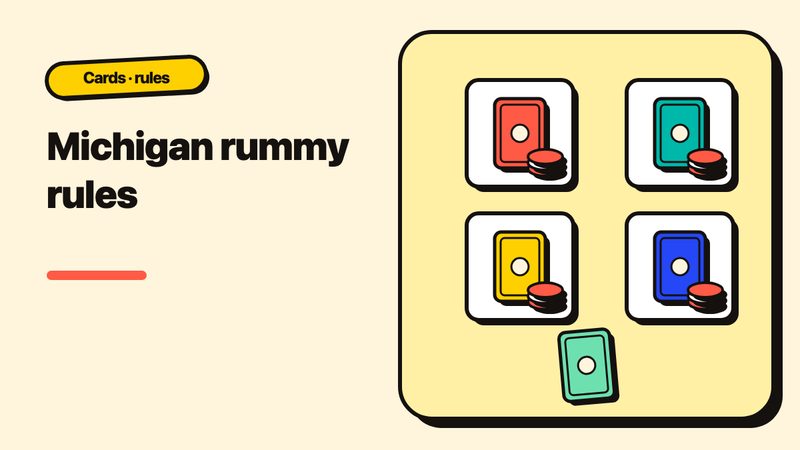
What You Need to Play Michigan Rummy
The kit is small. You need 1 deck and 4 boodle cards, and chips to put on them. A flat surface completes it.
Bicycle takes those 4 boodle cards from a second pack. So 52 cards go into the deal. The second pack only supplies 4 cards: the ace of hearts, king of clubs, queen of diamonds, and jack of spades.
PAGAT allows the layout to be a board. Or a cloth. Either way, the 4 boodle cards mark where the chips go.
The chips are the scoring system. Every player puts 1 chip on each boodle card. The dealer puts 2 on each. So the layout carries 4 chips per player, and 8 from the dealer.
House variant: take the 4 boodle cards out of the deck you play with. The same game then runs on 48 cards. You keep 48 cards in the deal instead of 52. Table A prints both setups.
Our assumptions for Table A: 1 deck of 52 cards, and the 4 boodle cards taken from a second pack. Each player gets 1 hand, plus 1 extra hand. Cards are dealt 1 at a time. The deal stops when the deck runs out.
The extra hand counts as a hand. It sits in the check column too, because it comes out of the same deck.
| Players | Hands on the table | Cards each, 52-card setup | Check | Cards each, 48-card variant | Check |
|---|---|---|---|---|---|
| 3 | 4 | 13 | 13 × 4 = 52 | 12 | 12 × 4 = 48 |
| 4 | 5 | 10 to 11 | 11 × 2 + 10 × 3 = 52 | 9 to 10 | 10 × 3 + 9 × 2 = 48 |
| 5 | 6 | 8 to 9 | 9 × 4 + 8 × 2 = 52 | 8 | 8 × 6 = 48 |
| 6 | 7 | 7 to 8 | 8 × 3 + 7 × 4 = 52 | 6 to 7 | 7 × 6 + 6 × 1 = 48 |
| 7 | 8 | 6 to 7 | 7 × 4 + 6 × 4 = 52 | 6 | 6 × 8 = 48 |
| 8 | 9 | 5 to 6 | 6 × 7 + 5 × 2 = 52 | 5 to 6 | 6 × 3 + 5 × 6 = 48 |
| 9 | 10 | 5 to 6 | 6 × 2 + 5 × 8 = 52 | 4 to 5 | 5 × 8 + 4 × 2 = 48 |
The formula behind the table: hands = players + 1, and cards each = 52 ÷ hands, rounded down. The remainder goes to the first players in the dealing order, and neither published version says which seat gets the extra card.
That is a house detail. At 4 players, that means 2 hands of 11. And 3 hands of 10.
Michigan is a card game with chips. It is not a board game with tiles. If you were looking for rummy on the board, Rummikub is the tile game with 106 tiles. It opens on a 30-point meld.
Deck sizes and card stock are in our playing card guide.
Setup: The Four Boodle Cards, the Ante and the Dead Hand
The 4 boodle cards go face up in the middle of the table. They stay there for the whole game. Bicycle calls them boodle or money cards. PAGAT calls them pay cards.
The ace of hearts, king of clubs, queen of diamonds, and jack of spades are the 4 cards that matter, and every hand of the game runs through them.
Before the deal, every player except the dealer bets. That is 1 chip on each of the 4 cards. The dealer puts 2 on each. That is the whole ante. It lands 4 × (players + 1) chips on the layout each hand.
Then the deal starts to the left of the dealer. Cards go 1 at a time, face down, and you pick them up. One extra hand is dealt immediately to the left of the dealer.
Bicycle says no player may see that extra hand. The exception is the player who exchanges for it. Cards are dealt out as far as they will go, even though players end up with different counts.
PAGAT says the extra hand is left face down and not used in the game. Three treatments of it are in print. Pick 1 before the first deal.
Bicycle lets the player who takes it exchange it. Their own hand goes back. PAGAT leaves it face down and unused.
PAGAT also records a variation. The dealer may exchange with it, or auction it unseen to the highest bidder. The buyer discards their own hand and pays the dealer the bid.
Dealing moves to the left after each hand. Hand after hand. PAGAT states that outright. Rank order is fixed in both versions: the ace is high, then king, queen, jack, 10 down to 2.
Played cards go face up. They stay in front of the player who played them. That player names the rank and the suit.
How a Turn Works: Lowest Card, Next Higher Card, Stop Cards
A turn is 5 steps. Each one is short. Here they are.
- The player to the left of the dealer leads. Lead with the lowest card you hold in that suit, not the lowest card you like.
- The next higher card of that suit must be played by whoever holds it, then the next card up, and so on, because a run only ever climbs. You cannot pass if you hold the card.
- The run ends at the ace, or at a card no one can follow. Bicycle says that card sits in the extra hand. PAGAT adds cards already played earlier.
- The player who played last starts the next run. The new run must be a different suit, and it opens on that suit's lowest card.
- You open that new suit with its lowest card. If you hold no card of another suit, pass the turn. It goes to the left.
Two mistakes carry a chip penalty. Both come from Bicycle. Both are in writing.
Starting a suit without its lowest card costs 1 chip to each opponent. After that error, you collect no boodle chips. Not from any card you play later.
Faking a stop means holding a card you could have played, and not playing it. Play continues as if nothing happened. The withheld card may still stop the run later. The offender often thinks the trick worked. The offender cannot collect chips from any boodle card after the error.
If chips are still sitting on the boodle card of that suit when the hand ends, the offender pays those chips to whoever holds the matching card. And if the offender empties their hand first, they do not win the hand. Play continues to find the real winner.
How to Keep Score: Chips on the Boodle Cards and the End-of-Hand Payoff
2 rules do all the scoring. That is all. First, when you play a card that matches 1 of the 4 boodle cards, you take every chip sitting on it. Second, play ends when you play your last card.
The winner collects 1 chip from each opponent, and that is 1 chip for every card left in that opponent's hand. Chips nobody collects stay on the layout. You pick them up in a later hand.
Bicycle says the chips remain there until they are won later. PAGAT says the same in 1 line.
Our assumptions for Table B: 1 chip counts as 1 unit, and no denominations are assumed. The ante is paid on all 4 boodle cards. Nobody collects a boodle card while the 4 hands run. A full hand means the largest card count from Table A.
| Players | Chips on the layout each hand | Chips for 4 hands | Winner takes when every hand is full |
|---|---|---|---|
| 3 | 16 | 64 | 26 |
| 4 | 20 | 80 | 33 |
| 5 | 24 | 96 | 36 |
| 6 | 28 | 112 | 40 |
| 7 | 32 | 128 | 42 |
| 8 | 36 | 144 | 42 |
| 9 | 40 | 160 | 48 |
The first column is 4 boodle cards × (players + 1). Each hand adds the dealer's extra chip. The dealer pays double on all 4 cards. The third column is (players − 1) opponents. Multiply by the largest hand from Table A.
So it is the most a winner can take in 1 hand.
A worked example: 5 players at the table, and the winner plays their last card before the others do. The other hands hold 3, 4, 2, and 5 cards. The winner takes 3 + 4 + 2 + 5 = 14 chips. That is 1 chip per card left in each hand.
One board set covers the ledger above. This Michigan rummy board set listing counts 2 decks and 200 chips. The second deck supplies the 4 boodle cards. And 200 chips pay the ante for 5 hands at 9 players.
Published Rules vs Common House Rules
Michigan has no governing body. So no rule here is an official standard. Bicycle and PAGAT are the 2 published rule sets. The third column holds the house rules and the recorded variations.
Our assumptions: the main line is Bicycle. PAGAT is printed beside it. Settle a disagreement out loud, before the first deal.
| Point | Published (Bicycle) | Published (PAGAT) or house rule | What we suggest you write down |
|---|---|---|---|
| Players | 3, 4, 5+ | PAGAT: about 3 to 8. The linked board set says 2 to 9 | Fix the count before the deal |
| The 4 boodle cards | From another pack, so 52 cards are played | PAGAT: the layout can be a board, a cloth, or a second deck | Keep a second pack for them |
| The extra hand | The player who takes it may exchange it | PAGAT: left face down and unused. Variation: the dealer exchanges or auctions it | Leave it face down |
| Who leads | The player left of the dealer, with the lowest card of any suit | PAGAT: same rule. House rule: the lowest card at the whole table | Use the published rule |
| Changing suit | A new suit after every stop, opening on its lowest card | PAGAT lists compulsory change of suit as a variation | Change suit, and say it out loud |
| What stops a run | The ace, or a card in the extra hand | PAGAT: the ace, or any card no one can follow, including one already played | Use the Bicycle wording |
| Leading the wrong card | 1 chip to each opponent, and no boodle chips after that | House rule: no penalty | Keep the Bicycle penalty |
| Faking a stop | No boodle chips after the error, and the leftover chips go to the matching card holder | House rule: ignore the withheld card | Keep the Bicycle rule |
| Chip placement | 1 chip per boodle card from each player, 2 from the dealer | PAGAT variation: a fixed number of chips placed anywhere on the layout | Use the Bicycle placement |
| Ending a session | The hand ends as soon as a player is out | House rule: play to a target such as 500 points, or for a fixed number of hands | Fix the number of hands |
Common Mistakes That Cost You Chips
Opening a suit with the wrong card is the usual way to lose chips. The penalty lands twice: 1 chip to each opponent, and no boodle card after that counts. It happens when you forget that the lowest card of the suit, not the lowest card you like, has to lead.
Withholding a card you could follow is worse. It costs more chips. The error stays invisible until the hand ends. Play goes on. The withheld card may still stop the run later. The offender often thinks the trick worked. The chips come due at the end of the hand.
And a player who goes out first after faking a stop does not win at all.
Missing your own boodle card is the quiet mistake. Playing the ace of hearts takes every chip on that card. Only the player who plays it may take them. Leave the ace of hearts in your hand, and the chips wait. They wait for the next hand.
Treating the extra hand as extra cards is the fourth mistake. It is a hand that nobody plays from. Its only job is stopping a suit run. It is not a reserve. It never joins your own cards.
Printable Quick Reference: Boodle Cards, Ante and Payout
Copy these lines onto a card. They hold the whole game.
- Boodle cards: ace of hearts, king of clubs, queen of diamonds, jack of spades.
- Ante: 1 chip on each boodle card from every player, 2 from the dealer.
- Play 1: lead the lowest card of any suit.
- Play 2: the next higher card of that suit must follow.
- Play 3: the ace, or a card in the extra hand, stops the run.
- Play 4: the player who played last starts the next run.
- Play 5: a new suit, opened on its lowest card.
- Payout: the first player out takes 1 chip per card left in each opponent's hand.
- Layout: 16 chips each hand at 3 players, 24 at 5, 40 at 9.
Common Rules Questions
What is the difference between rummy and Michigan rummy?
Rummy is a meld game. You build sets and runs. You lay cards down, and draw to replace them. Michigan rummy is a stops game. Nobody melds, nobody draws. Every play climbs 1 suit from the lowest card you hold.
Michigan also adds 4 boodle cards. Each one carries a chip stake. Meld rules and the leftover-card score are on our rummy rules page.
How many players can play Michigan rummy?
The published rule sets differ. Bicycle lists 3, 4, and 5 or more players. PAGAT says about 3 to 8. Retail boards are wider: the linked set says 2 to 9.
Table A gives the card count you need. It covers every count from 3 to 9. The 14-game comparison shows where Michigan sits.
Are Michigan Rummy and Tripoley the same game?
Yes, for the most part. Tripoley, Tripoli, Boodle, Stops, and Newmarket are names for the same stops game. Michigan is the American name for it. PAGAT also records a Three in One version. Each player picks 5 cards and plays a poker round first. That version is also sold as Michigan Rummy.
Watch the name Michigan Rum. That one is a version of 500 Rum instead. 500 Rum rules and Liverpool rummy rules cover those two games.
What happens to the extra hand?
The extra hand is dealt face down next to the dealer. It belongs to nobody. Bicycle lets the player who takes it exchange it. PAGAT says it is not used. PAGAT also records a variation where the dealer exchanges with it or auctions it unseen. Its only job in the game is stopping a suit run. You never play from it. Leaving it face down is the version we would play.
Who wins a hand and what do they collect?
The first player to play their last card wins the hand. The winner takes 1 chip from every opponent. That is 1 chip for every card still in that opponent's hand.
Chips on the 4 boodle cards that nobody collected stay on the layout for the next hand. At 5 players, opponents holding 3, 4, 2, and 5 cards pay 3 + 4 + 2 + 5 = 14 chips.
What to Read Next
Start with the card games hub for the full rule list.
Our basic rummy guide explains melds, layoffs, and the score by leftover cards.
The rummy family table compares 14 variants, including the contract games that need 2 decks.
500 Rum is the other rummy with a misleading name.
Liverpool rummy is the contract version of the family.
The card stock guide covers deck sizes and card stock.
Sources
- Bicycle Card Company, How to Play Michigan, bicyclecards.com/how-to-play/michigan (read 2026-11-02)
- John McLeod, Michigan, pagat.com/stops/michigan.html (page dated 3 June 2000, read 2026-11-02)
- Amazon listing data for the board set linked on this page, read 2026-11-02
- Table A, Table B, and the worked payout example: computed for this page from the published rules, 2026-11-02
How we check rules and build the tables: our methodology.