Mancala Strategy: Opening Moves, Extra Turns and Capture Traps
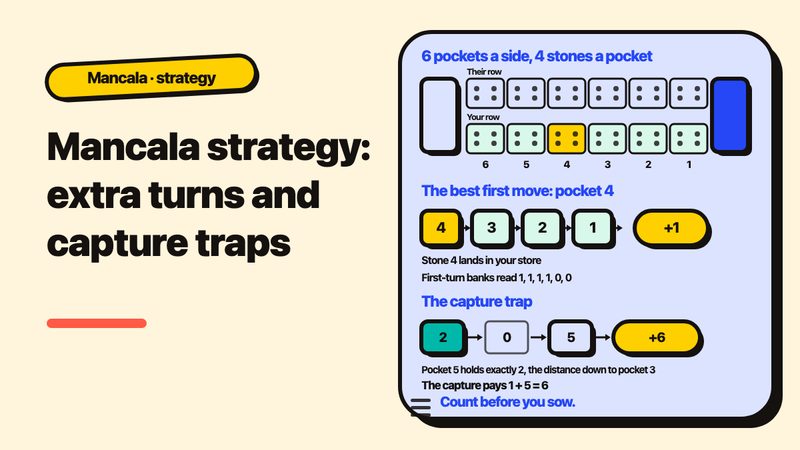
Mancala strategy comes down to three scorers: extra turns, captures and the end sweep. One opening move on the 6-pocket board banks a stone and buys a turn. Going second, the same arithmetic defends: 2 of the 6 replies below match that trick, and 3 of the 6 hand the first player nothing. Sowing, captures and setup stay on the mancala rules page. Every count below comes off 1 board: 6 pockets a side, 4 stones a pocket.
What actually scores in mancala
3 events move stones into a store. Everything else walks them around the board. Each trigger has a countable value. The values decide close games.
| Scorer | Trigger | What it pays | Printed where |
|---|---|---|---|
| Extra turn | your last stone lands in your store | 1 more sow, no chain limit | Wikipedia Gameplay, read 2026-11-22 |
| Capture | your last stone lands in your empty pocket, opposite holds at least 1 | 1 plus every stone opposite | Wikipedia's condition; Yellow Mountain omits the opposite clause |
| End sweep | a side empties; the other player moves all remaining stones to their store | your whole row at the finish | Wikipedia; Yellow Mountain omits it |
The board holds 48 stones, 24 a side. No move creates 1. A stone you bank is a stone they cannot bank. The triggers decide the game, not the sowing.
Keep the capture line exact. Only the last stone captures. A mid-sow stone on an empty pocket wins nothing. An empty opposite pocket pays 0 under the Wikipedia condition. The same landing can pay 6 or nothing.
The opening: one first move buys a second turn
Our assumptions
- A fresh board: 6 pockets a side, 4 stones a pocket, 48 stones, both stores empty.
- Sowing runs counter-clockwise into your own store; the opponent's store is skipped.
- Captures follow the Wikipedia condition: last stone, your empty pocket, opposite loaded.
- Pockets are numbered by distance to your store: pocket 1 sits beside it, pocket 6 the far one. The rules page counts left to right, pocket 1 farthest. That page's pocket 3 is this page's pocket 4.
- Other boards void the table: 3 pockets, or 3 or 5 stones a pocket, need a renumber before reuse.
| Opening pocket | Stones | Last stone lands | Extra turn | Banked |
|---|---|---|---|---|
| 1 | 4 | their pocket 4 | no | 1 |
| 2 | 4 | their pocket 5 | no | 1 |
| 3 | 4 | their pocket 6 | no | 1 |
| 4 | 4 | your store | yes | 1 |
| 5 | 4 | your pocket 1 | no | 0 |
| 6 | 4 | your pocket 2 | no | 0 |
The enumeration is a script's work, not a slogan. From pocket 4, stone 1 lands on pocket 3, stone 2 on pocket 2, stone 3 on pocket 1. Stone 4 lands in your store. A store landing buys another move.
The best first move in mancala is 1 line wide here: pocket 4.
Pockets 1, 2 and 3 bank 1 stone each. Their sows cross your store on the way to their row. Pockets 5 and 6 bank 0: 4 stones die inside your own row.
First-turn banks read 1, 1, 1, 1, 0, 0. No opening captures, because your side starts with no empty pocket.
Chaining extra turns: count the pockets to your store
A pocket pays a turn when its count equals its distance. Pocket 1 holding 1 sows straight into the store. Pocket 4 holding 4 is the opening above. The rule is ours, not a printed one. The script sowed every row below stone by stone.
| Pocket (steps to your store) | Count that ends in the store | Banks | One lap more | Banks |
|---|---|---|---|---|
| 1 | 1 | 1 | 14 | 2 |
| 2 | 2 | 1 | 15 | 2 |
| 3 | 3 | 1 | 16 | 2 |
| 4 | 4 | 1 | 17 | 2 |
| 5 | 5 | 1 | 18 | 2 |
| 6 | 6 | 1 | 19 | 2 |
One lap is 13 holes: your store, their 6, your 6. A pocket 13 over its distance ends in the store too and banks 2. The next lap parks 27 stones in 1 pocket. This page stops at 1 lap.
After the opening, your row reads 5, 5, 5, 0, 4, 4 and your store shows 1. The extra turn is live. No pocket holds its distance now: the 5s sit at distances 1, 2 and 3. The chain still pays, in stones, not turns.
| Second sow | Stones | Last stone lands | Banks | Store after |
|---|---|---|---|---|
| pocket 1 | 5 | their pocket 3 | 1 | 2 |
| pocket 2 | 5 | their pocket 4 | 1 | 2 |
| pocket 3 | 5 | their pocket 5 | 1 | 2 |
| pocket 5 | 4 | your pocket 1 | 0 | 1 |
| pocket 6 | 4 | your pocket 2 | 0 | 1 |
Each 5 banks exactly 1 mid-sow, then dies on their row. The two 4s stay home. No second extra turn exists here. The honest chain: 2 sows, 2 banked, turn passes.
Setting the capture: empty-pocket traps
The capture rule in 1 line: your last stone lands on your empty pocket, the opposite pocket holds at least 1, and both piles move to your store. The full steps sit on the rules page.
The trap is a distance sum. Pocket m holding exactly m - n stones lands its last stone on your empty pocket n.
| From pocket m | Stones needed | Lands on pocket | Pays when opposite holds 4 |
|---|---|---|---|
| 6 | 1 | 5 | 1 + 4 = 5 |
| 4 | 3 | 1 | 5 |
| 5 | 2 | 3 | 5 |
| 6 | 3 | 3 | 5 |
Put a board on the 2-stone row. Your row reads 4, 4, 0, 1, 2, 4. Their row reads 4, 0, 5, 4, 4, 4. The stores sit at 4 to 8. Pocket 5 holds exactly 2, the distance down to pocket 3.
Sow it. Stone 1 sits on pocket 4. Stone 2 lands on empty pocket 3, and their pocket 3 holds 5. The capture pays 1 + 5 = 6. Your store jumps from 4 to 10 in 1 move.
The same sum runs against you. A 0 on their side makes your opposite pocket a paid-out jar. Every stone parked there is a stone their last stone takes. The trap above turned 2 stones into 6. Pointed the other way, their 2 become your 6.
So count their empty pockets before each sow. Then count what your sow drops opposite them.
One house line to settle before stone 1. A capture clearing every pocket on their side at once is a grand slam. Neither printing behind the rules page scores it. Whether it pays, counts 0 or skips is a table decision, and it changes what every trap above is worth.
The end sweep decides close games
The end rule in 1 line: when a side empties, the other player sweeps every remaining stone into their own store. The higher store wins; ties stand. The sweep turns leftover rows into the final margin. Count before you sow.
Our assumptions
- Declared position: your store 18, your row 3 + 4 stones; their store 20, their row 3. Check: 18 + 20 + 7 + 3 = 48.
- They move first, and every sow is counted stone by stone.
- One landing hits an empty pocket with nothing opposite, so it captures nothing under the Wikipedia condition.
| Move | Stones | What it does | Stores after |
|---|---|---|---|
| they sow their pocket 3 | 3 | 1 banks, extra turn | 18 : 21 |
| they sow their pocket 1 | 1 | 1 banks, extra turn | 18 : 22 |
| they sow their pocket 2 | 1 | lands on their empty pocket 1, nothing opposite, no capture | 18 : 22 |
| you sow your pocket 6 | 4 | fills your pockets 5, 4, 3 and 2 | 18 : 22 |
| they sow their pocket 1 | 1 | 1 banks; their row empties, game over | 18 : 23 |
| the sweep | 7 | your 7 row stones go to your store | 25 : 23 |
The count was fixed before the first sow: 18 + 7 = 25 against 20 + 3 = 23. Their 3 banked stones and 3 extra turns never touched your row.
The late game runs on 1 comparison: your store plus your row against their store plus theirs. Captures are the only force that moves a stone across.
So add both sums before a late sow. If yours leads, feed their row nothing. Every stone there is theirs at the sweep. If yours trails, hunt the capture. Sowing alone cannot change the stones you hold.
When you go second: keeping the damage small
The reply table runs on 1 fixed line. The first player opens pocket 4, banks 1 and takes the extra turn. A pocket 3 follow-up banks 1 more.
After those 2 sows the stores read 2 : 0, your row is 4, 4, 4, 4, 5, 5 and their row is 6, 6, 0, 0, 4, 4. Six replies exist. The script played all 6.
| Your reply | Last stone lands | Banks | Extra turn | Fed to their row |
|---|---|---|---|---|
| pocket 1 | their pocket 4, an empty one | 1 | no | 3 |
| pocket 2 | their pocket 5 | 1 | no | 2 |
| pocket 3 | their pocket 6 | 1 | no | 1 |
| pocket 4 | your store | 1 | yes | 0 |
| pocket 5 | your store | 1 | yes | 0 |
| pocket 6 | your pocket 1 | 0 | no | 0 |
Rows 4 and 5 are the mirrors. Your pocket 4 still holds 4, its exact distance, and repeats the opening's trick. Your pocket 5 holds 5, loaded to its exact distance by their follow-up. Either mirror banks 1 and trims the gap to 2 : 1 without feeding their row.
Rows 1 to 3 bank the same 1 and feed their row 3, 2 and 1 stones. Row 1 is the odd one. Its last stone sits on their empty pocket 4, the 1 landing their next trap wants.
Row 6 banks nothing and stays home. Match the extra turn when the exact pocket exists, and keep stones off their row.
The mirror depends on their follow-up. Lines from their pocket 1 or 2 load your pocket 4 to 5 and kill that mirror. Your pocket 5 stays exact after all 3 banking follow-ups. Pocket 4 joins it only after the pocket 3 line.
Re-count before you answer. One stone decides which reply buys a turn.
Common strategy mistakes
6 mistakes cover most of the lost counts here. Each points back to its table. Each is a count you can run in seconds.
- Trusting the nearest-pocket feel. A bank needs count = distance. The distance table lists all 6 qualifying counts, plus the lap numbers.
- Splitting toward an empty pocket with an empty opposite. That landing captures nothing under the Wikipedia condition. Read the opposite count first.
- Feeding the pocket opposite their 0. Your stone there is the +1 in their next capture. The worked trap shows what loaded opposites cost.
- Sowing late without the sweep count. The sweep game above was fixed at 25 to 23 before its last sow. Add the two sums first.
- Spending an exact pocket. One stone off pocket 4 breaks the bank: 3 stones from pocket 4 land on pocket 1, not the store.
- Leaving the house rules unset. Grand slams, the sweep and the first player all change these counts. Settle them before stone 1.
Common Rules Questions
Does going first always win in mancala?
No printed table says so, and this page claims no win rate. The enumeration shows something smaller. An opening buys at most 1 extra turn and 1 banked stone. The reply table hands the second player mirrors for both. Rows 4 and 5 trim the stores to 2 : 1 within 1 round. Treat the first move as a counted edge, not a verdict.
What is the best second move after the extra-turn opening?
The enumeration ranks nothing; it counts. After the pocket 4 opening, your pockets 1, 2 and 3 hold 5 stones each. All 3 bank exactly 1. The pocket 3 line feeds their row 2 stones, against 3 from pocket 2 and 4 from pocket 1. That is the whole comparison, counts only.
Can you capture on your first move?
No. A fresh board has no empty pocket on your side: all 6 hold 4. A capture needs your last stone on an empty pocket of yours. The script's 6 opening rows contain 0 captures. A first sow banks at most 1 stone, on 4 of the 6 rows.
What is a grand slam and does it count?
A grand slam is 1 capture that empties every pocket on their side at once. Neither printing behind the rules page carries a grand-slam line. Whether it pays, counts 0 or skips is a table decision. Settle it before stone 1, because it reprices every trap count on this page.
Is it good to hoard stones in the pocket nearest your store?
Hoard stones score nothing; only store stones score. The nearest pocket banks at 1. At 14 it banks 2: one stone now, one after the 13-hole lap. Beyond that the pile is exposure. Keep pockets exact, not full.
Read next
- Mancala rules: the whole game, setup through the sweep, both printings side by side.
- Board game rules hub: one page per game in the board-games cluster.
- Backgammon rules: the other 2-player counting race on this shelf.
- Checkers rules: 2 players, 12 pieces a side, no stones to count.
- 2 player board games: the picks page behind this cluster, sorted by play time and setup.
Sources
- Wikipedia, Kalah, Gameplay section, en.wikipedia.org/wiki/Kalah. 6 houses a side, 4 seeds each, counter-clockwise sow, opponent store skipped, extra move on a store landing with no chain limit, capture from an empty own house with the opposite house loaded, end sweep to the store, draws allowed. Read 2026-11-22.
- Yellow Mountain Imports, How to Play Mancala. Pockets and stores wording, 4 stones a pocket, counter-clockwise sow, another turn, count the stores. Read 2026-10-16, recorded on the rules page. A recheck on 2026-11-22 was blocked by the publisher site, so this page quotes that record.
- Amazon item records. ASIN B0F3RXF9PS: 48 playing stones plus 8 extras, 14 pocket folding board, opens to 17.5 by 5.3 inches, folds to 8.7 inches. ASIN B007Z2ORBE: 48 glass stones, 0.5 inches, cloth drawstring bag. Read 2026-11-22.
- Rulenook: mancala rules, board game rules hub, backgammon rules, checkers rules, 2 player board games. Read 2026-11-22.
- Site recomputation: the 6 opening rows, both distance tables, the trap, the sweep line and the 6 replies come from 1 data file, sowed stone by stone by a check script. See how we compute. Read 2026-11-22.