Spades Bidding: How to Count Your Hand and Choose a Bid
Spades bidding: starting left of the dealer, each player bids one number from 0 to 13, and partners add their bids into the team's contract.
Bid past your tricks and the contract fails. Take more than you bid and each extra trick is a bag. The 10th bag costs 100. The count below turns 13 cards into a number you can defend. Spade honours first, then side aces, then the checklist for 0.
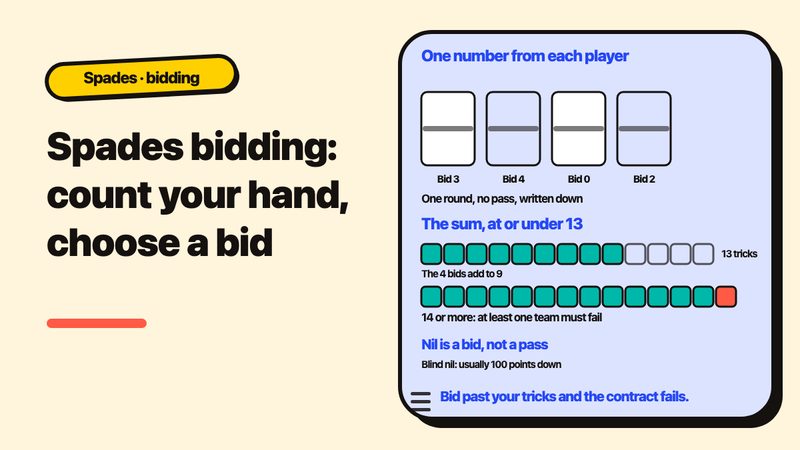
What you need and how the bids go around
One 52-card pack seats 4 players in 2 partnerships, 13 cards a hand. Dealing, following suit and the breaking rule live on how to play spades. Deck counts and card sizes sit on the playing card guide. Bidding itself needs no gear.
- The player to the dealer's left bids first. Both printings start the round there.
- Each player in turn says one number from 0 to 13: the tricks they expect to take. Wikipedia names the 0 bid: nil.
- There is one round and no pass. Bicycle prints it flat: every player must make a bid, and the minimum bid is One.
- Partners add their two numbers. The sum is the team's contract, the standard partnership rule on Wikipedia's page.
- Spades are always trump, so a bid names no suit. Bridge has an auction and conventions. Spades has neither.
- Write the 4 bids down. Bicycle puts a scorer on it: the sheet is what the hand is scored against.
Both printings agree on the shape: one round, one number each, spoken in turn. They differ on the floor and on 0. That is the next section's subject.
How to count your hand before you bid
Tricks come from two places: big spades and big side cards. Count your spades first, then your side suits, then decide on 0. The tally is ours, not a printed rule, so every assumption sits in the open.
Our assumptions
- The ♠ A counts 1 trick. In the standard order nothing beats it.
- The ♠ K counts 1 when 2 or more other spades sit behind it. Without that guard, the ♠ A drops on it and your king scores 0.
- The ♠ Q counts 1 with 3 or more other spades behind it; otherwise 0.
- Each ace outside spades counts 1.
- A king outside spades counts 1 only when the same hand holds that suit's ace. A lone king counts 0.
- Voids and side suits of 3 or fewer cards get no fixed add. A void with 2 or more spades behind it argues for 1 trick up; judge that by eye.
- The 0 call has its own checklist, printed after the worked hands.
| What you hold | Count | Guard it needs |
|---|---|---|
| ♠ A | 1 | none |
| ♠ K | 1 | 2 or more other spades |
| ♠ Q | 1 | 3 or more other spades |
| Side ace (♥ ♦ ♣) | 1 each | none |
| Side king | 1 | that suit's ace, same hand |
| Void or side suit of 3 or fewer | no fixed add | 2 or more spades argue 1 up |
| Nil (0) | 0 | the checklist below |
Three worked hands, counted row by row. Every number sits in a data file. A check script re-adds each one.
| Hand | 13 cards | Counted | Bid |
|---|---|---|---|
| 1 | ♠ A K 7 3 · ♥ A 9 5 2 · ♦ K 10 4 · ♣ Q 8 | 3 | 3 |
| 2 | ♠ A Q 9 6 4 · ♥ A K 7 3 · ♦ J 8 5 · ♣ 10 | 4 | 4 |
| 3 | ♠ 9 6 3 · ♥ J 10 7 2 · ♦ Q 8 5 · ♣ Q 10 4 | 0 | 0 (nil) |
Hand 1. The ♠ K has the 7 and the 3 behind it, so it counts. The ♥ A counts as a side ace. The ♦ K sits alone with no ♦ A, so row 5 leaves it at 0.
Hand 2. The ♠ Q has the 9, the 6 and the 4 behind it. That is 3 others, exactly the guard row 3 asks for. The ♥ K rides on the ♥ A. Counted, the hand comes to 4.
Hand 3. No ace, no king, no honour in spades. The tally runs to 0, and the checklist below says this is the nil shape.
The checklist has 4 lines, and all 4 must pass. No ace anywhere. No king anywhere. No spade above the 9. And 4 or fewer spades. Hand 3 passes. Hand 1 fails on 3 counts at once.
Minimums, Nil and blind nil: what the rules require
Both printings put a floor under every number bid. Bicycle prints the minimum as One and prints no nil at all. Wikipedia prints the 0 bid and names it nil. Every other bid keeps the floor of 1. Neither printing sets a minimum for the team total.
Our assumptions
- Bicycle quotes read off the page on 2026-11-21. Wikipedia quotes read off the entry the same day, maintenance banners included. A line only Wikipedia prints says so in its cell.
- Variant names come from Wikipedia's variations section: mirror, suicide, whiz. Black Spades is the G150 page's subject; The Root and BumpleDickle print that variant, not this game.
- A cell reading not printed means neither printing carries the line. It does not mean forbidden.
| Rule | Printed (Bicycle / Wikipedia) | Named variants | Black Spades (G150) | Settle first |
|---|---|---|---|---|
| Per-player minimum | Bicycle: 1. Wikipedia: 1, unless the bid is nil | mirror: your spade count; whiz: spade count or nil | board of 4 books, that variant's house rule | the floor number |
| Team-total minimum | not printed in either | whiz prints no team minimum | not printed | none, unless your table adds one |
| Nil (0) | Bicycle: not printed. Wikipedia: printed, a 0 bid is nil | suicide: 1 nil per team, forced; whiz: nil is the out | not printed | does 0 exist at this table |
| Blind nil | Bicycle: not printed. Wikipedia: printed, usually only when the team is 100 points down | Wikipedia: nil may pass 1 or 2 cards, blind nil only | blind bids score double (The Root, via G150) | trigger and score |
| Pass | Bicycle: no pass, every player bids | not printed as a move | not printed | no pass; 0 is a bid, not a pass |
| Bidding method | Bicycle: spoken in turn; a scorer writes the bids | Wikipedia: spoken, clockwise, dealer last | mirror fixes the number, nothing to say | spoken or written, one round |
So nobody must bid 2. No team of 4 must sum to 4 or to any other printed number. The floors in print are 1 per player, and 0 stays legal wherever nil is played. The 4-book board belongs to Black Spades, one variant's house rule.
Blind nil is a 0 called before anyone looks at their cards. Wikipedia prints the trigger. Your team must be 100 points down.
There are usual extras too. The nil bidder may pass 1 or 2 cards to the partner. That swap is usually reserved for the blind call. Bicycle's page carries none of this. Settle 2 lines before deal 1: the trigger, and whether cards cross.
Reading the table: your partner's bid and the other team's
The two contracts share the table's 13 tricks. The arithmetic sits on our how-to-play page. When the 4 bids add to 14 or more, at least one team must fail.
A pair at 12 or 13 has no lost trick to give away. A pair at 6 plans to watch 7 tricks go elsewhere.
- A partner's 0 changes your math, not theirs. An unguarded ♠ K now plays like a guarded one: your partner ducks, you take the trick. Count unguarded kings and queens one row up Table A, then bid the higher number.
- The other team's 9 or 10 makes every trick you take a trick they cannot get. Holding them under their contract is worth as much as making yours.
- The other team's 4 or 5 is a bag warning. Every trick you take above your own contract is a bag. The 10th bag costs 100. The full table sits on the scoring page.
- Your own pair's sum is a promise, so keep it at or under 13. Bids that ignore the ceiling are not ambition; they are a set waiting for its excuse.
Common bidding mistakes
Bidding errors trace back to one slide. A rule from a variant gets applied to the standard game. Or a count skips its own guard rows. Six places to check.
- Bidding your spade count is mirror, not spades. Six small spades with no ace and no king count 0 on Table A. The 6-trick call belongs to the variant that defines it.
- An unguarded ♠ K is not a trick. Row 2 asks for 2 spades behind it. The ♠ A is out there somewhere, and it wins the trick your king needed.
- The team sum has a ceiling of 13. The deck deals 13 tricks. A pair promising more is scoring a future set, not showing strength.
- Calling nil with an ace in hand breaks the checklist at line 1. Aces take tricks; nil promises none.
- Changing a number after your turn breaks the round. One round, one number each, clockwise. Bicycle's no-pass line is what keeps that shape.
- Bidding your usual count beside a partner's 0 strands the nil. Cover it: count your unguarded honours up, exactly as the section above says.
Common Rules Questions
Is there a minimum bid in spades?
For a number bid, yes: both printings put the floor at 1. Bicycle prints the minimum as One. Wikipedia prints at least 1 for every bid that is not nil. The 0 bid is legal where nil is played, which Wikipedia prints and Bicycle does not.
No team-total minimum appears in either printing. Your table sets one or leaves it out.
Do you have to bid your spade count?
No. Bidding exactly your spade count is the variant Wikipedia names mirror. Even mirror forces a 0 when the hand holds no spades.
Standard bidding asks for a trick estimate, which is the tally in Table A. A hand with 6 small spades and no honours bids 0 or 1, not 6.
Can you pass in spades?
No. Bicycle prints one round, every player bids, no player may pass. A 0 is not a pass. It is the nil bid, a promise to take no trick at all. It scores on its own. Wikipedia prints nil as a standard part of bidding.
What is blind nil and when can you call it?
Blind nil is 0, bid before the cards are picked up. Wikipedia prints the usual trigger: the team must be 100 points down. It also prints the usual extras. The nil bidder may pass 1 or 2 cards, usually on this call only.
Whether the call exists at your table is a house line. Settle it before deal 1.
Does bidding change with 2 or 3 players?
The round works the same; the deal under it changes. Three players take 17 cards each out of a 51-card pack. Two players draw and discard down to 13-card hands. The bid range moves with those numbers, and they live on the 2 or 3 player page.
How is bidding different in Black Spades?
Three ways. The unit is a book, not a trick. The floor is a board of 4 books, a house rule that variant prints. And blind bids score double in The Root's printing. The full comparison sits on the Black Spades page.
Read next
- How to play spades: the whole game, dealing through scoring.
- Spades scoring: what a kept bid earns, bags included.
- Spades for 2 or 3 players: the shorter deals and their bid ranges.
- How to play Black Spades: books, the board of 4, blind bids.
- All card game rules: the hub, one page per game.
- Playing cards for card games: deck counts, card sizes, index sizes.
Sources
- Bicycle Cards, How to Play Spades, bicyclecards.com/how-to-play/spades. Dealer's left starts, one round, the minimum bid is One, no player may pass. The scorer line. 500 and 200 targets. 10 a trick plus 1 an overtrick. Bags at 10 costing 100. Read 2026-11-21.
- Wikipedia, Spades (card game), en.wikipedia.org/wiki/Spades_(card_game). Standard bidding, nil, blind nil at 100 down, nil passing, suicide, whiz, mirror. The entry carries maintenance banners, so it counts as one printing, not a rulebook. Read 2026-11-21.
- Amazon item records. ASIN 1441309888: 2 decks, 52 cards plus 2 jokers each, 100% plastic, standard index, cards 2 1/2 by 3 1/2 in. ASIN B0CT3VV8HW: 320 score pads on 160 pages, 6 by 9 in. Read 2026-11-21.
- Rulenook: how to play spades, spades scoring, spades for 2 or 3 players, Black Spades. Read 2026-11-21.
- Site recomputation: the bid-count assumptions, the 3 worked hands and both figures come from one data file. A script re-adds every number. See how we compute. Read 2026-11-21.