How to Play Black Spades: Jokers, Book Bidding and Scoring
As an Amazon Associate, Rulenook earns from qualifying purchases.
How to play black spades: 52 cards with two jokers, 13 each, a minimum bid of 4 books, and 10 points per book bid plus 1 per over. Two printings share the name, and their decks differ. Part 3 drops the 2♥ and the 2♣. Part 1 keeps the 2♣. Count the jokers first.
The Root prints it at a family reunion. BumpleDickle prints it at cookouts, barbershops and HBCU dorm rooms. The Root ran 3 tutorials in March 2020. BumpleDickle printed another in July 2025.
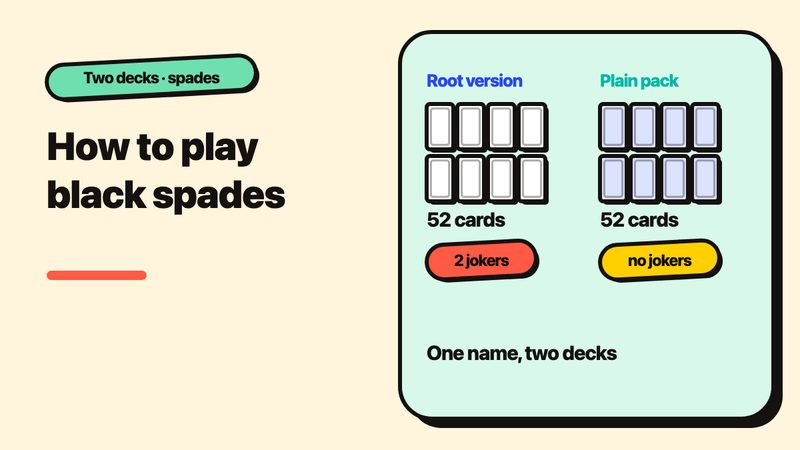
What you need and how the deck is set up
A pack, 4 players, a pen. The printings use different decks.
Part 3 starts with 52. Take out the 2♥ and the 2♣. Add 2 jokers. That is 52 again, 13 each. BumpleDickle prints the plain pack.
Our assumptions
- The Root column is Parts 1 and 3, read 2026-11-12. The BumpleDickle column is that printing, same day.
- Every hand is 13 cards for 4 players. The joker odds assume a hand drawn out of 52.
| Printing | Cards | Each | Out | In | Jokers in the pack | At least 1 joker | Both jokers | Jokers a hand |
|---|---|---|---|---|---|---|---|---|
| Part 3 | 52 | 13 | 2♥ and 2♣ | 2 jokers | 3.8% | 44.1% | 5.9% | 0.5 |
| BumpleDickle version | 52 | 13 | none | none | 0 | 0 | 0 | 0 |
| Standard spades | 52 | 13 | none | none | 0 | 0 | 0 | 0 |
The 2 jokers are 3.8% of the Part 3 deck. A hand of 13 holds at least 1 of them 44.1% of the time. Both land in one hand 5.9% of the time. Expect 0.5.
Count before you deal. Part 3 leaves 52, jokers included. Part 1 prints 16 trumps and keeps the 2♣. Its card count is not printed.
A 2-deck pack with 2 jokers in each deck carries both jokers and leaves a spare. Deck counts are on the playing card guide.
Which Black Spades are you playing?
Two printings, one name. Agree which one first.
Our assumptions
- The Root column is Parts 1 to 3, read 2026-11-12. BumpleDickle is that printing. Standard spades is Bicycle plus Wikipedia.
- Where 2 printings disagree, both numbers stay and neither is called correct.
| Rule | The Root version | BumpleDickle version | Standard spades | Settle first |
|---|---|---|---|---|
| Deck | Part 3: 2♥ and 2♣ out. Part 1: 2♣ stays | 52 cards, no jokers | 52 cards, no jokers | count the jokers |
| Cards each | 13 | 13 | 13 | 4 players |
| Card order | Part 3: joker, joker, 2♦, 2♠, A to 2. Suit of that 2: not printed. Part 1: A to 2, 2♣ stays | A♠ down to 2♠ | A down to 2 | write it down |
| Minimum bid | board, usually 4 books | not printed | Bicycle 1; Wikipedia board or 4 | name the floor |
| Blind bid | double the points | not printed | 120 for exactly 6, else −120 | pick one |
| Blind ceiling | not printed | not printed | Wikipedia caps a blind at 7 | set a ceiling |
| Team bid | each bids, partners add | the bid is a team total | Wikipedia: partners add | add or not? |
| Made bid | 10 a book | 10 a book | 10 a book | same in all 3 |
| Books over | 1 each, a bag | 1 each, a bag | 1 each, an overtrick | keep a bags column |
| Target | 500, or 350 with a crowd | 500 | 500; Bicycle prints 200 | pick 500 |
| All 13 books | Part 1: any Boston ends it. Part 2: bid and make | not printed | a made Boston wins outright | agree first |
Look in the pack first. 2 jokers mean the Root version. A 2♦ above the 2♠ is printed in Part 1 and Part 3. It does not name Part 3. Part 1 also prints joker, joker, 2♠, with no 2♦ above it. A board of 4 does not decide it.
Card order: where the jokers and the deuces sit
Rank order decides the cut. A 2♦ cut and a 2♠ cut differ once a deuce sits above the ace.
Our assumptions
- Each column is one printing, read 2026-11-12. The number is the rank.
not printedmeans that source prints no place for the card.
| Card | Part 3 | Wikipedia: deuces high | Wikipedia: joker-joker-deuce-ace | Standard spades (Bicycle) | Printing the cell comes from |
|---|---|---|---|---|---|
| Big joker | 1 | not printed | 1 | not printed | Root Part 3; Joker-Joker-Deuce-Ace |
| Little joker | 2 | not printed | 2 | not printed | Root Part 3; Joker-Joker-Deuce-Ace |
| 2♦ | 3, above the 2♠ | under the 2♠, then the ace | not printed | lowest | Root Part 3; deuces high |
| 2♠ | 4, under the 2♦ | above the 2♦ | 3, then the ace | lowest | Root Part 3; deuces high |
| 2♥ | removed in Part 3 | renamed big joker if none | not printed | lowest | Root Part 3; deuces high |
| 2♣ | removed in Part 3 | renamed little joker if none | not printed | lowest | Root Part 3; deuces high |
| A | 5 | after the 2♦ | 4 (A♠) | 1 | Root Part 3; deuces high |
| K | 6 | under the ace | not printed | 2 | Root Part 3 |
| Q | 7 | under the ace | not printed | 3 | Root Part 3 |
| J | 8 | under the ace | not printed | 4 | Root Part 3 |
| 10 | 9 | under the ace | not printed | 5 | Root Part 3 |
| 9 | 10 | under the ace | not printed | 6 | Root Part 3 |
| 8 | 11 | under the ace | not printed | 7 | Root Part 3 |
| 7 | 12 | under the ace | not printed | 8 | Root Part 3 |
| 6 | 13 | under the ace | not printed | 9 | Root Part 3 |
| 5 | 14 | under the ace | not printed | 10 | Root Part 3 |
| 4 | 15 | under the ace | not printed | 11 | Root Part 3 |
| 3 | 16 | under the ace | not printed | 12 | Root Part 3 |
| 2 | 17, suit not printed | not printed | not printed | not printed | Part 3 rank list |
Part 3 and Part 1 both print the 2♦ above the 2♠. With jokers in, deuces high prints the 2♠ and the 2♦, then the ace.
Part 3 takes the 2♥ and the 2♣ out. Part 1 keeps the 2♣. The 4-player cut is Joker-Joker-Deuce-Ace: the 2♣ and either the 2♥ or the 2♦ come out, or they replace the J♠ and the J♣.
In the Part 3 deal, 4 cards sit above the ace. They are 7.7% of the pack. A hand of 13 holds at least 1 of them 69.6% of the time.
Bidding books, board and blind bids
The bid comes first. The printing sets it.
Bids start on the dealer's left. Each player names a number. Partners add both. BumpleDickle prints a team total.
Part 2 adds a floor: bid and make 4. A set for bidding under it is not printed. BumpleDickle prints no minimum. Bicycle prints 1.
A blind bid comes before you look. Part 3 doubles it, and allows one only 100 behind.
Wikipedia caps a blind at 7. Blind 6 pays 120 only for exactly 6, and loses 120 otherwise. A trailing blind scores 20 a book.
Part 3 allows talk with your partner only while bidding. The misdeal is Wikipedia, not Part 3. Naming a card there is cross-boarding. The deal can pass, bags can be added, and the loss tops out at 100.
| Term | In this printing | Standard spades | Printing the row comes from |
|---|---|---|---|
| book | 4 cards in a turn | trick | Root Part 2 |
| board | the minimum bid, usually 4 books | not printed | Root Part 2 |
| blind | a bid before you look, worth double | a bid before you look, capped at 7 | Root Part 2; Wikipedia |
| dime | a bid of 10 books | not printed | Root Part 2 |
| cut | a spade wins a book led in another suit | trumping a trick | Root Part 2 |
| bag | a book over the bid; 10 cost 100 points | overtrick or sandbag | Root Parts 2, 3 |
Playing the books
The dealer's left leads. Follow suit if you can. If not, any card is legal, spades included.
Spades are trump. A spade over another suit wins the book. The Root version calls that a cut.
Another suit cannot win a book led in a different suit. The standard deal is on our how to play spades page.
Do not lead a spade first unless you hold only spades, or a spade is already out. Bicycle prints the same rule.
The winner leads next. A hand is 13 books. It ends when no card is left. Then count the books against the bid.
Scoring a hand and the score sheet
A made bid scores 10 a book. Each extra book adds 1. 10 bags cost 100.
Our assumptions
- The Root column is Parts 2 and 3. BumpleDickle is that printing. Standard spades is Bicycle plus Wikipedia.
- A set means fewer books than the bid. The 3 examples below are our arithmetic.
| Scoring point | The Root version | BumpleDickle version | Standard spades |
|---|---|---|---|
| Made the bid | 10 a book | 10 a book | 10 a book |
| Each book over the bid | +1, a bag | +1, a bag | +1, an overtrick |
| Set, 6 bid and 5 books | −10 a book, so −60 | 0 points | Bicycle 0; Wikipedia −10 a book |
| 10 bags | −100 | −100 | −100 |
| Nil bid made | not printed | +100 | Wikipedia +100 |
| Nil bid missed | not printed | −100 | Wikipedia −100 |
| Blind bid | double the points | not printed | 120 for exactly 6, else −120 |
| Boston, all 13 books | Part 1: any Boston ends it. Part 2: bid and make | not printed | a made Boston wins outright |
Three examples. Bid 6 and make 7: 61. Bid 6 and make 6: 60. Bid 6 and make 5: set for 60.
Bags sit apart from the bid. 10 bags cost 100. The count carries on. The sheet is on our spades scoring page.
How does the game end?
The target is 500. Part 3 also prints 350 when players wait. BumpleDickle prints 500. Bicycle prints 200 for a short game.
A tie at 500 is not printed in the Black Spades pages. Wikipedia and Bicycle print one more round of play.
Boston is one team taking all 13. Part 1 ends the game at any Boston. Part 2 prints bid-and-make as a house rule. Wikipedia prints the bid-and-make win.
Two or 3 players is a different game. The Root version is 4 players, partners opposite.
Three players is Joker-Joker-Deuce-Ace, not all of jokers high: jokers in, no cards out. The standard short deal is on spades for 2 or 3 players.
Official rules vs common house rules
No rule body. Check the printed pages first.
Our assumptions
- Column 1 is The Root and BumpleDickle. Column 2 is Bicycle and Wikipedia. Column 3 is agreed first.
not printedmeans the source prints no number for that row.
| Rule | The printed Black Spades rules | Standard spades as printed | Settle before the first card |
|---|---|---|---|
| Deck | Part 3: 2♥ and 2♣ out. Part 1: 2♣ stays. BumpleDickle: no jokers | 52 cards, no jokers | count the jokers |
| Jokers | Root: 2, above the ace. BumpleDickle: none | none; Wikipedia prints jokers high | do the jokers play? |
| 2♦ and 2♠ | Part 3: 2♦ above 2♠. Part 1 also prints joker, joker, 2♠. BumpleDickle: not printed | Wikipedia: 2♠ above 2♦ | write the order down |
| Minimum bid | Root: board, usually 4. BumpleDickle: not printed | Bicycle 1; Wikipedia board or 4 | use 4 or name another |
| Blind bid | Root: double the points. BumpleDickle: not printed | 120 for exactly 6, else −120 | pick one rule |
| Blind ceiling | not printed | Wikipedia caps a blind at 7 | set a ceiling |
| Books over the bid | 1 each | 1 each | same in both |
| 10 bags | −100 | −100 | keep a bags column |
| Target score | Root: 500, or 350 with a crowd. BumpleDickle: 500 | 500; Bicycle 200 | pick 500 |
| Boston | Part 1: any Boston ends it. Part 2: bid and make. BumpleDickle: not printed | a made Boston wins outright | agree first |
| Leading a spade first | spades only, or after a spade is out | the same rule | keep it as printed |
| Terms | book, board, blind, dime, cut, bag | trick, blind, overtrick | learn the words |
| Kitty | a variant to skip | Wikipedia prints a kitty | only if you agree |
| Talking while bidding | Root: with your partner, while bidding. BumpleDickle: no talking across the table | naming a card is a misdeal | say which printing |
Five rows break a game if skipped: the deck, the deuces, the floor, the blind, and 100 for 10 bags.
Common mistakes
- Leaving the 2♥ and the 2♣ in a Part 3 deal. Part 3 takes them out. Part 1 does not.
- Treating the little joker as the 2♥. The Root version removes that card, not renames it.
- Assuming the 2♦ beats the 2♠. The Root printing says it does, and Wikipedia says the opposite.
- Leading a spade first. Only with spades and nothing else, or after a spade is out.
- Scoring a blind at 10 a book. This version doubles the blind, so 6 books are worth 120.
- Forgetting the bags penalty. 10 bags cost 100 points, and the count carries over.
Common Rules Questions
How many cards do you use for Black Spades?
Part 3 deals 52 cards. Take the 2♥ and the 2♣ out, then add 2 jokers. Part 1 keeps the 2♣. BumpleDickle prints the plain 52-card pack, with no jokers at all. Count the cards before the deal. Two jokers means the Root version.
Do you need jokers?
The Root version needs 2, and both sit above the ace. BumpleDickle uses none. Wikipedia's jokers high line makes both jokers the highest spades. The 4-player cut is the Joker-Joker-Deuce-Ace line: the 2♣ and either the 2♥ or the 2♦ come out.
What is the minimum bid in Black Spades?
Part 2 calls it board, and board is usually 4 books. You must bid and make them. A set for bidding under that floor is not printed. BumpleDickle prints no minimum. Bicycle prints 1, and Wikipedia prints board or 4. Settle the number before the first hand.
What is a blind bid?
A bid you make without looking at your cards. The Root version scores it at double the points, and allows one only 100 points behind. Wikipedia caps a blind at 7. Blind 6 pays 120 only for exactly 6 tricks, and loses 120 for any other count. A trailing blind scores 20 a book.
Can you play Black Spades with 2 or 3 players?
No. The Root version is a 4-player game, partners opposite. Three players is the Joker-Joker-Deuce-Ace line, not all of jokers high: the jokers go in, and no cards come out. That is a different order. The shorter standard deal is on spades for 2 or 3 players.
Is this the same as the Black Spades mobile game?
No. A mobile game under that name is a separate product, with its own menus and its own rules. The card game uses a deck, 4 players, books and a score sheet. No app is described here, and no app is linked.
Read next
- How to play spades: the standard 52-card game.
- Spades scoring: the full scoring sheet, with the bags column.
- Spades for 2 or 3 players: the shorter deal of standard spades.
- Cribbage score sheet: a printable table sheet.
- All card game rules: the rest of the card game pages.
Sources
- The Root, How to Play Black Spades, Parts 1, 2 and 3, March 2020, theroot.com. Read 2026-11-12.
- BumpleDickle, Spades: African American Card Game for Millennials, July 2025, bumpledickle.com. Read 2026-11-12.
- Wikipedia, Spades (card game), with the variations section, en.wikipedia.org. Read 2026-11-12.
- Bicycle Cards, How to Play Spades, bicyclecards.com. Read 2026-11-12.
- Amazon listing record for B00E4AMFKK: 2 decks, 52 cards plus 2 jokers each. Read 2026-11-12.
- Site recomputation: deck arithmetic, joker odds, the 4 card orders and the 3 worked examples.
How we check numbers and name sources: our methodology.