Canasta Rules: Melds, Red Threes, the Frozen Pile and Scoring to 5,000
Canasta is a 4-player partnership rummy game played with 2 decks and 4 jokers, 108 cards in all. You meld cards of the same rank, never runs, and build them into canastas of 7 or more. Jokers and 2s are wild. Your side needs at least 1 canasta to go out, and the first side to 5,000 points wins.
The rules here are the classic American game as Bicycle publishes it. Hand and Foot, Samba and other relatives change the numbers; our Hand and Foot page covers the most popular one.
What do you need, and how do you deal?
| Item | Rule |
|---|---|
| Players | 4, partners sit opposite |
| Deck | 2 standard decks + 4 jokers = 108 cards |
| Cards each | 11, dealt one at a time |
| Wild cards | 4 jokers and 8 deuces |
| Game | 5,000 points |
After the deal, put the stock in the middle and turn the top card face up. If that upcard is a joker, a 2 or a 3, turn more cards onto it until a natural card from 4 to ace shows.
What are the cards worth?
| Card | Points |
|---|---|
| Joker | 50 |
| 2 (wild) | 20 |
| Ace | 20 |
| K, Q, J, 10, 9, 8 | 10 |
| 7, 6, 5, 4 and black 3s | 5 |
| Red 3 | Bonus card: 100 each (see below) |
What can you meld?
A meld is 3 or more cards of the same rank, and it needs at least 2 natural cards and no more than 3 wild cards, so 8 8 2 2 is legal and 8 2 2 is not. Wilds never stand alone.
A canasta is a meld of 7 or more cards with at least 4 natural cards.
| Canasta | What's in it | Bonus |
|---|---|---|
| Natural ("clean") | No wild cards at all | 500 |
| Mixed ("dirty") | 1 to 3 wild cards | 300 |
Square up a finished canasta: a red card on top for natural, black for mixed. It can keep growing. Adding a wild card to a natural canasta turns it mixed.
Partners share melds. One pile of melds per side. Your side can't have 2 separate melds of the same rank, but you can meld a rank the other side has already melded.
What do red and black threes do?
Red 3s never go in your hand. Lay each one face up on the table as soon as you get it and draw a replacement from the stock. Each is worth 100, or 800 for all 4 on one side, but they count for your side only if your side has melded during the deal; otherwise they count against you.
Black 3s can't be melded except when you go out, as 3 or 4 black 3s with no wild cards. Discarding one stops the next player cold: nobody can take a pile with a black 3 on top.
How big must your first meld be?
Your side's first meld of each deal must reach a minimum count of card values. Red 3 and canasta bonuses don't count toward it.
| Your side's total at the start of the deal | Minimum first meld |
|---|---|
| Below 0 | 15 |
| 0 to 1,495 | 50 |
| 1,500 to 2,995 | 90 |
| 3,000 or more | 120 |
Example: you need 50. You lay down K K K (30) and 8 8 2 (10 + 10 + 20 = 40), so 70 in all. That opens your side. Two melds? Fine.
When can you take the discard pile?
Taking the whole pile is the big swing in canasta, because a pile of 20 or 30 cards can hand your side a canasta in one turn. You must use the top card in a meld right away.
| Pile is | You can take it with |
|---|---|
| Not frozen | A natural pair matching the top card; or 1 matching natural card + 1 wild card; or by adding the top card to your side's meld |
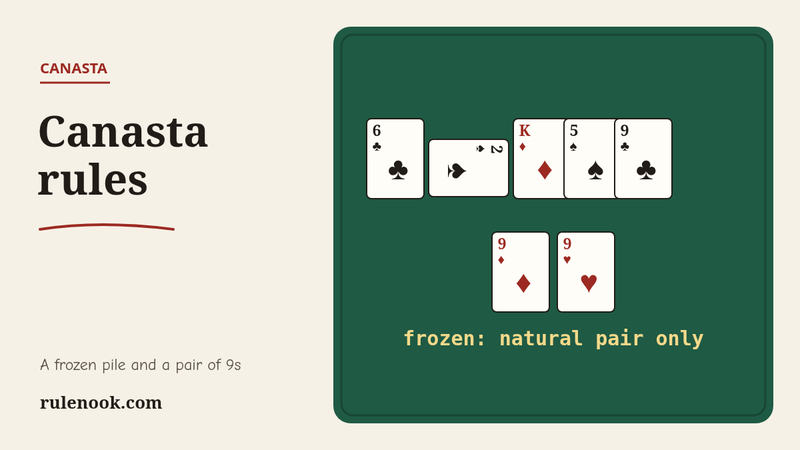
| Frozen | Only a natural pair from your hand matching the top card |
| Topped by a wild card or black 3 | Can't be taken at all this turn |
When is it frozen? Against your side, until your side has made its first meld. For everyone, once a red 3 is turned as the upcard, or a wild card or black 3 is turned up or discarded. Turn the freezing card sideways. Only taking the pile unfreezes it.
How do you go out?
Your side must have at least 1 canasta, or complete one as you go out. A final discard is optional. Before going out you may ask your partner, "Partner, may I go out?" The answer is binding.
Going out concealed means melding your whole hand in one turn, including a canasta, with no earlier melds by you. It earns an extra 100.
How do you score canasta?
Add the bonuses, add the value of every card your side melded, then subtract the cards left in both partners' hands.
| Bonus | Points |
|---|---|
| Each natural canasta | 500 |
| Each mixed canasta | 300 |
| Each red 3 | 100 (all 4: 800) |
| Going out | 100 |
| Going out concealed | 100 more |
Worked example: Side A goes out. Its melds: a natural canasta of 7 kings (70 in cards), a mixed canasta of 5 eights and 2 deuces (50 + 40 = 90), and 3 aces (60). Plus 2 red 3s. The partner still holds a queen and a 4 (15).
- Bonuses: 500 + 300 + 200 + 100 = 1,100
- Melded cards: 70 + 90 + 60 = 220
- Side A: 1,100 + 220 − 15 = 1,305
Side B melded 3 jacks and a joker (30 + 50 = 80) and has 1 red 3 (100). Its hands hold an ace, a 7, a 9 and a black 3 (20 + 5 + 10 + 5 = 40). Side B: 100 + 80 − 40 = 140.
The first side to reach 5,000 wins. No game bonus.
Common Rules Questions
Can you go out in canasta without a canasta?
You can't. Your side needs at least 1 completed canasta of 7 or more cards before or while you go out. If you can't meet that, you must keep at least 1 card in hand. It doesn't matter which partner made the canasta. Going out also earns 100, and 200 if you meld your whole hand at once with no earlier melds.
Why can't you pick up the discard pile when a black 3 is on top?
The pile can never be taken while a black 3 or a wild card is on top. The next player must draw from the stock. Under Bicycle's rules the black 3 also freezes the pile, so once a natural card covers it, only a natural pair can take it. Many home tables treat a black 3 as a one-turn stop instead. Agree which first.
Can you add cards to your opponents' melds?
Never. In canasta you can only add to your own side's melds. You may start a meld of a rank the other side has already melded, though, so 2 sides can each have a meld of 8s. Your side may not have 2 separate melds of the same rank, so an extra 8 joins your existing meld.
What to read next
Sources: Bicycle, Canasta (deck, deal, wild cards, card values, red and black 3s, melds and canastas, minimum first meld, frozen pile, going out, permission to go out, concealed hand, scoring and game target), read 2026-10-10. Worked examples are our arithmetic, rechecked by script. Last updated 2026-10-10.
Sources
- Bicycle, Canasta rules, bicyclecards.com (read 2026-10-10; snapshot verify/sources/bicycle_canasta.html)