Rummikub for 2 Players: Deal, Pool and the Two-Game Match
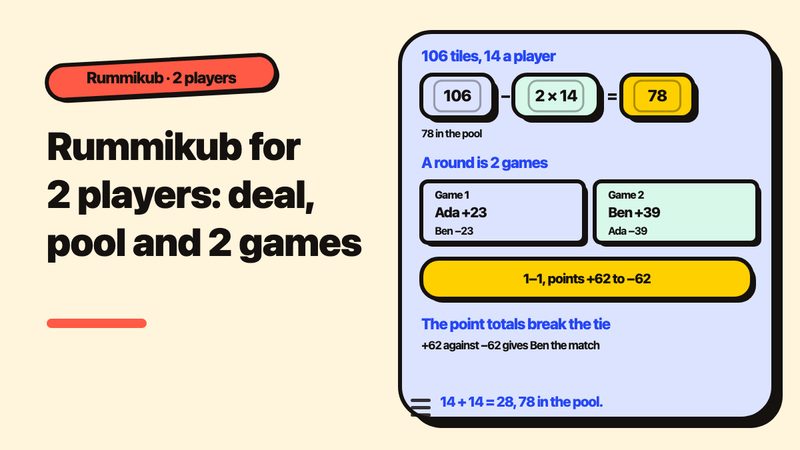
Rummikub for 2 players is official rules: 14 tiles each, 78 in the pool, and a round is 2 games. The 30-point first meld and scoring stay the same. Both rulebooks list 2 to 4 players. The box you own already covers your table.
Only 3 numbers move: the deal, the pool, and the games per round. Every set, run, joker and rearrangement rule is on our Rummikub rules page. This page keeps the two-player numbers together and checkable.
Can You Play Rummikub With 2 People?
Yes. Both printings put 2 at the bottom of the player count. The 2019 manual from rummikub.com lists 2 to 4 players, ages 7 to adult. The 2015 Pressman sheet prints 2 to 4 players, ages 8 to adult.
Neither book asks you to add tiles, cut the set, or invent a third seat.
What changes is smaller than most tables expect. A round gets shorter. The pool gets deeper. Everything else, from the 30-point opening to the joker penalty, holds at every count.
| Rule | Official rule at 2 players | Changed at 2? | Where it comes from |
|---|---|---|---|
| Tiles dealt | 14 each, so 28 leave the mix | No | 2019 manual, Set-up ("Each player takes 14 tiles"); Pressman sheet, same deal |
| The pool | 106 − 2 × 14 = 78 tiles | Yes | Arithmetic on the 106-tile set; deal printed in the manual, Set-up |
| Games in a round | 2 | Yes | 2019 manual, Set-up ("with two players a round is made up of two games"); Pressman sheet, same |
| First meld | 30 points, from your rack only | No | 2019 manual, Playing The Game ("at least 30 points"); Pressman sheet prints the same 30 |
| Joker | Fills any gap; on a rack at game end it costs 30 | No | 2019 manual, The Joker and the Scoring note; Pressman sheet, same penalty |
| Scoring | Losers' racks go negative; winner takes the positive sum | No | 2019 manual, Scoring |
| Turn clock | 1 minute per turn; over it, you draw 1 | No | 2019 manual, Time Limit; the Pressman sheet prints no clock |
Read the table as a checklist. Two rows move. Five rows do not. If your table deals 7 tiles, or stops after 1 game, that is a house choice, not a rule from either book. The house rules section below sorts those out.
A table that keeps this count ends up wanting its own set. The box matters less than the numbers on it: 106 tiles, 4 racks, and a player count that starts at 2.
Two-Player Setup: Tiles, Deal and the Pool
Our assumptions, before any arithmetic.
- A standard set: 106 tiles, which is 104 number tiles plus 2 jokers, and 4 racks in the box.
- The deal is 14 tiles a player at every count. The pool is whatever the deal leaves.
- Nobody adds tiles from a second set. Every number below spends the same 106.
Setup is 4 steps from the manual.
- Turn all 106 tiles face down and mix them on the table.
- Each of you draws 1 tile. Highest number goes first. Return the tiles and mix again.
- Stack the tiles in piles of 7. The manual recommends this layout for ease of play.
- Each player takes 14 tiles onto a rack, faces hidden. The 78 left over are the pool.
| Players | Tiles dealt | Pool | Set check | Games in one round |
|---|---|---|---|---|
| 2 | 28 | 78 | 2 × 14 + 78 = 106 | 2 |
| 3 | 42 | 64 | 3 × 14 + 64 = 106 | 3 |
| 4 | 56 | 50 | 4 × 14 + 50 = 106 | 4 |
Every row deals 14 a player out of the same 106-tile set. One set, three counts. The pool is the remainder: 106 − 2 × 14 = 78, then 106 − 3 × 14 = 64, then 106 − 4 × 14 = 50. Games per round are the manual's own line: 2, 3, 4.
The 78-tile pool is an arithmetic difference, not a feel. Four players drain a 50-tile pool between them. Two players face 28 more than that. At 7 tiles a pile, the two-player pool sets up as 11 piles with 1 over.
How a Two-Player Game Plays Out
A two-player game runs on the same turn loop as any other count. The high draw from set-up decides first, and play passes to the left. Two seats, one opponent. With 2 players, left means the turn simply comes back to you.
Your first turn needs 30 points from your rack alone. Three 9s in different colors total 27, so they stay put. Red 10, 11 and 12 total 33 and open. That threshold never moves.
If nothing reaches 30, you draw 1 tile from the pool and the turn ends. The tile you drew waits. You cannot lay it down until your next turn.
Once someone has opened, the table belongs to both of you. Either player can rearrange sets on their own turn. The only conditions: only legal sets remain, and the turn uses at least 1 tile from a rack.
Nobody lifts a joker before their own opening meld. The manual's manipulation examples cover the splits and lifts in detail. The same examples apply at 2 seats with no third rack to consult.
The 1-minute clock applies at 2 players exactly as printed. Run past the minute and you draw 1 tile. The turn is over.
A move you cannot finish inside the minute costs more. Restore the table, take back what you played, and draw 3 tiles. The 2015 Pressman sheet prints no clock, so tables using that sheet play untimed.
The pool looks endless and is not. A stuck turn removes exactly 1 of the 78 tiles. Exhaustion needs 78 drawn tiles in a single game.
The manual still prints the ruling for when it happens. If the pool empties and nobody has gone out, play continues until no more plays can be made. The lowest rack total then wins that game.
The full adjudication, with the arithmetic, sits in the scoring section of our Rummikub rules page. The ruling waits behind 78 draws. Slow is not never.
A game ends when one rack empties. The player who lays the last tile calls Rummikub. That is the whole ending. There is no discard pile. There is no bonus for how you got there.
The Two-Game Match: Scoring a Round for 2
Our assumptions, before the table.
- Both players start each game at 0, and no score carries between games.
- A loser counts face value on the rack. A joker still on a rack adds 30.
- The winner's positive score equals the losers' negative total in each game.
Here is a full round you can check tile by tile. Game 1: Ada empties her rack. Ben still holds red 7, black 9, blue 4 and orange 3. That is 7 + 9 + 4 + 3 = 23, so Ada scores +23 and Ben scores −23.
Game 2 goes the other way. Ben empties his rack. Ada holds orange 5 and blue 4, plus 1 joker that never left her rack. The number tiles count 5 + 4 = 9, the joker adds 30, and her game score is −39 against Ben's +39.
| Game | Winner | The losing rack | Winner's score | Loser's score |
|---|---|---|---|---|
| Game 1 | Ada | Ben: 7 + 9 + 4 + 3 = 23 | +23 | −23 |
| Game 2 | Ben | Ada: 5 + 4 = 9, plus 1 joker at 30, so 39 | +39 | −39 |
| Round total | 1 game win each | +62 | −62 |
The round is not settled until the match is. Ada and Ben hold 1 game win each. The point totals break the tie: +62 against −62 gives Ben the match.
The manual also hands you a check. The winner's points should equal the other players' totals added up. That holds in every game and across the round.
Between games, put all 106 tiles back on the table and deal again by the set-up steps. Racks do not carry over. The score does, because the match reads the two games together.
Official Rules vs Common House Rules
Three choices come up at almost every two-player table. Two have official answers. The third is yours to set.
How many games make a round? Official rule: 2 games at two players, 3 at three, 4 at four. The manual adds that players can determine the number of rounds and may keep their own house rules. So a single game is a shortened round, not a different rulebook.
Score it as game 1 of a round your table cut short. Record the game win. The next score you add is a fresh game, not a continuation.
Does the clock run? Official rule: 1 minute per turn, printed in the 2019 manual. Common house rule: a practice game drops the clock. No rulebook prints a no-clock rule. The 2015 Pressman sheet simply leaves the time limit out, and tables playing by that sheet inherit the silence.
How many tiles do you deal? Official rule: 14 each out of 106. The 7-tile and 10-tile deals belong to card rummy. This box holds no deck. Dealing 7 a side would leave 92 tiles in the pool, and every count on this page assumes 14.
Common Mistakes at a Two-Player Table
4 mistakes cover most of what goes wrong at this count. Each one is a count you can check in seconds.
- Dealing 7 tiles out of card-rummy habit. This box deals 14. Count the racks after the deal: 14 + 14 = 28 dealt, and 78 should sit in the pool.
- Stopping after game 1. A round is 2 games, so the match needs both scores. One win is half a match. A win and a loss is a 1–1 tie that only the point totals can settle.
- Missing the joker on the losing rack. Turn the rack over before you add. Any joker still there adds 30 to the loser's total, on top of the number tiles.
- Laying down a first meld short of 30. Three 9s total 27 and do not open. Add before you place tiles. If nothing reaches 30, draw 1 tile and let the turn go.
Common Rules Questions
Can you play Rummikub with 2 players?
Yes. Both rulebooks list 2 to 4 players. Neither one adds a 2-player condition beyond the numbers on this page.
How many tiles do you deal in a 2-player game?
14 each, so 28 leave the mix and 78 stay in the pool. The count resets every game, because all 106 tiles go back on the table before game 2.
Does the first meld stay 30 with 2 players?
It does. The 30 points must come from your own rack. Tiles already on the table do not count toward the opening.
What if the pool runs out?
The manual keeps the game going until no more plays are possible, and the lowest rack total wins that game. With 78 tiles and 1 draw per stuck turn, two players work through the pool slowly. The ruling is printed either way.
Is a round 1 game or 2 games?
2 games at two players. Three players play 3 games a round, and four players play 4. The table can shorten the round, but score what you actually play.
Read next
- Dominoes for 2 players: the same short-table treatment for a tile set with a boneyard.
- Mahjong for 2 or 3 players: which walls, deals and skips change when the seats empty.
- Spades for 2 or 3 players: bidding and scoring adapted to a missing pair of hands.
- 2 player board games: pick the next box by play time and complexity, not by player count.
Sources
- Rummikub international rules manual, English pages, December 2019 PDF, rummikub.com (file 2600-English-1.pdf). Read 2026-11-26.
- Sections of that manual used on this page: the contents line (106 tiles, 4 racks); Set-up (the deal of 14, piles of 7, games per round); Playing The Game (the 30-point initial meld, the draw rules); Manipulation; The Joker; Time Limit; Incomplete Runs; Winning; Scoring.
- Pressman Toy, Rummikub instruction sheet 0400G10_V15_0815, 2015. Ages 8 to adult, the same play, no printed clock. Read 2026-10-14, held in the site record behind our Rummikub rules page.
- Amazon item records. ASIN B001TM0SYG: 2 to 4 players, ages 8 and up, bright over-sized numbers, package 13.25 × 10.5 × 2 in at 2.2 lb. ASIN B07Q8VCC42: racks, large number engraved tiles, storage bag. Read 2026-11-26.
- Site recomputation: the deal table (106 − 2 × 14 = 78, with the 3- and 4-player rows), the worked example (7 + 9 + 4 + 3 = 23; 5 + 4 + 30 = 39; round totals −62 and +62) and the figure numbers. All re-derived by script from one data set on 2026-11-26.
- Rulenook pages: the Rummikub rules hub, dominoes for 2 players, mahjong for 2 or 3 players, spades for 2 or 3 players, 2 player board games. Read 2026-11-26.