Euchre Rules: The 24-Card Deck, Bowers, Ordering Up and Scoring
Euchre is a 4-player partnership game played with 24 cards, the 9 through the ace of each suit. Each player gets 5 cards, one team names trump, and that team needs 3 of the 5 tricks to score. The jack of trump (the right bower) and the other jack of the same color (the left bower) are the 2 highest cards, and the first team to 10 points wins.
The name is pronounced "YOO-ker," which is why it's often spelled euka or youker in searches. These are the standard 4-player rules as Bicycle publishes them, with the common Midwest house rules marked where they differ.
What deck do you need?
| Item | Count | Note |
|---|---|---|
| Cards | 24 | 9, 10, J, Q, K, A in each of 4 suits |
| From a standard deck | Remove 28 cards | Take out every 2 through 8 |
| Players | 4 | Partners sit opposite each other |
| Score markers | 2 cards per team | Many tables use a spare 6 and 4 to show points |
How do you deal euchre?
- Draw for partners and the first deal. Under the published rules the lowest card deals, with the ace counting low for this draw only; plenty of tables simply deal cards face up until the first jack appears instead.
- Deal 5 cards to each player, clockwise, in two rounds: 3 then 2, or 2 then 3. Each player must get 5.
- Put the last 4 cards face down as the kitty. Turn the top card of the kitty face up. That's the upcard.
- The deal passes to the left after every hand.
Which cards are highest?
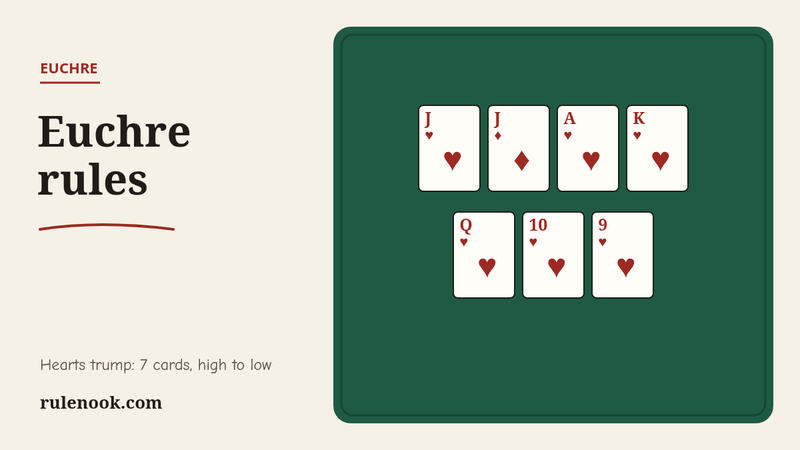
This is the part that trips up new players. Once a suit is trump, its jack and the jack of the same color both become trump, and they rank above the ace.
| Rank in trump | Hearts trump | Diamonds trump | Spades trump | Clubs trump |
|---|---|---|---|---|
| 1. Right bower | J♥ | J♦ | J♠ | J♣ |
| 2. Left bower | J♦ | J♥ | J♣ | J♠ |
| 3 to 7 | A K Q 10 9 ♥ | A K Q 10 9 ♦ | A K Q 10 9 ♠ | A K Q 10 9 ♣ |
So the trump suit holds 7 cards, while the other suit of the same color holds only 5 because its jack has moved over to trump. The 2 suits of the other color keep all 6. That's 7 + 5 + 6 + 6 = 24.
The left bower changes suit. If hearts are trump, the J♦ is a heart for the whole hand. When diamonds are led, you can't follow with it. When hearts are led and it's your only heart, you must play it.
How do you choose trump?
Round 1. Starting left of the dealer, each player either passes or tells the dealer to pick up the upcard, making its suit trump. That's called ordering it up. The dealer may also pick it up on their own turn. Either way the dealer adds the upcard to their hand and discards 1 card face down.
Round 2. If all 4 pass, the dealer turns the upcard face down. Starting left of the dealer again, each player may name any other suit as trump, or pass.
If all 4 pass twice, the published rule is a new deal by the next dealer.
Official rule vs house rule. Many tables play stick the dealer: if the first 3 players pass in round 2, the dealer must name a suit. No redeal. It speeds the game up and puts pressure on the dealer.
The team that names trump is the makers. The other team is the defenders.
Can you play alone?
Yes. When you make trump, you may say "alone" at that moment, and your partner lays their cards face down and sits out the hand. You then try to take all 5 tricks by yourself, which scores 4 points instead of the 2 a team march earns.
How do you play the tricks?
The player left of the dealer leads the first trick. If that player's partner is playing alone, that player sits out and the opening lead passes to the player across from the dealer. Everyone must follow suit if they can, remembering the left bower now belongs to trump. If you can't follow, play any card, trump included. The highest trump wins; with no trump, the highest card of the suit led wins. The winner leads next.
Failing to follow suit when you could is a renege. A common penalty is 2 points to the other team.
How does euchre scoring work?
| Result | Points |
|---|---|
| Makers take 3 or 4 tricks | 1 to makers |
| Makers take all 5 (a march) | 2 to makers |
| Loner takes 3 or 4 tricks | 1 to makers |
| Loner takes all 5 | 4 to makers |
| Defenders take 3 or more (makers are euchred) | 2 to defenders |
The game is usually played to 10 points. Some tables play to 5 or 7 for a quicker game.
Worked example: 4 hands. North-South are Team A; East-West are Team B.
- North orders up hearts. Team A takes 3 tricks: A 1, B 0.
- East calls spades and goes alone, taking all 5: A 1, B 4.
- South names clubs, but Team A takes only 2 tricks. Team B euchres them: A 1, B 6.
- West orders up diamonds and Team B takes all 5 with both partners playing, a march: A 1, B 8.
Team B now needs 2 more points. A single march, a euchre or a pair of ordinary wins will finish the game.
Common Rules Questions
Is euchre hard to learn?
Not for long. The trick-taking part is simple, and with only 5 tricks per hand a full deal takes a couple of minutes, so you get plenty of practice quickly. The hurdles are the left bower changing suit and deciding when to order up. Most new players get the bowers right after a few hands if someone calls out "the left is trump" each time. Knowing when to call trump takes longer.
Is euchre mostly skill or luck?
Both. Luck matters more in any single hand than over a whole game, since with only 5 cards each the deal decides a lot. Over a game to 10, skill shows in when you order up, when you go alone, and how you and your partner read each other's leads. Strong partnerships win more often, but a weaker team can win any one game.
What card should you lead in euchre?
No rule covers it. If your partner made trump, lead a trump, often the right bower, to pull the opponents' trumps. If the other team made trump, lead an off-suit ace. Avoid leading the suit your opponents just turned down unless you have a strong reason. When you are alone, lead your highest trump first.
Can you look back at earlier tricks?
Under most published rules, no. Once a trick is gathered and turned face down, nobody may look at it again. A common house rule lets players see the most recent trick until the next card is led. The same answer applies in spades and other trick-taking games, so agree on it once for all your games.
What do "stick the dealer" and "farmer's hand" mean?
Stick the dealer forces the dealer to name trump when everyone else passes twice; see the trump section above. A farmer's hand is a house rule: a player dealt only 9s and 10s may swap 3 of those cards for the 3 face-down cards in the kitty before bidding. Definitions differ by table, so confirm whether 9s and 10s alone qualify.
What to read next
Sources: Bicycle, Euchre (read 2026-10-10): the 24-card pack, draw for deal, making trump, redeal after two passes, going alone, opening lead and scoring, including games to 5, 7 or 10. House rules (stick the dealer, farmer's hand, score markers, renege penalty) are labeled as such. Worked example is our arithmetic. Last updated 2026-10-10.
Sources
- Bicycle, Euchre rules, bicyclecards.com/how-to-play/euchre (deal, making trump, scoring)
- Common US house rules labeled in text (stick the dealer, farmer's hand)