Ticket to Ride Strategy: Ticket Combos, Card Counting and the Endgame Run
Ticket to Ride strategy comes down to three levers: pick tickets that share track, draw for the colors you need, and time the endgame to your last trains. The printed USA map shows how far apart two ticket pairs can land. New York–Atlanta and Atlanta–Washington share one 6-space corridor. Chicago–New Orleans plus Sault Ste. Marie–Nashville needs 19. That gap is the whole game. Rules and scoring stay on our Ticket to Ride rules page.
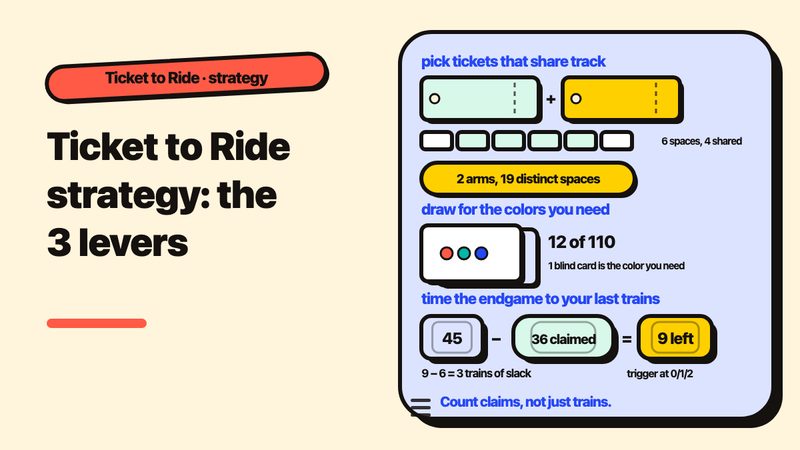
What moves your score: three levers
Route points are the floor. Every claimed route pays the printed table: 1 space pays 1 point, 6 spaces pay 15. Tickets are the swing. Finish a 7-point ticket and it adds 7. Miss it and it subtracts the same 7. The deck sets your pace: 110 cards, 12 in each of 8 colors, 14 locomotives.
| Lever | What it moves | Counted at |
|---|---|---|
| Ticket portfolio | a finish adds the printed value, a miss subtracts it | Table A |
| Draw efficiency | 12 cards a color out of 110, 14 locomotives | Table B |
| Endgame timing | 45 trains, the 0/1/2 trigger | Table D |
The booklet's own example shows the swing. Its pair, Montréal–Atlanta plus New York–Atlanta, adds 15 points when both finish. One 6-space route also pays 15. The difference is direction. Routes only go up. Tickets swing both ways.
Ticket combos: pick pairs that share track
Official rule: the setup deal is 4 tickets, and you keep at least 2. Midgame you draw 3 and keep at least 1. The opening ticket deal belongs to the rules page. Your job at the deal is narrower. Keep pairs whose paths overlap.
Our assumptions
- Segment counts come off the board map printed in the 2025 rules booklet, counted space by space.
- A double route counts as 1 side for planning; both sides are the same length.
- The two long arms are traced paths, not shortest-path claims; the map's central corridors are not fully counted here.
| Pair | Path that serves it | Spaces | Shared | Read |
|---|---|---|---|---|
| New York–Atlanta + Atlanta–Washington | New York–Washington, Washington–Raleigh, Raleigh–Atlanta | 6 | 4 | 1 path, 2 tickets |
| Montréal–Atlanta + New York–Atlanta | Montréal–New York, then the same 6 | 9 | 6 | 1 extra leg, 15 printed points |
| Chicago–New Orleans (7 printed) + Sault Ste. Marie–Nashville | 2 arms over Pittsburgh–Washington–Raleigh–Atlanta | 14 + 11 | 6 | 19 distinct spaces |
Read pair 1 as one purchase. Claim the 6 spaces once, and 2 tickets finish together.
Pair 2 shares even more. Only Montréal–New York, 3 blue spaces, belongs to the Montréal ticket alone. The booklet prints that pair's combined value: 15 points.
Pair 3 is the budget trap. Both arms run south over the same spine. Yet 19 distinct spaces stand between 2 tickets and 2 scores.
The booklet prints 1 full ticket card: Chicago–New Orleans, 7 points. Treat that as the scale for single tickets. Treat pairs as the real currency.
Redraw timing runs on the same ledger. Say you hold New York–Atlanta finished except Raleigh–Atlanta, with 20 trains unclaimed. Draw 3 and keep Atlanta–Washington. It costs 0 new spaces; its 4 ride track you need anyway.
Now the mirror case. You have 12 trains left, a plan needing 10, and a 4th ticket on the table asking for 4 more spaces. Pass. A draw is cheap only while the spaces are already yours.
Card colors: what the deck owes you
Our assumptions
- The deck is fresh and full: 110 cards, 12 in each of 8 colors, 14 locomotives.
- No public information yet; recount after every card you see.
| Question | Arithmetic | Answer |
|---|---|---|
| 1 blind card is the color you need? | 12 of 110 | 10.9% |
| 2 blind cards, at least 1 right? | 1 − (98/110 × 97/109) | 20.7% |
| wanted color in the face-up row? | 5 × 12/110 | 0.55 cards |
| 1 blind card is a locomotive? | 14 of 110 | 12.7% |
| the printed 3-locomotive redeal fires? | 3 or more of 5 face-up | 1.4% of rows |
All 5 rows are site recomputation off the printed deck mix. The deck runs 110 cards deep. One blind card finds your color about 1 time in 9. Two blind cards double the hit rate. The turn costs the same. The face-up row owes you about half a card of any color. That is why staring at 1 color rarely pays.
Counting makes it exact. Every color has exactly 12 cards. The booklet sends claimed sets straight to the discard pile, so seen cards stay seen until the printed reshuffle.
The face-up row is public. So is your hand. So is every set you watched get claimed and dumped. Site practice: subtract the reds you have seen from 12.
Worked count: the row shows 2 red, your hand holds 3, and a claimed set took 4. That is 9 reds out. At most 3 reds remain unseen. Stop waiting on red and switch targets.
Official rule: a face-up locomotive costs your whole draw. The trade has a price. Take it and you bank 1 certain card. Draw 2 blind instead, and 20.7% of the time 1 of them is your color.
Take the locomotive when it completes a set you claim on your next turn: 3 green in hand, a 4-space green route, 1 locomotive in the row. Draw 2 instead when you need 2 or more specific cards, or when the gray route is uncontested. A whole turn for 1 card is a price, not a gift.
Route conflicts: when to claim, when to block
Official rule: at 2 or 3 players only 1 route of each double can ever be claimed. The other side closes for everyone. Gray routes accept any 1 color, so short gray segments are the shared hot spots. Washington–Raleigh, 2 gray spaces, serves every path in Table A.
| Scene | Move | Counted cost |
|---|---|---|
| Both players hold New York–Atlanta; 1 side of the New York–Washington double is already claimed | launch through Pittsburgh: New York–Pittsburgh 2, Pittsburgh–Washington 2, then the spine | 8 spaces instead of 6: +2 trains, +2 route points |
| Opponent blocks Atlanta–Nashville, 1 space, to hurt a Sault Ste. Marie–Nashville ticket | reroute over Raleigh–Nashville, 3 black spaces | 11 spaces either way: the block buys nothing |
Worked count 1: the direct path runs 6 spaces and scores 6 route points. The Pittsburgh detour runs 8 and scores 8. The double route took the cheap side, not the ticket. The loss is tempo: 2 trains and 2 points. You can earn that back.
Worked count 2: the blocked corridor runs 2+2+2+2+2+1 = 11 spaces. The reroute over Raleigh–Nashville runs 2+2+2+2+3 = 11. The blocker spent a train and a turn to move nothing.
There is the rule: block only when the reroute is longer than the block is cheap. Count the victim's escape before you spend trains on someone else's map.
The squeeze is sharpest at 2 players, where the map plays thin. Our 2 player board games page collects the maps that play best there.
The endgame run: counting your last trains
Official rule: end a turn holding 0, 1 or 2 trains, and the final round starts. Everyone still plays 1 more turn, you included. Then tickets reveal, misses subtract, and the longest path pays its 10.
Our assumptions
- The budget lines are site recomputation off the printed 45-train start and the 0/1/2 trigger.
- The worked count assumes no reshuffle lands mid-plan.
| Line | Count |
|---|---|
| Trains left | 45 − 36 claimed = 9 |
| Plan | Raleigh–Atlanta 2 + Atlanta–New Orleans 4 = 6 spaces |
| Claims the plan takes | 2 |
| Slack | 9 − 6 = 3 trains |
Two claims need 2 of your turns. The trigger hands the table only 1 extra turn each. A 2-claim plan must start before anyone runs dry.
The worked count leaves 3 trains of slack: enough for a draw or two, not for a third claim. Count claims, not just trains. The first number sets your turns. The second sets your deadline.
Aggressive finish: claim Atlanta–New Orleans as your 41st through 44th train. You sit on 2 trains, inside your own trigger, with the plan banked.
The printed rule gives you that final turn anyway. Spend it on a 1-space patch for your longest path, or on a safe blind draw.
Last turn, 3 choices, in order. Claim a 1 or 2 space route if it finishes a ticket or feeds your longest path. Blind draw if nothing worth claiming is open: no gain, no loss. Take tickets last, and only keep 1 your trains already touch. A disconnected ticket is a printed minus, its full value off your total.
Common strategy mistakes
- Keeping the longest tickets without checking direction. Table A is the fix: shared corridors turn 2 tickets into 1 path.
- Staring down 1 color all game. Table B: 2 blind cards find it 20.7% of the time. The face-up row owes you 0.55 cards of it.
- Waiting on a color already spent. Once 9 reds are public, at most 3 remain. Recount and switch.
- Drawing tickets with no train budget. Table D: a plan needing 6 spaces has no room for a 4th ticket's spaces.
- Blocking for free. The Atlanta–Nashville block costs a train and buys 0 spaces. Count the escape route first.
- Spending the final turn on ticket draws. The order holds: claim, then blind draw, tickets last.
Common Strategy Questions
What is the best strategy in Ticket to Ride?
No single play wins this game, and the printed rules crown none. What the map hands out is arithmetic. Tickets that share track turn 6 spaces into 2 scores. The deck pays steady rates. The train budget sets your deadline. Find the lever your table is worst at, and fix that one first.
How do you win at Ticket to Ride?
Route points are the floor and tickets are the swing. Every train you lay scores 1 to 15 by length. The swing lands at the reveal, where each missed ticket subtracts its full value. A 7-point ticket missed while a rival banks the same 7 opens a 14-point hole on 1 card. Make your ticket holes small and your corridors cheap.
What triggers the end of Ticket to Ride?
A player who ends a turn holding 0, 1 or 2 trains triggers the final round. Everyone still plays 1 more turn, that player included. Then tickets reveal and the longest path pays its 10. The counting habit is Table D: track claims left, not just trains left.
What is the highest score possible?
The booklet prints no ceiling, so we give you the printed anchors instead. Routes pay 1 to 15 by length. The longest continuous path adds 10. Finished tickets stack their values, 15 for the booklet's example pair. A hard number needs a census of the board in front of you: count the spaces, apply the printed table, add the bonus once.
Does the same strategy work on Ticket to Ride Europe?
Not with these numbers. Every count on this page is USA map, 2025 Refresh. Europe runs its own deck and board: its listing prints 46 tickets against the USA booklet's 33, and tunnels, ferries and stations change the arithmetic. The 3 levers travel. The numbers need a recount before you trust them.
Read next
- Ticket to Ride rules: setup, turn order, scoring and the 2025 changes.
- Board game guides: the whole shelf, 1 page per game.
- Catan: network planning with trading and a robber.
- Carcassonne: claiming land tile by tile instead of by color sets.
- 2 player board games: the picks page behind this cluster.
Sources
- Days of Wonder, Ticket to Ride rules booklet, 2025 Refresh, 7201N, linked from daysofwonder.com/game/ticket-to-ride/. Read 2026-11-27. Printed there: 110 train cards (12 each in 8 colors, 14 locomotives), 33 tickets, 45 trains a player, 5 face-up cards with the 3-locomotive redeal, keep 2 of 4 tickets at setup and 1 of 3 midgame.
- Same booklet, read 2026-11-27: gray routes take any 1 color; the route table pays 1 to 6 spaces for 1 to 15 points; the 0/1/2 end trigger gives everyone 1 final turn; the longest path adds 10; claimed sets go to the discard pile, and discards reshuffle when the deck empties.
- Same booklet, ticket examples: the printed ticket card shows Chicago–New Orleans at 7 points. The scoring example adds Montréal–Atlanta and New York–Atlanta for 15, and nets Sault Ste. Marie–Nashville against a failed Atlanta–Washington at +4. Segment counts in Tables A and C are transcribed from the board map printed in this booklet.
- Amazon item records, read 2026-11-27. ASIN B0F8PKN4B7, Asmodee Ticket to Ride (2025 Refresh): listing title prints 2 to 5 players, 30 to 60 minutes, ages 8 and up. ASIN B015OWB3GS, Asmodee Ticket to Ride United Kingdom + Pennsylvania expansion: listing prints that the base game is required. The Ticket to Ride Europe listing prints 46 tickets and 110 train cards.
- Rulenook: Ticket to Ride rules, board games hub, Catan, Carcassonne, 2 player board games. Read 2026-11-27.
- Site recomputation: the draw probabilities, the ticket-pair ledgers, both conflict counts and the train budget, from content/_notes/G161/g161_data.json, rechecked by g161_check.py (74 of 74 checks pass) on 2026-11-27. How we compute: methodology.